We partner with Rewilding Britain to help protect our natural spaces for future adventures.
All centres are vetted for safety and quality. Your adventure is in good hands with adventuro.
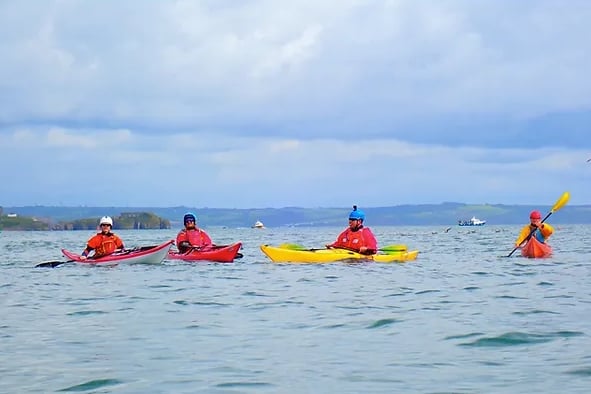
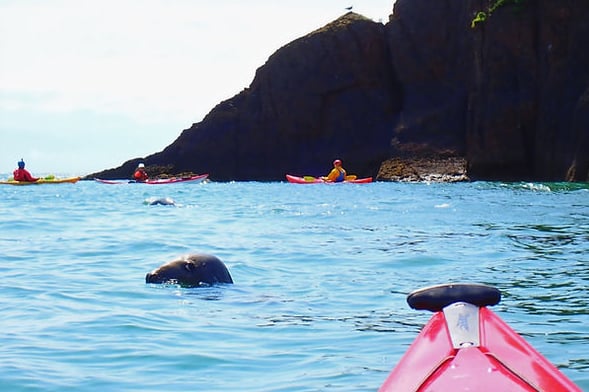
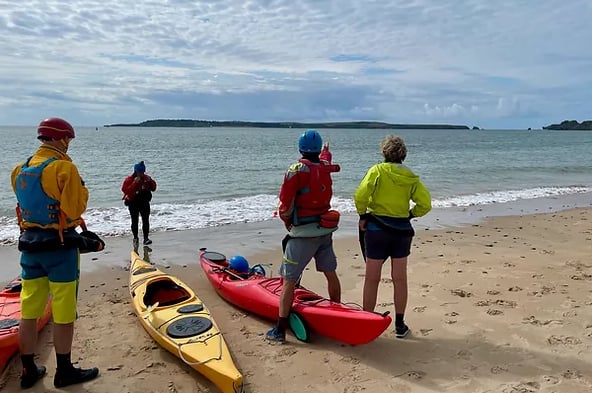
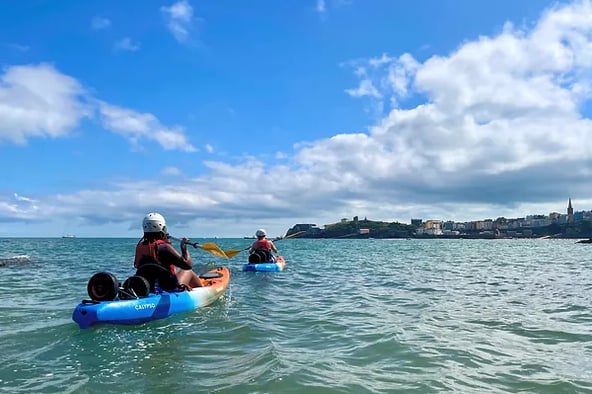
Paddling across the waters from Tenby South Beach to Caldey Island offers a guided wildlife-focused sea kayaking experience centred around Atlantic grey seals and seasonal seabird colonies. Led by highly qualified sea kayak leaders and coaches with national governing body awards, the session combines open-water paddling with responsible wildlife observation.
Meet-up takes place on Tenby South Beach where your instructor will issue equipment, complete a safety briefing and outline the plan for the crossing. Once ready, the group launches into the bay and begins paddling towards Caldey Island under guided supervision.
Approach routes follow coastal waters where seals are commonly seen, along with seasonal bird colonies depending on the time of year. Early season journeys may include nesting seabirds such as guillemots and razorbills, while later months often bring increased seal activity, including pups resting along the shoreline.
All wildlife viewing remains strictly from the water with no landings permitted on the island. The return leg follows a similar route, with pace and distance adjusted throughout to match sea conditions and group ability for a controlled crossing in both directions.
Tenby South Beach provides a broad sandy launch point with direct access into the waters surrounding Caldey Island. Conditions here are influenced by tides and offshore exposure, which play a key role in shaping each day’s route and timing.
Caldey Island lies just offshore and is recognised for its marine wildlife, particularly Atlantic grey seals and seasonal seabird populations. Routes are selected daily based on sea state to ensure safe passage while maintaining appropriate distances from wildlife.
Participation requires prior kayaking experience due to the open-water nature and duration of the trip. Paddlers should be comfortable maintaining steady effort for extended periods and have a reasonable level of fitness.
A previous kayaking session within the last year or an equivalent qualification is needed before joining. A capsize and recovery experience is also required, with guidance available to help arrange practice where necessary.
All sessions are delivered by highly qualified sea kayaking professionals holding advanced leadership and coaching awards recognised by the national governing body for paddlesports. Safety management, tidal planning and environmental awareness are integrated into every decision on the water.
Guided wildlife encounters are carried out responsibly with strict adherence to marine conservation guidance, ensuring minimal disturbance to seals and birdlife. Equipment is selected specifically for coastal crossings, and routes are adapted daily to reflect sea conditions and group capability.
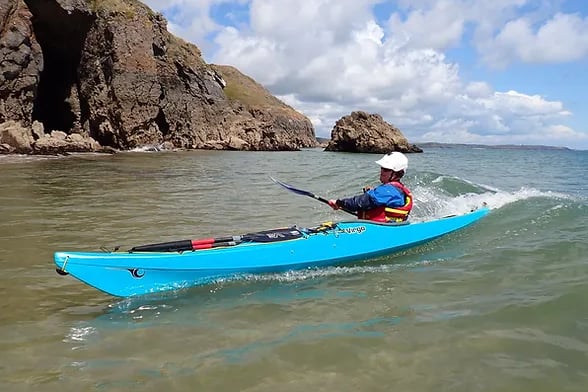
Sea kayaks are designed with a closed cockpit that you sit inside, with your legs covered by the deck. More experienced paddlers may use a spray deck to create a watertight seal around the cockpit. They are typically longer and narrower than sit-on-top kayaks, which makes them faster through the water but generally less stable. Sea kayaks used here are fitted with adjustable seating, footrests, and storage hatches to keep equipment dry during longer journeys.
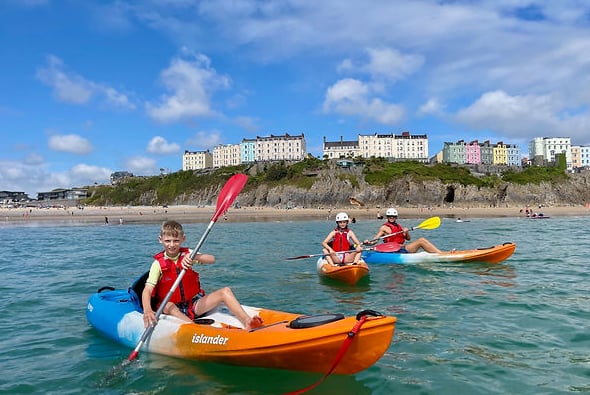
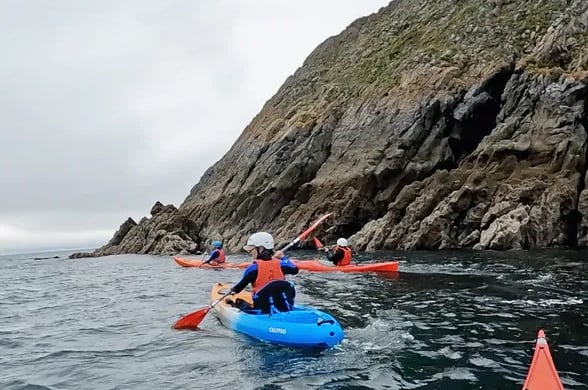
Sit-on-top kayaks have an open design where you sit on top of the craft with your legs exposed. They are very stable and easy to use, making them well suited to beginners. These kayaks include padded seating and back support, with secure areas for kit, although these are open to the elements. For tours, trips and training sessions, dry bags are provided to help keep personal belongings protected.
All essential equipment is included for your session, including your craft (kayak or paddleboard depending on your activity), paddle, buoyancy aid with a zip pocket, and safety equipment such as helmets where required. Waterproof jackets are provided in wet conditions, and spray decks are supplied for sea kayak sessions when appropriate. For sessions of two hours or more, a dry bag is also included for carrying lunch or spare clothing.
Wetsuits are available for hire at an additional cost and are allocated on a first come, first served basis. All wetsuits are cleaned and sanitised between uses, and participants are asked to wear a base layer or underwear underneath for comfort and hygiene.
All sessions take place on the water, so you should expect your feet, ankles and hands to get wet, along with some splashing during your activity. In kayaks, seating can also become wet, so clothing that keeps you warm and comfortable both on and off the water is important. Conditions can change, so layers that can be added or removed are usually best.
Many of the routes take place along coastline or estuary environments where you will be away from facilities once the activity begins. It’s best to assume you will not be able to return to shops or cafes until the session has finished, so bring anything you may need for the duration with you at the start.
You don’t need to be a strong swimmer to take part, and those who are less confident in the water are still welcome. It is helpful to make the team aware beforehand so the right support can be provided during your session. Everyone is issued with a buoyancy aid which is designed to help keep you afloat while on the water.
Sessions are led by qualified instructors who manage group safety throughout, and support is given where needed so participants can feel comfortable during the activity.
Pets can behave unpredictably on the water, particularly around changing conditions or wildlife, so they are not permitted on group sessions. This is to avoid disruption to the activity and to ensure all participants can enjoy a safe and consistent experience.
For private bookings, dogs may be considered depending on conditions, route and activity type. However, they will not be permitted on trips where wildlife encounters are likely, such as areas with seals or nesting birds on the water.
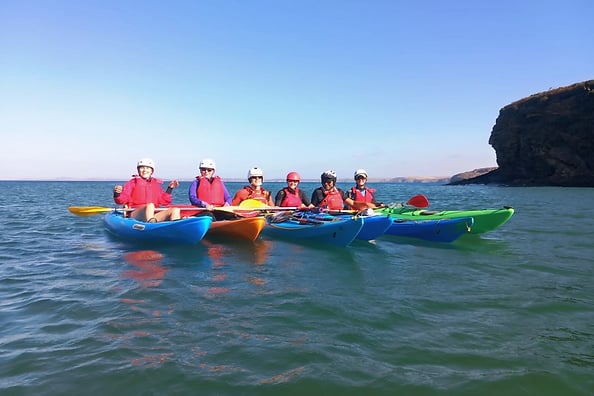
Group sizes follow recognised safety guidance for paddlesport instruction and vary depending on the activity type, conditions and craft used. Most sessions operate with around six participants per instructor, while more technical or longer trips may have smaller ratios to maintain closer supervision.
There is no fixed upper limit to overall group size, but numbers are kept at a level that respects other water users, local communities and the environment. Larger groups are split across multiple instructors to maintain safety and quality of experience.
Experience levels are used as a guide to help match you with the most suitable activity. A novice or complete beginner has little or no recent experience, while a beginner may have tried paddling before but still be developing basic skills, especially on the sea.
Improver and intermediate levels are for those who paddle more regularly and want to build confidence in varied conditions or develop specific skills such as rescues or navigation. Advanced paddlers are experienced in a range of conditions, including more exposed environments, and may be working towards leadership or coaching roles.
These terms are based on recognised paddlesport guidance used for safety planning. Sheltered water refers to close-to-shore environments with lighter wind conditions and straightforward access points, making them suitable for introductory sessions. Moderate water includes slightly more exposure, stronger winds and longer crossings, while still remaining within controlled limits.
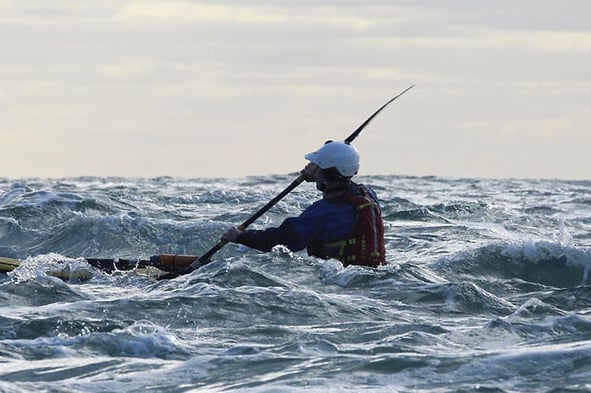
Advanced water involves more challenging environments where tidal movement, exposed coastline or surf conditions may be present. These sessions are only suitable for experienced paddlers, and conditions are always assessed on the day to ensure they remain appropriate for the group.
All equipment is regularly maintained and sourced from established paddlesport brands. Sea kayak sessions use a range of stable and performance-focused craft suitable for both beginners and experienced paddlers, with options to suit different sizes and styles of paddling. Sit-on-top kayaks are also available and are designed for ease of use and stability.
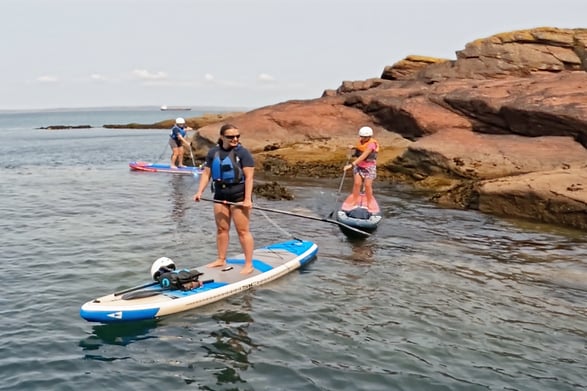
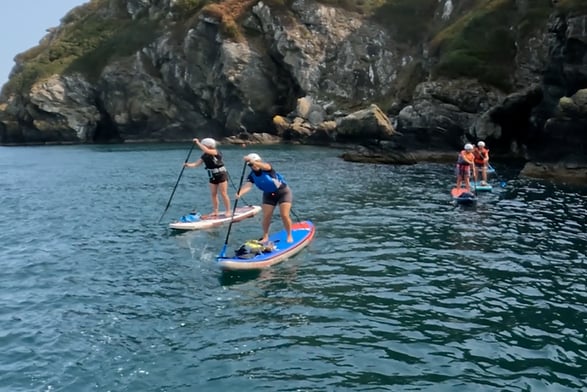
Paddleboards are chosen for all-round use across different conditions and come in a range of sizes to suit different paddlers. All equipment is checked regularly and matched to the session type to ensure it is appropriate for the conditions and the experience level of the group.
The session is centred around wildlife observation, particularly Atlantic grey seals around Caldey Island. It combines a longer sea crossing with time spent observing marine life from the water.
Guides manage positioning carefully to ensure respectful distances are maintained at all times in line with conservation guidelines.
Seal sightings are very likely but cannot be guaranteed, as wildlife is unpredictable and free-moving. The area is a known habitat for seals and seasonal seabird colonies.
Conditions, tides and time of year all influence what may be seen during the trip.

About the centre
Pembrokeshire
Operated by Paddle Pembrokeshire, a partner of adventuro.


Surrey, East and West Sussex, United Kingdom
From £89


Somerset and Dorset, United Kingdom
From £55


Mid & South-West Wales, United Kingdom
From £450
Mid & South-West Wales, United Kingdom
From £110