We partner with Rewilding Britain to help protect our natural spaces for future adventures.
All centres are vetted for safety and quality. Your adventure is in good hands with adventuro.
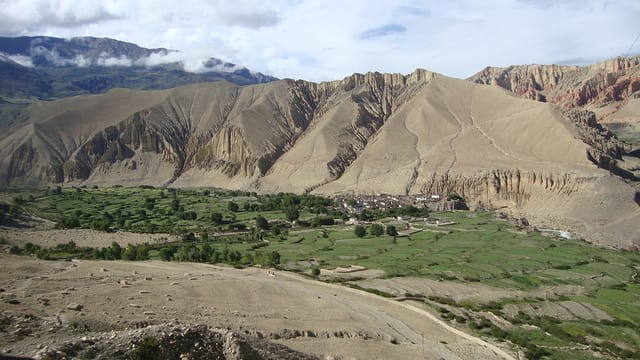
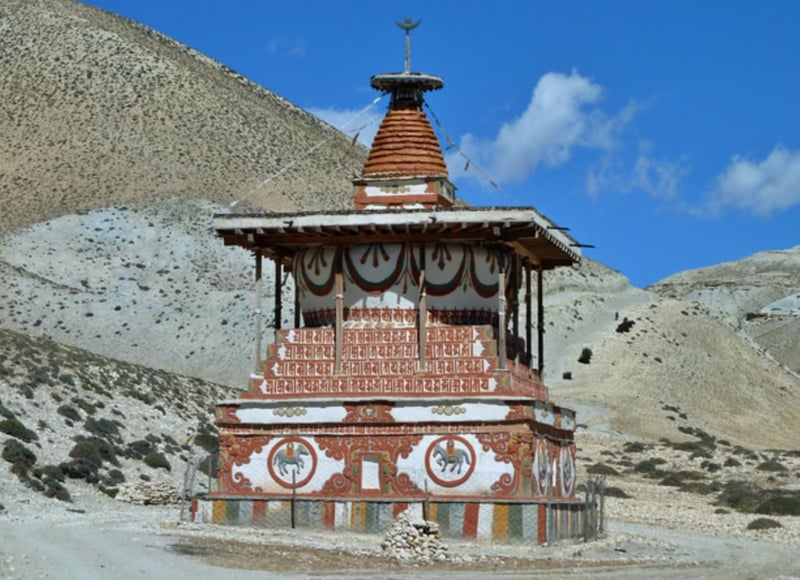


This 18-day journey explores one of Nepal’s most culturally intact regions, walking through arid valleys, ancient trading routes, and walled settlements shaped by Tibetan Buddhism. The route reaches Lo Manthang, once the capital of an independent Himalayan kingdom, where daily life, monasteries, and architecture remain largely unchanged.
Unlike greener Himalayan treks, Upper Mustang sits in the rain shadow north of the Annapurna range. Expect wide landscapes, strong winds, big skies, and a pace that allows time to understand the history, religion, and people of this restricted region.
This trek follows the ancient salt-trade route up the Kali Gandaki into the former Kingdom of Lo. After reaching Kagbeni, the landscape changes abruptly into dry valleys, eroded cliffs, and fortified villages. Over several days you cross high passes, visit working monasteries, and walk between settlements built from mud, stone, and timber.
Time in Lo Manthang is deliberately unhurried, allowing exploration of temples, palaces, and surrounding valleys. The return journey takes a different high route, adding variety while gradually descending back to Jomsom and Pokhara.
Upper Mustang lies north of the Annapurna and Dhaulagiri ranges, bordering the Tibetan Plateau. Its position in the rain shadow creates a dry, high-desert environment unlike most Himalayan trekking regions.
The region was closed to foreign visitors until the early 1990s, which has helped preserve language, religion, and settlement patterns. Many monasteries date back centuries and still function as active centres of worship and learning.
This trek is suitable for walkers with reasonable fitness who are comfortable walking multiple days in a row. No technical skills are required, and trails are well defined, though exposed to wind and sun.
Participants should be comfortable at moderate altitude and prepared for simple accommodation. An interest in culture and history is important, as this trek focuses as much on people and place as on walking.
Upper Mustang offers something increasingly rare: a living cultural landscape largely untouched by modern development. The restricted permit system limits visitor numbers, keeping trails quieter and villages less commercial.
The itinerary balances walking with meaningful time in key locations, especially Lo Manthang. With permits, flights, and logistics handled in advance, the focus remains on understanding the region rather than managing complexity.
✔ Award-Winning Expertise
More than 2 decades of experience and a trusted trusted company with accolades for exceptional services.
✔ Local Culture & Eco Values
Experience authentic Nepal while supporting environmental sustainability and local traditions.
✔ Sustainable Development
Committed to fostering responsible tourism with a focus on long-term growth and originality.
✔ Premium Services
We offer the best in comfort, safety, and quality for every travel adventure.
✔ Best Price Guarantee
Enjoy top-notch experiences at the most competitive prices in the industry.
Arrive in Kathmandu and meet your representative at the international airport. Transfer to your hotel and take time to rest after your journey. Later in the day, explore Thamel, where you can change money, buy last-minute supplies, and get a first feel for Nepal’s capital. In the evening, attend a full trek briefing covering permits, safety, and the journey ahead. Overnight in a hotel.
Today’s route crosses eroded terrain of loose scree and dry soil. Despite the short distance, the walking can feel demanding due to altitude and footing. Arrive in Charang, a significant settlement with a large monastery and fortress overlooking the valley. Spend time exploring the village and monastery complex. Overnight in Charang.
Leave Lo Manthang and climb to the highest point of the trek, Marang La. The route follows open highland terrain before descending to Ghar Gompa, one of Mustang’s oldest monasteries. Continue down to Dhakmar, a village set beneath striking red cliffs. Overnight in Dhakmar.
Descend steadily through dry valleys and river crossings back to Kagbeni. The reappearance of greenery and lower altitude is noticeable. Spend the evening relaxing in this historic trading village. Overnight in Kagbeni.
The walking itself is not technically hard, with steady paths and moderate daily distances. Most days involve gradual ascents rather than steep climbs.
The challenge comes from altitude, dry conditions, and wind rather than steep terrain, making pacing and hydration important.
Upper Mustang is a restricted region due to its cultural sensitivity and proximity to the Tibetan border. Visitor numbers are controlled to protect heritage and communities.
The permit system helps preserve traditional lifestyles and limits large-scale tourism development.
Accommodation is in traditional teahouses with basic but comfortable rooms. Facilities are simpler than in Everest or Annapurna regions.
Most rooms are twin-share, and heating is limited to communal dining areas
Days are often sunny and mild, but mornings and evenings can be cold, especially above 3,500 m.
Wind can significantly reduce perceived temperature, making layered clothing essential.
Yes, for fit beginners who are comfortable with multi-day walking and basic accommodation.
It is often chosen by people wanting a cultural trek rather than a physically demanding one.
The landscape is dry and dramatic rather than green, with strong Tibetan cultural influence.
Villages, monasteries, and cave systems are central to the experience, not just mountain views.
Charging is available in some villages but often at an extra cost and not always reliable.
A power bank is strongly recommended.
Meals are simple and filling, typically including rice, noodles, soups, vegetables, and local breads.
Dietary requirements can usually be accommodated with notice.
Afternoon winds are common, especially in the Kali Gandaki valley.
Early starts help avoid the strongest winds and make walking more comfortable.
Yes. Insurance must cover high-altitude trekking and emergency evacuation.
Due to remoteness, evacuation costs can be high without proper cover.
About the centre
Thamel, Kathmandu
Operated by Mountain Delights Treks & Expedition, a partner of adventuro.
Arunachal Himalaya (Tawang & Siang Region), Nepal
From $2000
Himachal Pradesh (Shimla, Manali, Spiti), Nepal
From $1750
Arunachal Himalaya (Tawang & Siang Region), Nepal
From $1700
Bagmati Province, Nepal
From $2500
Bagmati Province, Nepal
From $1358