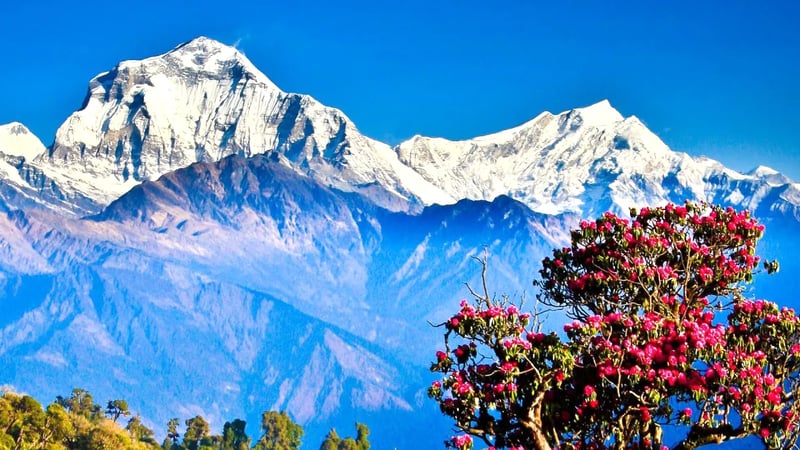
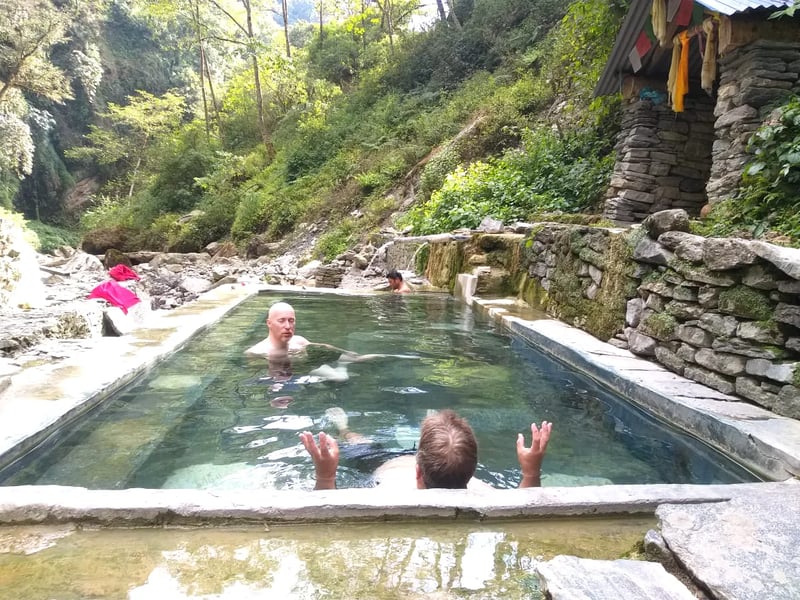
From Nayapul or Kimche you walk Gurung trails toward Chhomrong and drop to Jhinu Danda, where natural hot springs sit above the Modi Khola. The soak after stone steps is the highlight of the trip. Gurung stone villages and forest paths lead to the pools at Jhinu, where the Modi Khola runs below the steam.
Village lodges, forest paths, and Annapurna views fill the walking days. You return to Pokhara with tired legs and a long soak behind you. Ghandruk or Chhomrong nights sit before the soak, so the springs close the walk rather than replace it.
Our office team completed adventure-tourism training and keep taking outdoor and business courses so Pokhara departures stay tidy. You'll leave Nayapul for Ulleri and Ghorepani, take the Poon Hill sunrise, then continue through Tadapani and Ghandruk toward Chhomrong.
We'll book the Jhinu Danda lodge so the Modi Khola pools come after the walking. Your guide finishes through Pothana, Dhampus, and Phedi, with no Base Camp morning on this calendar.
In the morning, we start with a drive of 1.5 to 2 hours covering 45 km (28 miles) between Pokhara and Nayapul. The highway is cut through green hills, terrace fields, and small villages, giving an insight into what daily life is like in rural Nepal. After getting to Nayapul (1,070 m / 3,510 ft), the journey begins with a relaxed walk down the Modi Khola River.
We cross Birethanti and have the permit inspected, then proceed on forest-lined trails, intersected by waterfalls, and through farmland. The road is slowly getting steeper and closer to Ulleri. The last part is the hardest climb, consisting of approximately 3,200 stone steps.
This section is challenging, but it pays off in the form of the scenery of Annapurna South and Hiunchuli. On arrival at Ulleri (2,050 m / 6,725 ft), we get into a teahouse and rest as we see the serene mountain atmosphere.
We begin our hike from Ulleri (2,050 m / 6,725 ft) to Ghorepani (2,875 m / 9,432 ft) after breakfast. The trail is approximately 10 km (6.2 miles) in length and lasts 4-6 hours. It starts with a gradual walk uphill, through the deep woods of rhododendron and oak.
These forests are blooming in spring and are colored with flowers. We pass on the road through small villages such as Banthanti and Nangethanti. They are nice spots to rest, have tea, and admire the mountain scenery.
If we are lucky, we will also encounter wildlife, which includes monkeys, birds, and grazing yaks. As we approach Ghorepani, the scenes of Annapurna, Dhaulagari and Machhapuchhre are more visible, and they are more impressive. On arriving in the village, we check into the teahouse, where we get to enjoy the fresh mountain air.
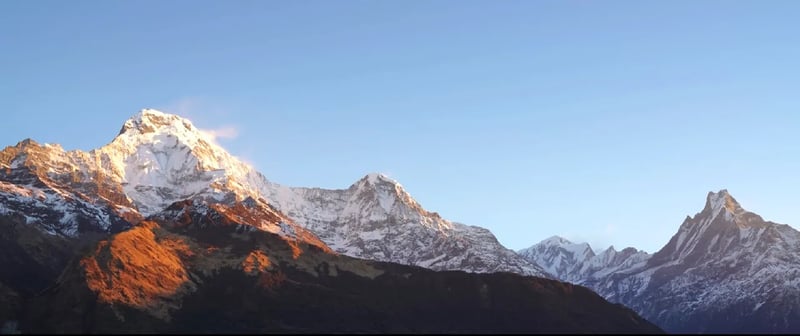
In the morning, we walk to Poon Hill (3,210 m / 10,531 ft), a 30-minute walk. This viewpoint provides one of the best sunrise scenes in the Annapurna region. The sun shines directly on the snow-white tops, such as Annapurna, Dhaulagiri, and Machhapuchre, forming a gorgeous golden sight as the sun makes its appearance.
After seeing the sunrise, we go back to Ghorepani and have breakfast. Then we keep on trekking to Tadapani (2,675 m / 8,776 ft). The path goes through the woods of rhododendron and oak trees.
On the road, we can observe birds, animals, streams, and waterfalls. There are also uphill climbs and downhill walks, which make the trail quite diverse and interesting. When we are nearing the Tadapani, the panoramas of Annapurna South and Machhapuchhre are.
The day starts after breakfast with a short and easy walk between Tadapani (2,675 m / 8,776 ft) and Ghandruk (1,950 m / 6,398 ft). This is approximately an 8km (5 miles) trail taking 3-4 hours. The major part of the road is descending through thick rhododendron and oak woods.
It is a quiet walk, with the sounds of birds and running streams. In spring, the forest is colored with the blooming flowers. On our way down, we go through small villages and terraced farmland, which allows us to have a closer glimpse of the local life.
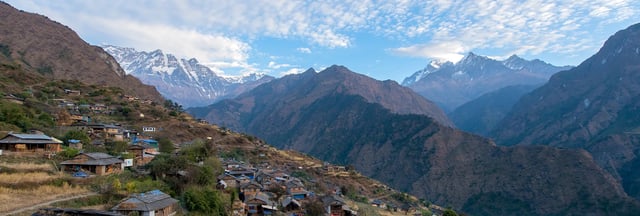
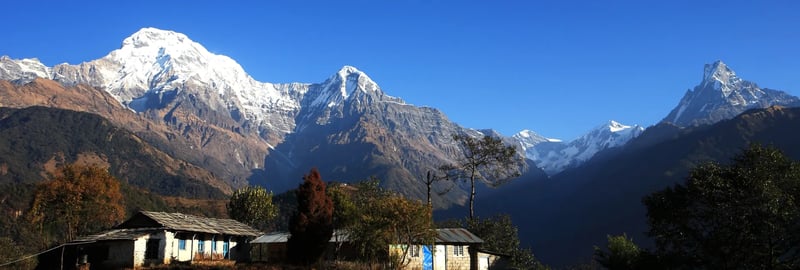
Ghandruk is a big and scenic village of the Gurung. This is the point where we have a clear view of the Annapurna South, Machhapuchhre, and Hiunchuli. Upon arrival, we get ourselves checked into a teahouse, and we have the time to visit the village.
The trail on this day takes us through Ghandruk (1,950 m / 6,398 ft) to Chhomrong (2,170 m / 7,119 ft). The path is approximately 10 km (6.2 miles) and takes between 5 and 6 hours. We begin with a slow descent passing through fields and forests until we come to the Kimrong Khola.
Across the river, we pass over a suspension bridge. Beyond this, the road turns onto the steep side, whence we ascend the hill, through rhododendron and oak forests. On the route, we observe Machhapuchhre, Annapurna South, and Hiunchuli.
We go through small villages where we get to witness the traditional farming and life in the mountains. The path is becoming less difficult, and the valleys and mountains are in full sight as we approach Chomrong.
We hike out of Chomrong (2,170 m / 7,119 ft) down to Jhinu Danda (1,750 m / 5,741 ft) after breakfast. It covers a distance of 6km (3.7 miles) and takes 2 to 3 hours. The path begins with a sharp drop in stone steps along a wooded path and farmland.
We pass the Chomrong Khola via a suspension bridge and then proceed with the trail that has short ascents and descents. It is a path that goes over little villages and forests. Jhinu Danda is famous for its natural hot springs, which are one of the main highlights of the trek.
Once in the village and having registered in our teahouse, we can make a brief walk to the hot springs close to the river.
We start our walk on the morning of a relaxing day from Jhinu Danda (1,750 m / 5,741 ft) to Pothana (2,870 m / 9,416 ft). It is approximately 13 km (8 miles), and it takes approximately 6 to 7 hours.
The path begins with a slow ascension in the woods and agricultural land, which features the Modi Khola Valley. Our first stop is the picturesque village of Landruk with its mountainous scenery and traditional houses.
It goes on through forests of Tolka, and then to Deurali Pass (2,100 m / 6,889 ft). Here, one gets panoramic scenes of the Annapurna and Dhaulagiri ranges.
We head off after breakfast on our last part of the trek from Pothana (2,870 m / 9,416 ft) to Phedi (1,130 m / 3,707 ft). The hike is approximately 8km (5 miles), and can last between 3 and 4 hours. The path is a downward one through woods and terraces.
On the road, we cross the attractive village of Dhampus (1,650 m / 5,413 ft), and the views of the mountain are excellent. From this point onward, the road gets steeper, and we head downwards to Phedi. On arriving at Phedi, we make a 45-minute drive back to Pokhara (827 m / 2,713 ft).
Upon arrival at Pokhara, we will be able to rest either in the hotel or around the lakeside.
Most guests fly into Tribhuvan International Airport in Kathmandu. Share your arrival time ahead of travel so a Thamel hotel transfer can be arranged, or make your own way to the meeting hotel.
Many departures include a road transfer to Pokhara before walking starts from Nayapul or a nearby trailhead. Allow a little extra time after the trek before international flights home.
Twin or double rooms in a comfortable Kathmandu hotel cover your first nights and your return from the trail, with breakfast on those city stays when included in the package. Briefings happen at the hotel, and airport collection from Tribhuvan is available when flight times are shared in advance.
Family-run teahouses or lodges line the route with twin beds and a shared dining room. Rooms get simpler and colder as you climb, with shared bathrooms common at higher villages. Hot water, Wi-Fi, and charging are paid at the lodge when offered.
Stable trekking weather most often falls in pre-monsoon spring and post-monsoon autumn. Monsoon cloud sits lower on the hills while winter brings ice on steps above village level.
If your dates sit in winter or monsoon, pack rain and cold layers and accept that flight or pass days may move by a day when safety requires it. Weather can shift daily plans, so your guide keeps a steady pace with regular breaks.
You should be comfortable on steep stone steps and forest paths for four to six hours with a daypack. Hill training and longer weekend walks in the months before travel help your legs and lungs on uphill trail days.
Hill training, stair climbing, and longer weekend hikes in the months before travel help your legs and lungs, even when acclimatisation days are built into the route. Break in boots before you fly and carry a light daypack on practice walks.
Guided trekking with licensed leaders, lodge nights on the trail, meals as described for walking days, and permits for the regions crossed are included when they are part of this trip. Domestic flights, porters, and airport transfers apply only when they are part of this trip.
Domestic flights, road transfers, porter support, and airport transfers apply only when they are part of this trip. Permits for the regions you cross are arranged in Kathmandu or Pokhara when included.
International flights to Nepal, visa fees, compulsory travel insurance, personal trekking clothing, snacks and drinks outside included meals, and tips for crew are not covered. Hot showers, Wi-Fi, and battery charging in lodges are usually paid locally when offered.
Charges for hot showers, Wi-Fi, or battery charging in lodges are paid locally when offered unless your trip notes say otherwise. International flights, visa fees, and personal insurance stay outside the trek package.
Thamel hotel meet after airport pickup is standard; confirm whether briefing is in Kathmandu, Pokhara, or both. Allow a little extra time after the trek before international flights home in case mountain roads or flights move.
Trailhead transport from Pokhara is timed so you reach Nayapul in daylight when possible. Trail conditions are checked each morning before the group moves.
Guides set a steady pace and watch for headache, nausea, or dizziness as you gain height. Your crew would rather wait for a safe window than rush marginal weather.
Tell your guide early if symptoms appear so tomorrow's stage can shorten or descent can start before conditions worsen. Thamel hotels are the usual meet point; drivers need flight numbers to meet you at the international terminal.
Road transfer from Kathmandu to Pokhara and a short drive to Nayapul or another start point are common when transport is included. Your guide confirms departure times at briefing.
Motion sickness medicine helps on winding mountain roads. Shoulder weeks need an honest weather call before high passes or dawn viewpoints.
Annapurna Conservation Area Permit and TIMS registration apply on this route. The team arranges paperwork in Kathmandu or Pokhara when you provide passport copies and trek dates.
Keep copies in your daypack for checkpoint stops. Your crew would rather wait for a safe window than rush marginal weather.
Families join when children can manage the daily hours and terrain on this specific route. Pace and daily hours can be adjusted on private departures, though that may extend the calendar.
Ask our Kathmandu team if you are planning with younger walkers. Private departures can shorten daily hours, though that may add a day or two to the calendar.
Comprehensive travel insurance that covers trekking to the highest altitude on your itinerary, medical evacuation, and helicopter rescue when applicable is essential. Many standard policies exclude high altitude by name.
Read the wording before you travel so you can adjust cover if trekking above 5,000 metres is not named. Many standard policies exclude high altitude by name, so read the wording before you fly.
We partner with Rewilding Britain to help protect our natural spaces for future adventures.
All centres are vetted for safety and quality. Your adventure is in good hands with adventuro.

About the centre
Kathmandu
You'll travel with a Kathmandu-based team that plans treks, peak climbs, helicopter flights, motorbike journeys, and cultural trips across Nepal, Tibet, and Bhutan. Routes range from classic teahouse walks and high passes to luxury lodge itineraries and longer expedition-style climbs, with departures shaped around how you want to pace the mountains.
Licensed guides and office staff train regularly on mountain safety and guest care. Porters are insured, fairly paid, and equipped for the trail, with sensible load limits on lodge routes. We work with remote communities through sustainable tourism, including support for education in village areas, so your booking helps local people as well as your own adventure.
Operated by Himalayan Adventure Treks & Tours, a partner of adventuro.
Bagmati Province, Nepal
From $7000