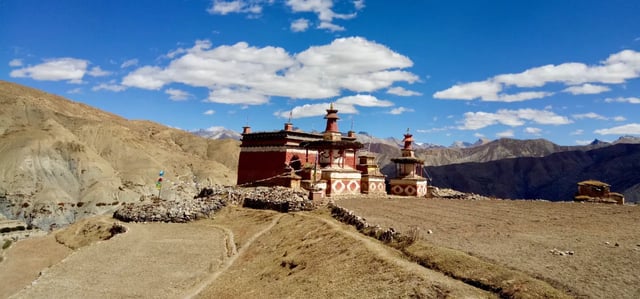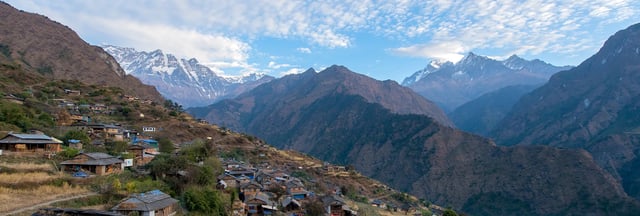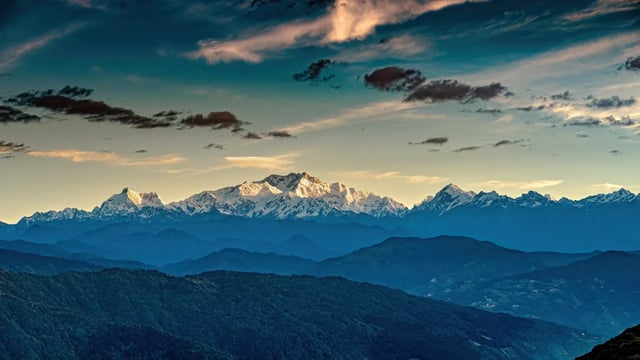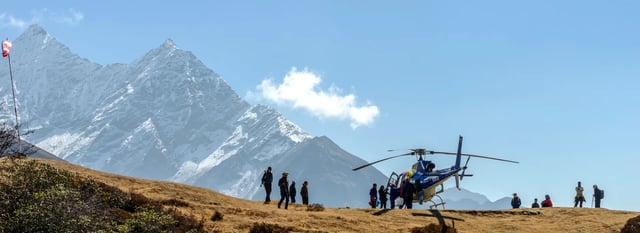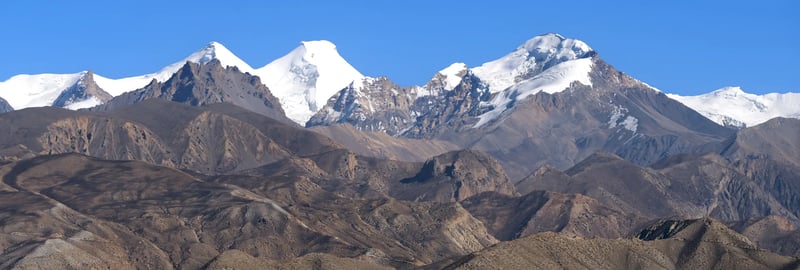
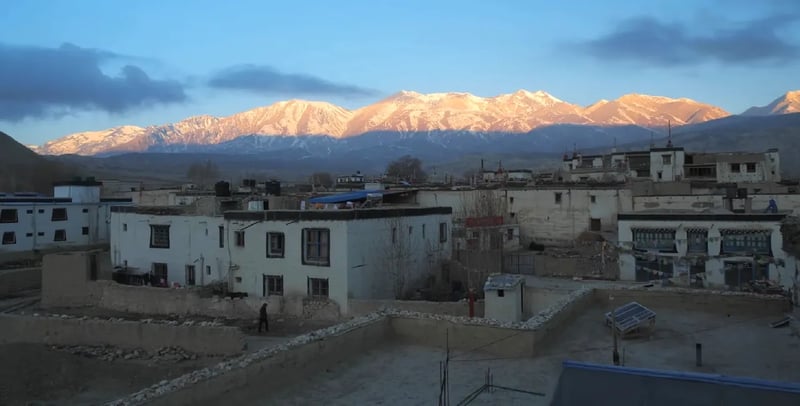
On foot, Upper Mustang walks the Kali Gandaki and side valleys to Lo Manthang with teahouse nights in Chele, Syangbochen, Ghami, and Tsarang. Restricted permits and a licensed guide are required from Kathmandu. Chele, Ghami, Tsarang, and Lo Manthang on foot put you in the former kingdom at walking pace.
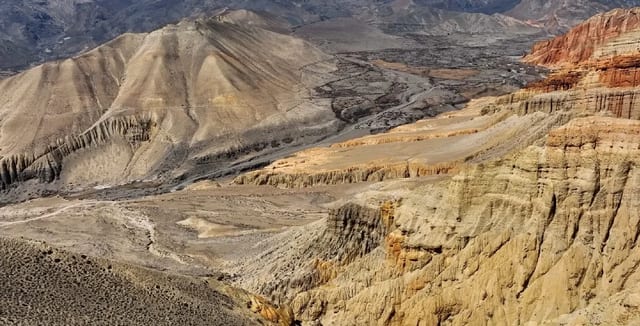
Lo’s palace walls, sky caves, and arid passes are the landmarks. You exit via Muktinath or Jomsom after days in the former kingdom. Teahouse nights stay in the desert villages, so you feel the climb toward the palace rather than hopping the road.
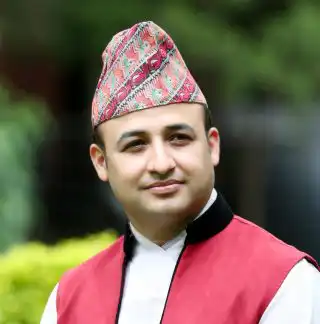
Bhagwat started as a porter in 1998, is a licensed guide, studied tourism in Nepal and the UK, and still leads groups when he can. On this walk he, or a sirdar he has trained, paces Kagbeni, Chele, Ghiling, and Charang so you reach Lo Manthang on teahouse days.
You'll have insured porters with kit renewed each year, one porter for two guests and loads kept around 25 to 30 kg. We'll confirm the Jomsom flight, the Chogo La and Gyu La mornings, and the Muktinath to Jomsom walk-out before you pack, and your guide shares the next lodge night every evening.
Your Upper Mustang adventure starts when you arrive in Kathmandu, the busy and colourful capital of Nepal. Upon landing at the Tribhuvan International Airport, you will be welcomed by a friendly representative of our team who will transfer you to your hotel.
Thamel has local markets, shops, and day-to-day life, which you will see on the drive to Thamel.
You will be visiting some of the cultural highlights of Kathmandu Valley today and getting ready to begin your Upper Mustang trek. In the morning, you will receive a guided tour of the city.
You will traverse Swayambhunath (also Monkey Temple), Boudhanath Stupa, Pashupatinath Temple, and Kathmandu Durbar Square. In every destination, you will get to know about the Hindu and Buddhist culture of Nepal and get to see sights of temples, courtyards, and stupas.
You will drive out of Kathmandu and to Pokhara, a serene lakeside city, after breakfast. The highway is along the Prithvi Highway and lasts approximately 6-7 hours. On your path, you will observe the Trishuli River, terraces, small towns, and green hills.
We will have tea and lunch breaks to have a break and appreciate the scenery. At the end of the afternoon, you will reach Pokhara (820 m) on the edge of Phewa Lake.
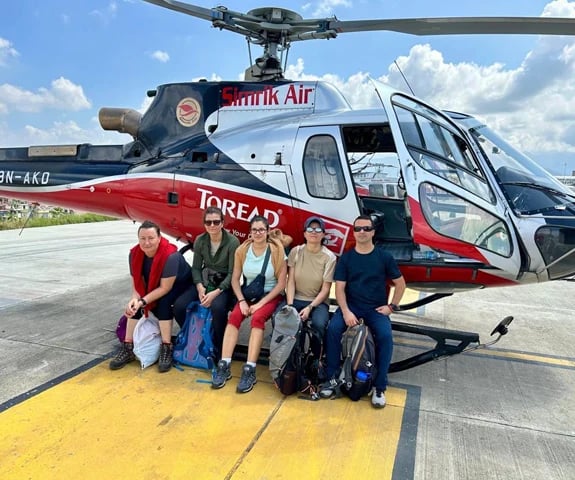
You will go on a brief mountain flight the next day in the morning in Pokhara to Jomsom. You can have a close sight of Annapurna, Dhaulagiri, and the Kali Gandaki Valley in this 20-minute flight. Once you land in Jomsom (2,710 m), you will be greeted by your trekking crew and begin to walk.
The path goes along the Kali Gandaki River on generally level and exposed lands. You will go through Ekle Bhatti and watch the scenery gradually transforming in a dry high desert.
Following breakfast, you will begin your first full day within the Upper Mustang area. The path traces along the east bank of the Kali Gandaki River through a dry valley that has high cliffs.
You will go through Tangbe village, with whitewashed houses, small fields, and orchards. Then you go on to Chhusang (2,980 m), where the river is framed by colorful rock walls.
Having rest and lunch in Chhusang, you will cross a bridge and a steeper and rocky trail. It leads to Chele (3,050 m), a small village on the other side of the gorge.
Your Upper Mustang itinerary today traverses your first high pass. You will leave Chele and follow a zigzag path to Taklam La (Approximately 3,620 m). Here, you will have the views of Nilgiri, as well as the broad Mustang scenery.
You will come to the trees and the fields of a silent village, Samar (3,660 m), after the pass. Here you will have a rest awhile, and then you will start on a path which leads through little canyons and ridges.
The trek will continue after breakfast to the Nyi La Pass (4,010 m), which is among the higher places in the Upper Mustang tour. It is a gradual but not strenuous climb that you can take at your leisure, taking time to observe the colored cliffs and the snow peaks at a distance.
At the pass, you will go down to Ghami (3,520 m), one of the larger villages of Mustang. A short way along, you will find a Mani wall which is covered with carved prayer stones.
Today will be one of the most special days of your Upper Mustang Trek itinerary. You will leave Charang and pass over the Charang Khola, and come to a gentle ascent.
You will also see on the road Lo Gekar (Ghar Gompa), which is one of the oldest monasteries in the area, and is associated with Guru Rinpoche. Within the monastery, you will appreciate ancient paintings and have a spiritual ambiance.
Today you will remain in Lo Manthang and have a further sightseeing of this ancient town and the surroundings. During the morning, you can walk up Namgyal Gompa (approximately 3,930 m), a small hill above the valley, and have a fine view of Lo Manthang and the fields below.
You will go back to the town and then visit the key monasteries of the town, including Jampa Lhakhang, Thubchen Gompa, and Chodey Gompa.
You will begin to walk back by way of another path, having said goodbye to Lo Manthang. The valley will lead you to the highest Pass of the Upper Mustang trek, Chogo La (4,280 m), which you will climb out of the valley. Long rows of red and brown ridges and the great Mustang wind will greet you right at the top.
Then you will come downwards gradually, along a rocky path, into a new valley. You can also go back to Ghar Gompa along the way, in case you did not see it.
After breakfast, you will start to go downhill and head back to the villages you have been to. It will go through a valley with small bushes and then up a small ridge, then down to Ghami (3,520 m). Out of Ghami, you will go down by the stream and road through the land and by the hamlets of such as Jaite.
The further you go down, the warmer the air is and the easier it is to walk. After a soft reascending in the afternoon, you will gain height slowly and then arrive at Syangmochen (3,800 m), a village that you have already covered in your Upper Mustang tour plan.
After breakfast, you will take a walk which will be chiefly downhill. You will go over the road you went over to Samar and get a new sight now that you are going in the opposite direction.
You can also go on a short side trip to Ranchung Cave, which was an ancient cave monastery that is intertwined with Guru Rinpoche's stories. At Samar, you must still pass through the colorful canyon, in which you were climbing last in the journey.
You will leave the Mustang canyon area today and approach the Annapurna side. You will cross the Kali Gandaki to the east bank and climb towards Tetang (approximately 3,040 m). At Tetang, the path then goes up the mountain to Gyu La (4,077 m), the final large pass in your trek in Upper Mustang.
Along the road, there are fossils of black stones known as Shaligrams, which are sacred among Hindus. Gyu La will provide you with expansive scenery of Annapurna, Dhaulagiri, and other mountains.
In the morning, you will see the Muktinath temple zone (approximately 3,800 m) there. Here you will find the holy water taps and little temples where pilgrims come to pray and bathe. You will begin your final day of trekking after this spiritual visit.
You will pass by Jharkot village, then the less-traveled Lupra Valley. Lupra ranks among a few Nepalese villages in which the ancient religion of Bon is practiced. The small Bon monastery, traditional houses, and fields can be visited.
Then you will trace down the stream to join the main Kali Gandaki valley again at Ekle Bhatti.
Following breakfast, you will board an early morning flight back to Pokhara in Jomsom. You will also have the beautiful mountain scenery again because you will be on the plane. The greenery and the warmer climate in Pokhara will be much welcome after the dry highlands.
You will take a rest of the day in your hotel. You may rest along the Phewa Lake, a short boat ride, visit Tal Barahi Temple and enjoy the cafe in the lake.
You will drive back to Kathmandu today on the same highway that you were on before. In the morning, you will leave Pokhara and take the Prithvi highway with rivers and hills. The tour lasts approximately 7- 8 hours including tea breaks, snacks, and lunch.
During the journey, you will be able to reflect on your days in the Upper Mustang area and admire the landscape changes. Later in the afternoon, you will reach Kathmandu, where you will be checked into a hotel. Our team will host a farewell dinner in a traditional restaurant in the evening.
You will get to experience Nepali food, music, and dance, and make a memory with your guide and team.
This is your last day in Nepal. You will eat breakfast at your hotel, depending on the time of flight you have, and maybe have a day free to do some last-minute shopping or take a small stroll around the area.
Our personnel will also transport you to Tribhuvan International Airport at the correct time, typically 3 hours prior to your international flight. In the drive, you are able to reflect on the beautiful days of your Upper Mustang trip and the nice people you encountered.
Fly into Tribhuvan International Airport in Kathmandu unless the itinerary uses another regional hub. Airport or hotel pickup can be arranged when you share arrival details ahead of travel.
Briefings cover road or domestic travel to the trailhead. Build buffer time before onward international flights in case mountain weather shifts the schedule.
Twin or double rooms in a comfortable Kathmandu hotel cover your first nights and your return from the trail, with breakfast on those city stays when included in the package. Briefings happen at the hotel, and airport collection from Tribhuvan is available when flight times are shared in advance.
Family-run teahouses or lodges line the route with twin beds and a shared dining room. Rooms get simpler and colder as you climb, with shared bathrooms common at higher villages. Hot water, Wi-Fi, and charging are paid at the lodge when offered.
March to May rhododendron bloom and October to November crisp air are peak windows for this itinerary. July and August mean leeches and cloud on lower slopes; December to February can ice steps above village level.
Your guide reads the forecast before long cols or sunrise hikes. Shoulder weeks need an honest weather call before high passes or dawn viewpoints.
You should be comfortable walking several hours a day on uneven paths with a daypack, including steady uphill sections as you gain height. Hill training and longer weekend walks in the months before travel help your legs and lungs on uphill trail days.
Hill training, stair climbing, and longer weekend hikes in the months before travel help your legs and lungs, even when acclimatisation days are built into the route. Break in boots before you fly and carry a light daypack on practice walks.
Guided trekking with licensed leaders, lodge nights on the trail, meals as described for walking days, and permits for the regions crossed are included when they are part of this trip. Domestic flights, porters, and airport transfers apply only when they are part of this trip.
Domestic flights, road transfers, porter support, and airport transfers apply only when they are part of this trip. Permits for the regions you cross are arranged in Kathmandu or Pokhara when included.
International flights to Nepal, visa fees, compulsory travel insurance, personal trekking clothing, snacks and drinks outside included meals, and tips for crew are not covered. Hot showers, Wi-Fi, and battery charging in lodges are usually paid locally when offered.
Charges for hot showers, Wi-Fi, or battery charging in lodges are paid locally when offered unless your trip notes say otherwise. International flights, visa fees, and personal insurance stay outside the trek package.
Share your Tribhuvan arrival time ahead of travel for a Thamel hotel transfer, or make your own way to the meeting hotel in the capital. Thamel hotels are the usual meet point; drivers need flight numbers to meet you at the international terminal.
Briefings cover Lukla bag weight, porter duffle limits, and what to wear on the mountain flight. Weather can shift daily plans, so your guide keeps a steady pace with regular breaks.
Guides set a steady pace and watch for headache, nausea, or dizziness as you gain height. Trail conditions are checked each morning before the group moves.
Tell your guide early if symptoms appear so tomorrow's stage can shorten or descent can start before conditions worsen. Your crew would rather wait for a safe window than rush marginal weather.
Jeep or bus days to the remote trailhead are arranged when they are part of your package. Your guide confirms departure times at briefing.
Motion sickness medicine helps on winding mountain roads. Allow a little extra time after the trek before international flights home in case mountain roads or flights move.
National park or restricted-area permits apply depending on the valleys you cross. The team arranges paperwork in Kathmandu or Pokhara when you provide passport copies and trek dates.
Keep copies in your daypack for checkpoint stops. Monsoon cloud sits lower on the hills while winter brings ice on steps above village level.
Families join when children can manage the daily hours and terrain on this specific route. Pace and daily hours can be adjusted on private departures, though that may extend the calendar.
Ask our Kathmandu team if you are planning with younger walkers. Private departures can shorten daily hours, though that may add a day or two to the calendar.
Comprehensive travel insurance that covers trekking to the highest altitude on your itinerary, medical evacuation, and helicopter rescue when applicable is essential. Many standard policies exclude high altitude by name.
Read the wording before you travel so you can adjust cover if trekking above 5,000 metres is not named. Many standard policies exclude high altitude by name, so read the wording before you fly.
We partner with Rewilding Britain to help protect our natural spaces for future adventures.
All centres are vetted for safety and quality. Your adventure is in good hands with adventuro.
About the centre
Kathmandu
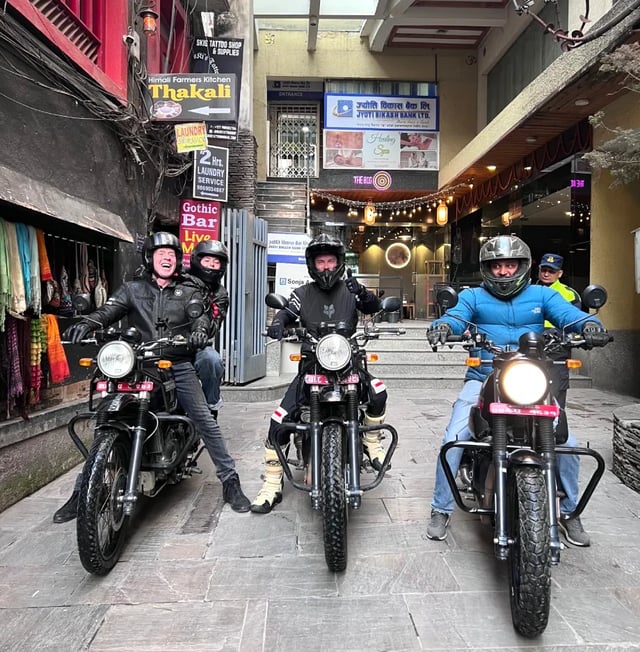
You'll travel with a Kathmandu-based team that plans treks, peak climbs, helicopter flights, motorbike journeys, and cultural trips across Nepal, Tibet, and Bhutan. Routes range from classic teahouse walks and high passes to luxury lodge itineraries and longer expedition-style climbs, with departures shaped around how you want to pace the mountains.
Licensed guides and office staff train regularly on mountain safety and guest care. Porters are insured, fairly paid, and equipped for the trail, with sensible load limits on lodge routes. We work with remote communities through sustainable tourism, including support for education in village areas, so your booking helps local people as well as your own adventure.
Operated by Himalayan Adventure Treks & Tours, a partner of adventuro.
Bagmati Province, Nepal
From $7000