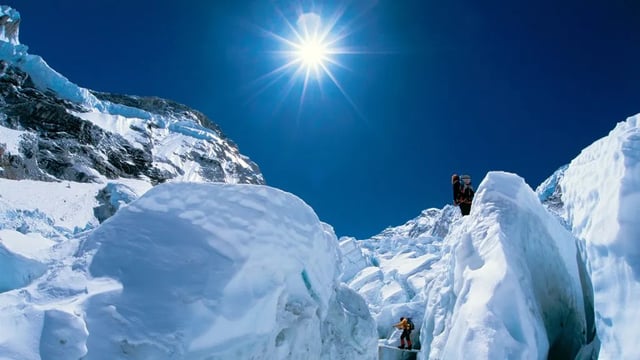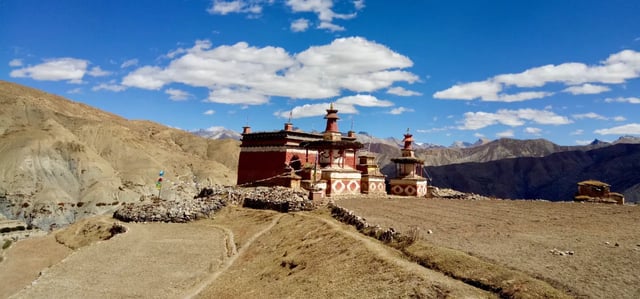
This Khumbu crossing links Gokyo Lakes, Cho La Pass, and Everest Base Camp in one loop. You walk from Lukla through Namche, climb toward Gokyo Ri, then cross the icy Cho La toward Dzongla, Lobuche, and Gorak Shep. Gokyo Ri, the icy Cho La, and Everest Base Camp in one loop is the full Khumbu crossing guests ask for.
Base Camp and Kala Patthar sit on the east side of the pass before you walk out to Lukla. Guides carry the pace on snow steps and glacier approaches; crampons come out when the col is icy. Dzongla, Lobuche, and Kala Patthar sit on the east side so you still stand at the icefall after the pass.
Your guide is licensed through MOCTCA and NATHM, trained on altitude illness, and used to icy steps on Cho La between Gokyo and Dzongla. Kit for porters is renewed yearly for that colder pass morning, with one porter for every two guests on lodge nights, or a dedicated porter if you travel solo.
A security deposit sits with Nepal's Ministry of Tourism for guest protection, and our crews are insured on duty from Lukla through Gokyo Ri, the col, Lobuche, Everest Base Camp, and Kala Patthar. You'll brief in Kathmandu on crampons and turn-around calls so the crossing is paced.
Welcome to the unique Kathmandu, where all your Himalayan journey begins. As you step out of the airport, you will find our representative with a sign in hand, ready to take you on a private ride to your hotel. After you check in, take a moment to relax, afterward you will have time to buy any necessary gear.
Where is the best place to do this and not get lost in the noisy streets, our guide will tell you in detail. Later in the evening, our guide will tell you all about the travel program of our Everest Cho La Pass trek and everyone will also get to know each other.
After an early morning departure to the domestic airport, we will approach the flight to the Lukla town of Everest region. This will be an utterly mountain flight of your life when you can gaze at Kanchenjunga, Manaslu, and Everest literally pass by beneath your feet. And, the landing will be equally exciting as you wait for the plane to stop at the shortest runway of the airstrip.
6187 m high Kongde Ri will wave you as soon as you exit the small aircraft. Now, you will have a small meeting with our Sherpa guide and porters then you will depart to take the first walk which will gradually lead you to the amazing Gokyo and Cho La Pass.
After we leave Phakding, we will once again walk enjoying the cascading waters of Dudh Koshi River that runs north. The route will go straight up the hill and pass through the beautiful oasis of rhododendrons and pines. At Toktok, we will meet an enticing waterfall and not far away, we can see the striking image of Thamserku (6609 m).
Soon, we will arrive at Benkar where our trail will guide us across the river of Dudh Koshi along the highly suspended metal bridge. Now, the trail will climb towards Chomoa till we reach Monjo. Here, our pathway will enter into the Everest (Sagarmatha) National Park.
At the park entrance, the rangers will check our permits to ensure we have paid the entrance fee and register our arrival.
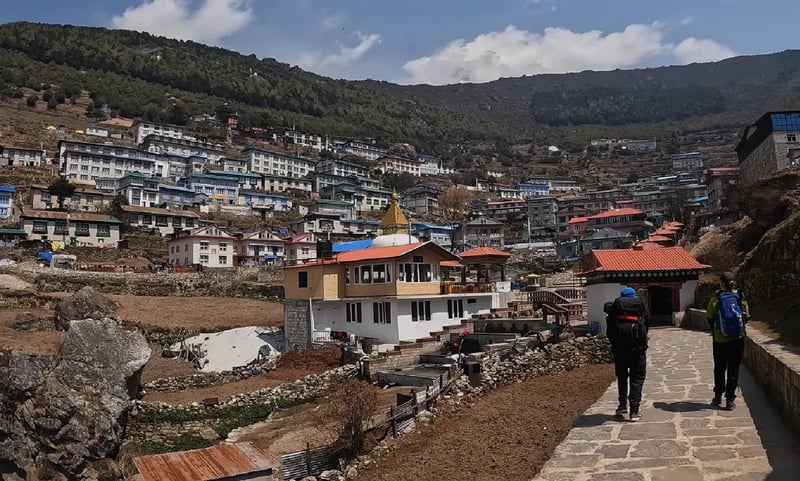
Namche Bazaar is positioned at a significant elevation, therefore, here we can feel the first signs of altitude sickness. To ensure that we have a successful journey on our Cho La Pas trek, it is important that we spend another night at Namche to allow our bodies to adjust to the new environment. Today, we will go to the village of Khumjung, home to a mountaineering museum and the intriguing Yeti scalp.
Additionally, we will also make a stop at the Everest View Hotel, a luxurious Japanese establishment particularly designed for those who like to observe Everest and its sister companions without trekking to the base. After all the necessary exploration in Khumjung, we will make our descent back to Namche Bazaar.
We are about to reach new heights today as we ascend to the heights of more than 4000 m at Dole. Taking our time, we will slowly approach Kyangjuma observing the striking profiles of Thamserku, Nuptse (7861 m), and the Ama Dablam (6812 m).
Now, hugging the slope of rhododendrons, we will travel to Sanasa. Here, the trail splits: the right one goes up to Everest Base Camp while the left one will be our trail.
Get ready to climb the trail that rises sharply along the steep staircase that has been carved into the cliff. We will be atop the 3973 m Mongla Danda which bestows the remarkable view of the Tengboche Monastery.
Today promises to be a very short, simple, and beautiful day for the EBC Gokyo Cho La Pass trek as we will walk only 6 km gaining almost 300 m. As we advance with our hike, we will wander through the green grasslands that have taken the place of the once-thick forest.
We will first traverse the pasture of the Lhabarma Kharka and then of Luza Kharka. Macchermo is not that far now and the route is more enjoyable as we glimpse at the white silhouettes of Thamserku, Cho Latse, Cho Oyu, and Tawache.
Here we are at Macchermo on time to eat our lunch. Then we will go out for a small acclimatization walk around the small village.
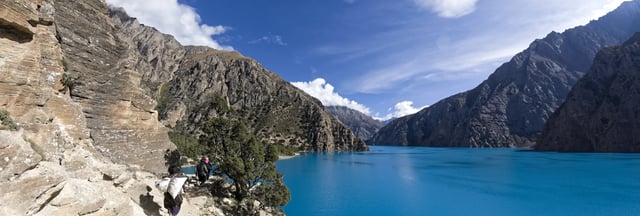
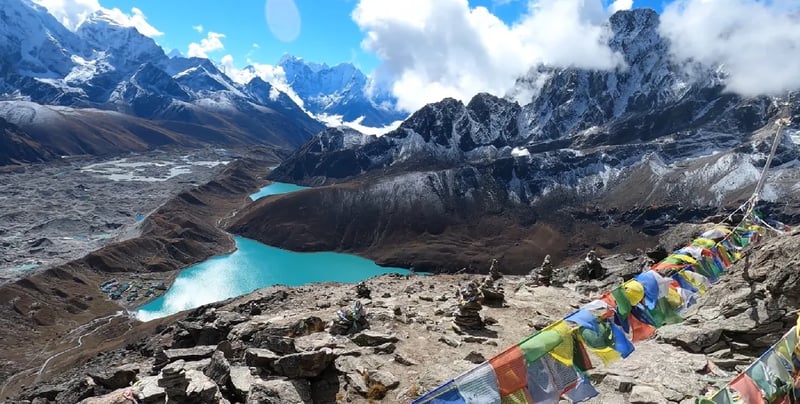
Today, we are set to reach one of Nepal’s most enchanting treasures: the high alpine glacial lake of Gokyo. Located beneath the feet of the Himalayas, there are five lakes in total that make up the Gokyo Lake.
Today, we will traverse only three and the remaining two will be left for tomorrow. After leaving Macchermo, we will ascend the ridge and advance towards 4390 m high Pangka.
Prepare as you will have to trek upward along the more rugged trail towards the rocky terrain of Nilibuk. The new pathway has been formed here for ease and then one by one we will approach the first Gokyo Lake: Longponga Lake at 4,560 m, Taujung at 4,720 m, and Dudh Pokhari at 4,790 m.
Today is a big day for many of us as we will be heading to the summit of Gokyo Ri which rises to 5360 m. Its altitude is more than some of the peaks that are found in the world so it will be the major milestone in your trekking career. The climb to this summit is not technically complicated, but it will be a true test of your resolve and determination.
We will commence our climb before dawn and cross the small stream en route. After about 2 to 4 hours, we will be already atop the summit meeting the beautiful dawn over Mount Everest, Gyachung Kang, Nuptse, Cho Oyu, Lhotse, Makalu, Cho Latse, and Taboche.
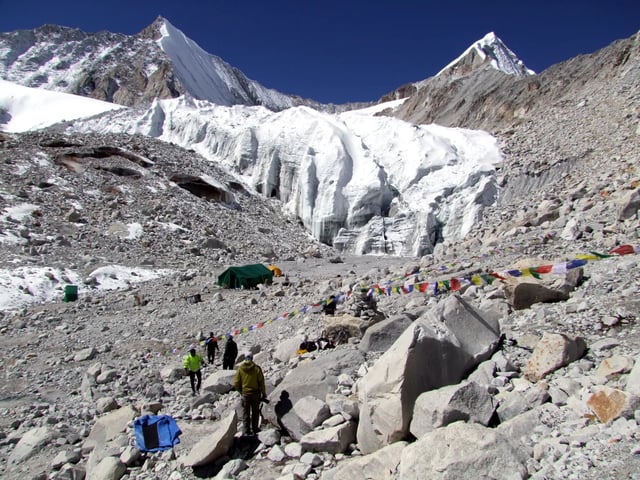
From Gokyo, we will take the snow-covered track that will lead us to Tanjung Pokhari. Here, the trail diverges: one path will go to the Macchermo and the other one will take us to our intended destination. Tracing the edge of the moraine, we will climb the ridge and cross the vast expanse of the Ngozumpa Glacier that lies at the foot of Cho Oyu.
We will navigate carefully the crevasses for about 45 minutes and finally scramble back up the moraine wall on the glacier's western flank. The route will now take us down into the lower Valley where Thagnag awaits our arrival.
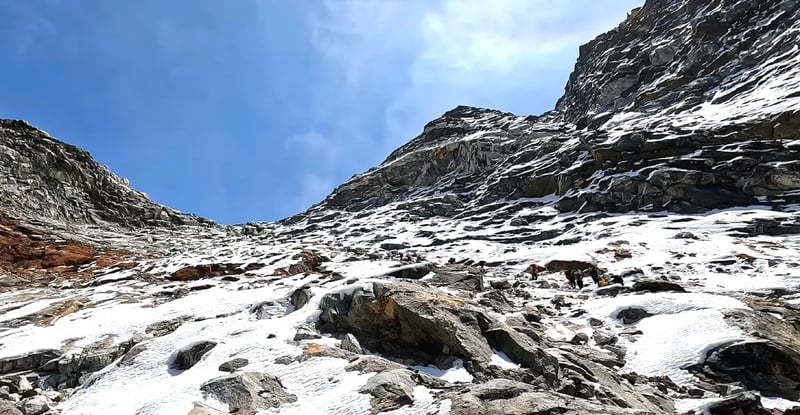
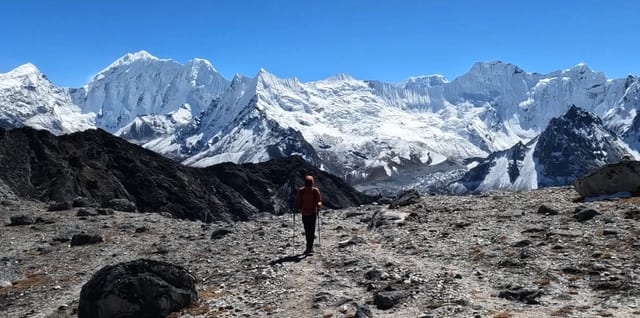
We will start out very early today following the rule of alpine start. We will be crossing the mighty Cho La pass today which is also lovingly known as Chhugyuma La in the Sherpa language.
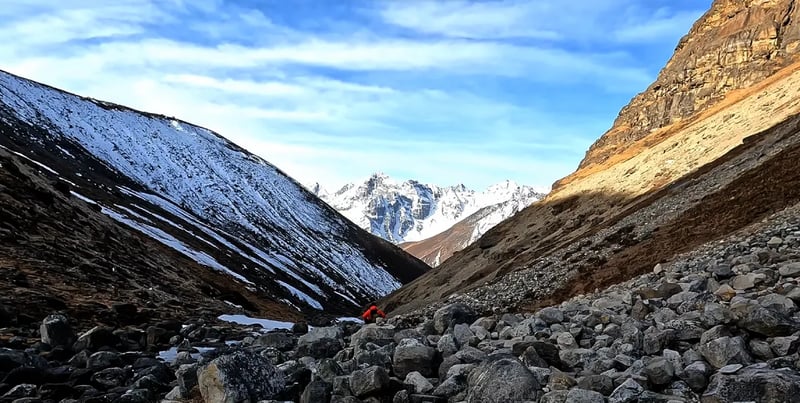
The Pass is not technically challenging, but we must be prepared for the strenuous hike, with steep inclines and biting cold. We will traverse the narrow valley of Phedi and come along the rugged terrain.
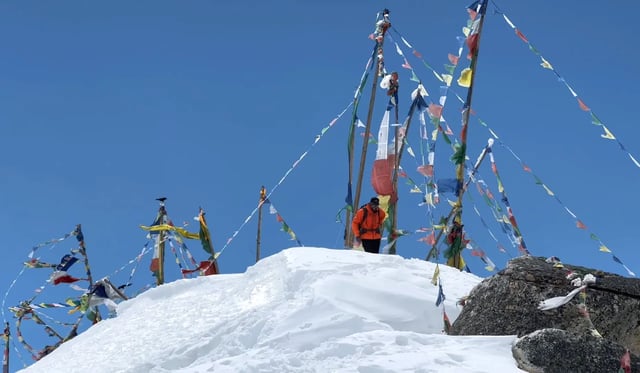
A three to four hour long journey will advance us towards the high alpine frozen lake. After crossing the lake, we will undertake the last inclined section that will lead us to the ultimate height of the Pass.
From Dzongla, we will start to walk down for around two hours to reach Dughla. From here, we will face a challenging climb up to the Dughla Pass, a solemn place filled with countless symbolic graves of deceased Sherpas and mountaineers on Mount Everest.
Here, we can also see one of the most beautiful profiles of Pumori (7161 m) that rises majestically along with Lobuche, and Ama Dablam. The terrain is high alpine and delicate that now goes easily along the small river taking us to Lobuche.
The next phase of our Everest Cho La Pass trek will now take us to EBC today. After Lobuche, we will follow the trail on the western side of the wide Khumbu Valley.
We will then gently climb through meadows beside a glacial moraine. The conical summit of Pumori, Lingtren, Mahalangur, and Khumbutse can be seen as we move on along the steeper and uneven terrain.
We will reach the Thangma Riju Pass commonly called the Lobuche Pass and then move to cross the lateral moraine of Changri Glacier. After a bend, we will see the ridge of Kala Patthar just below the Pumori.
Yet another day for the very early alpine start as we are set to head straight for Kala Patthar, the sugar peak of Pumori at its tail. The path leading us to the top of this Black Rock is not that challenging but the hike can be strenuous particularly due to high elevation and frigid cold.
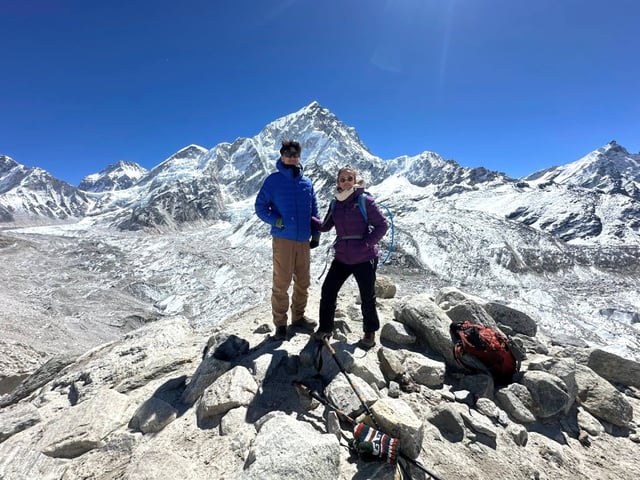
At first, the track will go steeply up and then easy until the final boulder. Now, the very last meters to the summit will be quite battle but at last, we will be at the tip where we can see the first sun ray touching the black tip of Everest.
We will also be able to see the walls of Pumori, Nuptse, Khumbutse, Changtse, Lobuche, Lhotse, Ama Dablam, and Lingtren. We will now go down to Gorakshep, pack our belongings, and go down the familiar road towards Pangboche.
After we leave Pangboche, w make our way down to Imja Khola, cross it, and then enter the vast green zone of the Khumbu Valley. Our route will now be relatively easy and flat running through pine, birch, juniper, and rhododendron trees taking us to the lovely village of Deboche.
The trail will now ascend sharply to the monastic grounds of Tengboche, which is undoubtedly the most significant monastery for the Sherpa community. We will have the opportunity to visit the monastery after which we will take on another sharp descent of about 600 m to reach Phunki Thenga (3250 m).
We say goodbye to the highest snowy giants and continue along the familiar path of Top Danda, Jorsalle, and Monjo.
We will leave the National Park of Everest and hike along the young tracks running through Benkar, Phakding, Thadokoshi, Chheplung, and Chaurikharka to step once more at the land of Lukla.
The moment has come for us to once again fly in the small aircraft that will return us either to Ramechhap or Kathmandu. After a take-off, in about 40 minutes, we will be back again in the noise and frenzy of the city.
Let’s celebrate our evening with an eye and tongue-pleasing dinner with our team and revel in the moments that we spend together in Everest.
The beautiful and intrepid travel journey of our Everest Cho La Pass trekking has ended. As we see you off at TIA, we await the day we will reunite again.
We wish you a truly delightful journey back home.
Most guests fly into Tribhuvan International Airport in Kathmandu. Share your arrival time ahead of travel so a Thamel hotel transfer can be arranged, or make your own way to the meeting hotel.
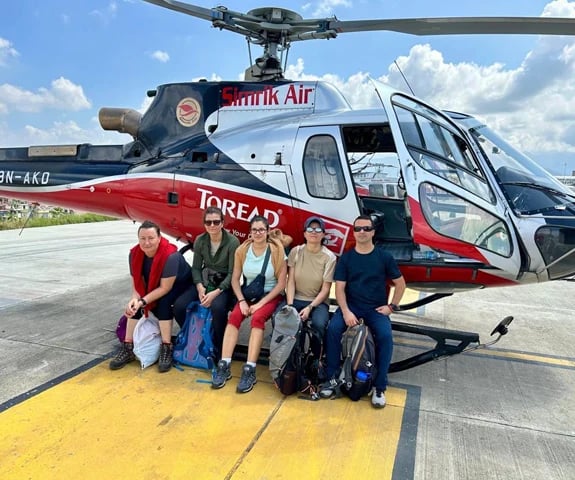
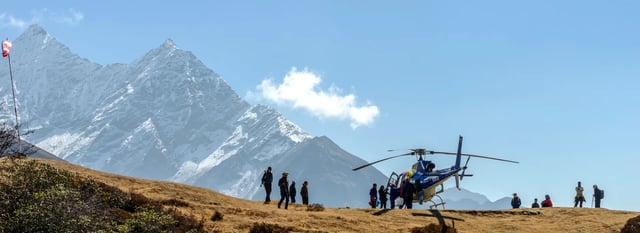
Pre-trek briefings usually take place in Kathmandu before the Lukla flight or helicopter sector. Allow extra days after the trek in case mountain flights are postponed by weather.
Twin or double rooms in a comfortable Kathmandu hotel cover your first nights and your return from the trail, with breakfast on those city stays when included in the package. Briefings happen at the hotel, and airport collection from Tribhuvan is available when flight times are shared in advance.
Family-run teahouses or lodges line the route with twin beds and a shared dining room. Rooms get simpler and colder as you climb, with shared bathrooms common at higher villages. Hot water, Wi-Fi, and charging are paid at the lodge when offered.
Stable trekking weather most often falls in pre-monsoon spring and post-monsoon autumn. Monsoon cloud sits lower on the hills while winter brings ice on steps above village level.
If your dates sit in winter or monsoon, pack rain and cold layers and accept that flight or pass days may move by a day when safety requires it. Weather can shift daily plans, so your guide keeps a steady pace with regular breaks.
You should be comfortable walking several hours a day on uneven paths with a daypack, including steady uphill sections as you gain height. Hill training and longer weekend walks in the months before travel help your legs and lungs on uphill trail days.
Hill training, stair climbing, and longer weekend hikes in the months before travel help your legs and lungs, even when acclimatisation days are built into the route. Break in boots before you fly and carry a light daypack on practice walks.
Guided trekking with licensed leaders, lodge nights on the trail, meals as described for walking days, and permits for the regions crossed are included when they are part of this trip. Domestic flights, porters, and airport transfers apply only when they are part of this trip.
Domestic flights, road transfers, porter support, and airport transfers apply only when they are part of this trip. Permits for the regions you cross are arranged in Kathmandu or Pokhara when included.
International flights to Nepal, visa fees, compulsory travel insurance, personal trekking clothing, snacks and drinks outside included meals, and tips for crew are not covered. Hot showers, Wi-Fi, and battery charging in lodges are usually paid locally when offered.
Charges for hot showers, Wi-Fi, or battery charging in lodges are paid locally when offered unless your trip notes say otherwise. International flights, visa fees, and personal insurance stay outside the trek package.
Hotel meet in Thamel is typical; send flight numbers so pickup can meet you at the international terminal. Allow a little extra time after the trek before international flights home in case mountain roads or flights move.
Rest day buffer after the trek helps if Lukla or helicopter sectors slip by a day. Trail conditions are checked each morning before the group moves.
The itinerary builds rest days and climb-high, sleep-low hikes where the route requires them. Your crew would rather wait for a safe window than rush marginal weather.
Tell your guide early if symptoms appear so tomorrow's stage can shorten or descent can start before conditions worsen. Thamel hotels are the usual meet point; drivers need flight numbers to meet you at the international terminal.
Mountain weather can delay or postpone Lukla flights even in peak season, and Ramechhap diversions happen when the airstrip is congested. Shoulder weeks need an honest weather call before high passes or dawn viewpoints.
Build buffer days after the trek for international connections, and follow crew advice if schedules change or flights shift to Ramechhap. Keep a spare day in Kathmandu after the trek if Lukla or Ramechhap flights move.
Sagarmatha National Park and Khumbu municipality permits apply in the Everest region. The team arranges paperwork in Kathmandu or Pokhara when you provide passport copies and trek dates.
Keep copies in your daypack for checkpoint stops. Your team files the paperwork in Kathmandu or Pokhara once you share passport copies and dates.
Families join when children can manage the daily hours and terrain on this specific route. Pace and daily hours can be adjusted on private departures, though that may extend the calendar.
Ask our Kathmandu team if you are planning with younger walkers. Private departures can shorten daily hours, though that may add a day or two to the calendar.
Comprehensive travel insurance that covers trekking to the highest altitude on your itinerary, medical evacuation, and helicopter rescue when applicable is essential. Many standard policies exclude high altitude by name.
Read the wording before you travel so you can adjust cover if trekking above 5,000 metres is not named. Many standard policies exclude high altitude by name, so read the wording before you fly.
We partner with Rewilding Britain to help protect our natural spaces for future adventures.
All centres are vetted for safety and quality. Your adventure is in good hands with adventuro.
About the centre
Kathmandu
You'll travel with a Kathmandu-based team that plans treks, peak climbs, helicopter flights, motorbike journeys, and cultural trips across Nepal, Tibet, and Bhutan. Routes range from classic teahouse walks and high passes to luxury lodge itineraries and longer expedition-style climbs, with departures shaped around how you want to pace the mountains.
Licensed guides and office staff train regularly on mountain safety and guest care. Porters are insured, fairly paid, and equipped for the trail, with sensible load limits on lodge routes. We work with remote communities through sustainable tourism, including support for education in village areas, so your booking helps local people as well as your own adventure.
Operated by Himalayan Adventure Treks & Tours, a partner of adventuro.