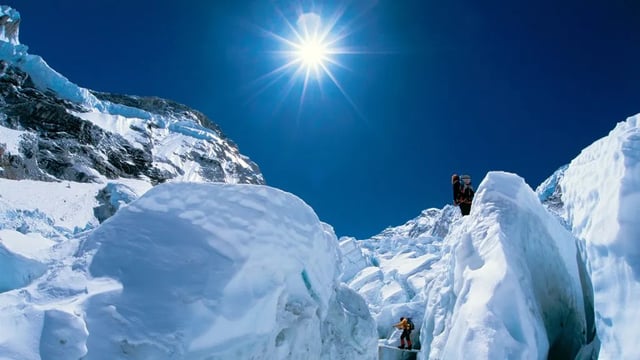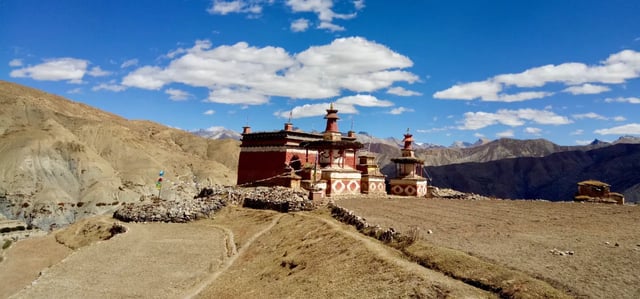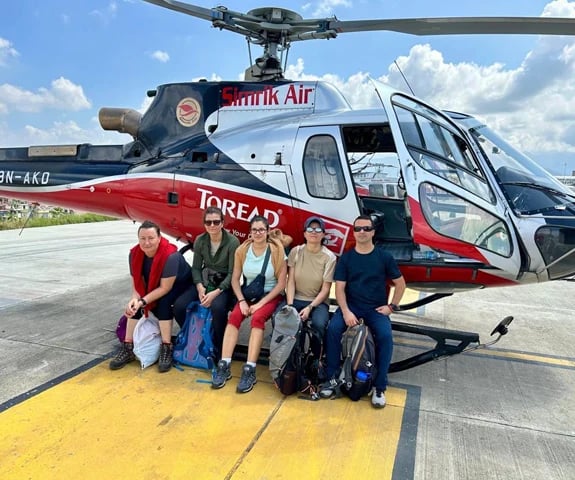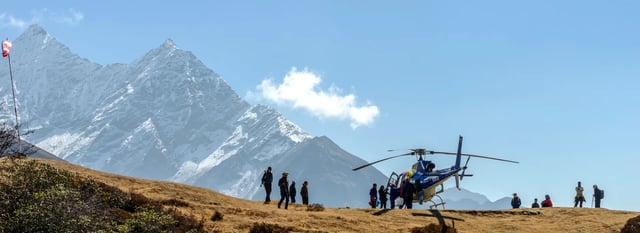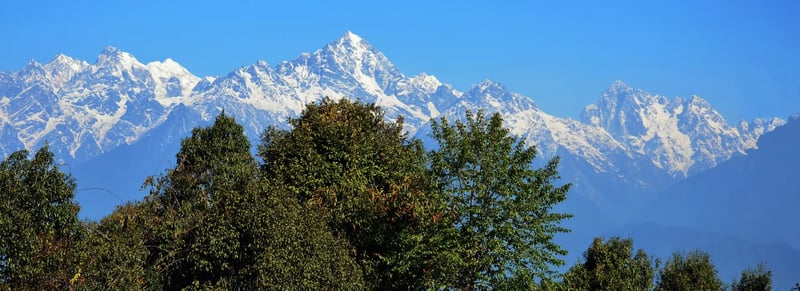
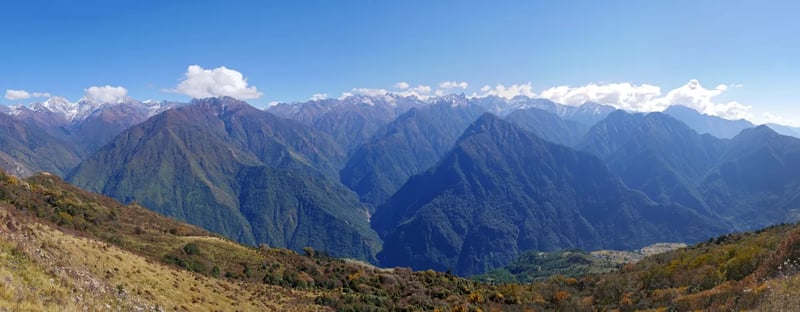
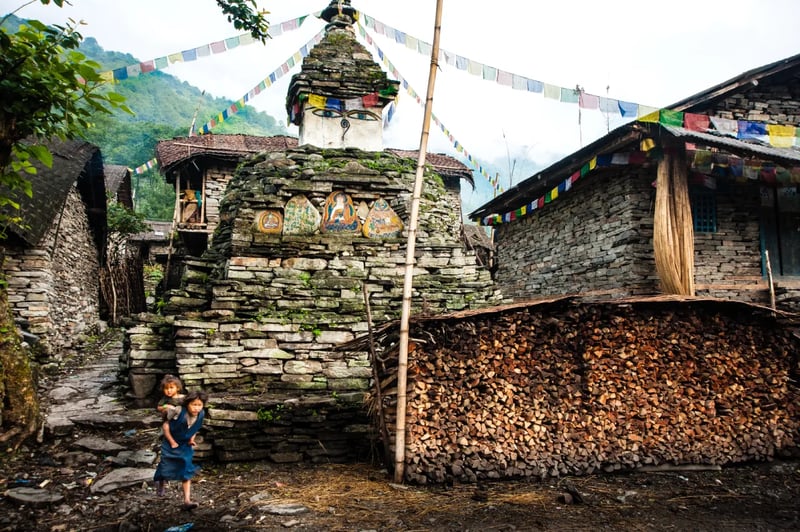
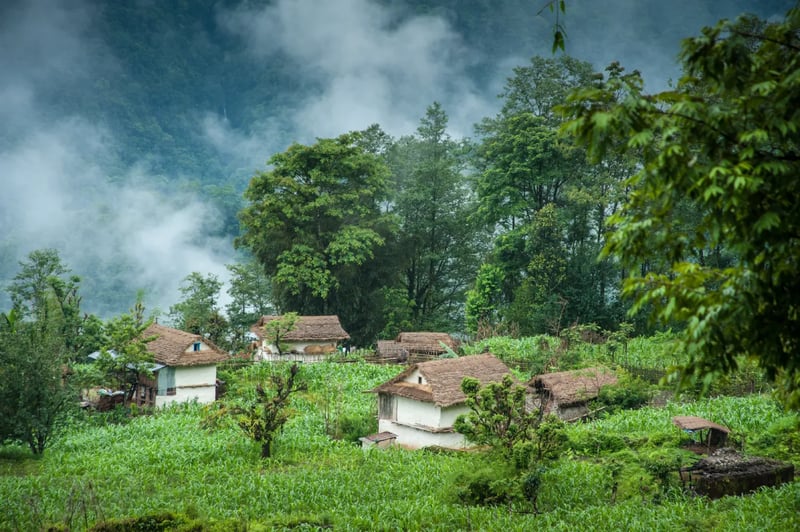
The Arun Valley in the east follows the Arun River toward Makalu country through Rai and Sherpa villages, cardamom groves, and hot lowland days before the hills cool. You fly or drive toward Tumlingtar to start. Cardamom groves, Rai villages, and the Arun’s heat give way to cooler hills as Makalu appears.
Makalu appears as you gain height. Lodge nights are simple, and the trail feels far from the main Khumbu flight path. Hot river days ease as you climb toward Num, with cardamom drying on village terraces.
Guides licensed through MOCTCA and NATHM, and chosen for the eastern valleys, pace the Arun heat from Tumlingtar through Kariki Ghat, Salpa Phedi, and Gudel. You'll walk with insured porters, one for two guests, loads around 25 to 30 kg, and kit renewed each year.
We'll confirm lodge nights in Rai and Sherpa villages from Kathmandu, then time the cooler hill days toward Pangum and the Lukla flight out. Your guide shares the next stage every evening so river heat and the final approach to Lukla stay honest.
As you arrival at Tribhuvan International Airport in Kathmandu at 1,400 m / 4,593 ft, you are welcomed by a representative from our team and transported to a hotel. Driving covers a distance of approximately 30 minutes.
Once checked in, you can rest or have a quick walk around Thamel, which is a bustling locality with cafes, small shops, and trekking shops. You get briefed by your guide in the evening on the trek, the flight schedule, the packing list, and what to do on the trail.
This gathering makes you feel ready and self-confident. Have lots of water and sleep early so that you can become accustomed to the new time before the adventure starts.
You start a guided sightseeing journey of the most well-known cultural sites of the valley after having breakfast at your hotel in Kathmandu at an altitude of 1,400 m / 4,593 ft. You go to ancient temples, courtyards, and stupas with prayer flags and spinning prayer wheels. Your guide tells you the history and religious significance of every place in a simple manner.
You get to have a local life, art, and architecture during the day. You go back to your hotel in the afternoon to get ready for the trek. You check your equipment, pack your duffel bag, and verify domestic flight details.
This is the day before going to the mountains, when everything is prepared.
In the morning, you do a scenic flight out of Kathmandu on 1400m / 4593ft to Tumlingtar on 518m / 1699ft. The landing has spectacular scenes of hills and river valleys. Upon arrival, you start hiking to Kariki Ghat, 351 m / 1,152 ft.
The road cuts across hot and green rural areas and small agricultural villages. You walk up and down local roads and over rivers on suspension bridges. The air is warmer and a bit moist due to the low altitude.
The initial hiking day will allow your body to get used to backpack walking. Five or six hours later, you arrive at Kariki Ghat and take a rest in a teahouse.
You start by taking the trek to Goethe Bazaar at 685 m / 2,247 ft after having your breakfast at Kariki Ghat at 351 m / 1,152 ft. The route runs along the Arun River and goes through tiny villages like Balwa Besi. You traverse the Irkhuwa River via suspension bridges and pass-through forest with uphill climbs.
The trail is not overly steep and is not that challenging to hike on. You can see local farmers in the fields and children going to school. Goethe Bazaar is an active village unifying the surrounding communities.
Once you arrive at your lodge, you unwind by taking a hot meal and then going to sleep.
You set off today from Goethe Bazaar, 685 m / 2,247 ft, towards Salpa Phedi, 1,520 m / 4,987 ft. The path goes through Lankuwa and Dhobani villages. You pass bamboo trees, terraces and forested hills.
The ascent increases with the elevation. The atmosphere is colder than in the lower valleys. You walk in a moderately slow, steady manner with attention paid to even breathing and walking.
On the way, there are houses with traditions and hospitable locals. 5-6 hours of trekking lead to Salpa Phedi. It is a chilly evening and some warm clothes can help.
The day starts with a longer ascent after breakfast from Salpa Phedi at 1,520 m / 4,987 ft up to Guranse in 3,000 m / 9,843 ft. It is considered one of the hardest days of the trek. The path is ascending through thick woods and mountainous tracks.
With increased elevation, you are blessed with expansive sceneries of stratified hills and valleys in between. You go through the Jau Bari village and can also come across a small Sherpa monastery. Go step by step to save on energy.
It is colder towards Guranse. On arriving at your lodge, you are able to rest and have the serene mountain environment of this elevated location.
You begin your day in Guranse at 3,000 m 9,843 ft and hike to Sanam 2,840 m 9,318 ft. The path passes through quiet woodland and through little streams. On the walk, you have a view of Karylang Peak and other nearby ridges.
As you enter the Solukhumbu area, the landscape starts to display more Sherpa culture. The path consists of moderate slopes and hilly areas, and the day is pleasant following the former ascent. Sanam is a small traditional village that is situated in the mountains.
It takes 5-6 hours of hiking before you reach and spend your time in your teahouse, enjoying the serene environment.
On this day, you start on a trek at 2,840 m / 9,318 ft from Sanam and go towards Gudel at 1,965 m / 6,447 ft. The road slowly winds down and curves around the green mountains.
On the trail, you can pass Nimtsola, where you observe a small gompa, and, looking at the culture, you can see that it is gradually acquiring Sherpa rather than Rai traditions. It is a landscape leading to broad expanses of terraces and farm and buffalo sheds.
You pass by small villages and encounter people toiling on their farms. During a clear day, it is possible to see the mountains in the distance, such as Mera Peak.
You go out of Gudel today and walk to Kiraunle Gompa. The path passes through terraced fields and villages. You cross little streams and woodland and the landscape becomes still more distant.
The nature of the walk is peaceful because of the bird sounds and the fragrance of the forest. The higher you go, the colder and fresher the air appears. You reach Kiraunle Gompa in the afternoon.
This stop is unique because of the peaceful environment. Visit the monastery, take photos, and enjoy the peaceful atmosphere of the mountains before dinner and sleep.
On this day, you hike to Sibuje at 2,686 m / 8,812 ft, after having breakfast at Kiraunle Gompa. The path ascends gradually until it reaches a ridge with chortens and mani walls. The path is surrounded by rhododendron forests, particularly in spring.
You head on intoSurke La, with clear views of the ridges. On sunny days, one can view mountains like Karylung, Khatang, and Numbur in the background. The path is smooth with slight rises and falls, yet easy to follow.
The day is rewarding with fresh mountain air and extensive landscapes. Several hours later, you get to Sibuje and relax in your teahouse. The day is finished in a peaceful way with a warm meal and mountain views.
You leave Sibuje at 2,686 m / 8,812 ft in the morning and start to go to Pangum at 2,850 m / 9,350 ft. The path passes through a series of hills and is close to Gai Kharka. During clear days, Mera Peak will shine in the distance once again.
The path has forested areas and the classical villages that are affected by the Tibetan culture. The gradual path allows one to walk easily without having to take extensive, steep ascents. You will have an opportunity to take pictures and take brief breaks along the route.
Pangum is a friendly village that has simple teahouses and nice people. Once you get to your lodge, you rest, have dinner, and prepare for the next phase towards Lukla.
After breakfast in Pangum, at 2,850 m / 9,350 ft, you start walking towards Painya at 2,730 m / 8,957 ft. It is a path that proceeds to Kharte village and reaches Khari La pass, then descends further. The trail goes through woods, rocky areas, and open horizons.
In the hills, you can see such distant villages as Bupsa and Karikhola. The landscape is also quite diversified, and the day is not monotonous, as there are both upward and downward slopes. The surrounding nature is not noisy and congested as it is in other trekking spots.
On arriving at Painya, you are able to relax and enjoy the rural village environment. In case it is a clear night, you might see beautiful stars over the hills in the sky.
You leave Painya at an altitude of 2,730 m / 8,957 ft and head towards Lukla at an altitude of 2,860 m / 9,383 ft. The foot trail uses sandy tracks and hills. The walking distance is not very long, but some sections are steep and require careful steps.
The views of the hills and mountains pay off at the end of the trek. It is to get to Lukla since this is the end of your journey. The fact that the moment is special is due to arriving on foot on this less-traveled path.
Having been accommodated in your lodge, you can visit Lukla Bazaar, go to the little shops, and rest. During the evening, a number of the trekkers have a final dinner together and reminisce on the trip.
The day starts in the morning when a short scenic flight is undertaken from Lukla at 2,860 m / 9,383 ft to Kathmandu at 1,400 m / 4,593 ft on this day. The last aerial views of the mountains and ridges that you have traversed during the trek are provided by the flight. Upon landing, you check into your hotel.
The remaining part of the day is at your liberty to shop, relax, or have a hot shower. This is followed by a farewell dinner in a traditional Nepali restaurant in the evening. You feast to celebrate your accomplished trip with local food and music, with cultural dance.
And it is a good and joyous way of bringing your adventure in the Himalayas to an end.
This is your final day of the Arun Valley Trek. You pack your bags after breakfast and check your travel documents. You are picked up by a representative from our teamand transferred to Tribhuvan International Airport, three hours before the flight.
Throughout the ride, you can remember the villages, forests, passes, and mountains that you were in during the Arun Valley Trek. This journey along the eastern Nepal is accompanied by the feeling of accomplishment. The experience provided cultural exploration, tranquil sceneries, and substantive local experiences.
At the airport, you bid your farewells to your team and Nepal. You go away with great memories and even an intention to go back to the Himalayas adventure sometime again.
Fly into Tribhuvan International Airport in Kathmandu unless the itinerary uses another regional hub. Airport or hotel pickup can be arranged when you share arrival details ahead of travel.
Briefings cover road or domestic travel to the trailhead. Build buffer time before onward international flights in case mountain weather shifts the schedule.
Twin or double rooms in a comfortable Kathmandu hotel cover your first nights and your return from the trail, with breakfast on those city stays when included in the package. Briefings happen at the hotel, and airport collection from Tribhuvan is available when flight times are shared in advance.
Family-run teahouses or lodges line the route with twin beds and a shared dining room. Rooms get simpler and colder as you climb, with shared bathrooms common at higher villages. Hot water, Wi-Fi, and charging are paid at the lodge when offered.
Spring from March to May and autumn from September to November usually bring the clearest views and stable walking conditions on this route. Winter is quieter but colder at altitude, while monsoon months bring cloud and wet trails at lower elevations.
Shoulder weeks need an honest weather call before high passes or dawn viewpoints. Monsoon cloud sits lower on the hills while winter brings ice on steps above village level.
You should be comfortable walking several hours a day on uneven paths with a daypack, including steady uphill sections as you gain height. Hill training and longer weekend walks in the months before travel help your legs and lungs on uphill trail days.
Hill training, stair climbing, and longer weekend hikes in the months before travel help your legs and lungs, even when acclimatisation days are built into the route. Break in boots before you fly and carry a light daypack on practice walks.
Guided trekking with licensed leaders, lodge nights on the trail, meals as described for walking days, and permits for the regions crossed are included when they are part of this trip. Domestic flights, porters, and airport transfers apply only when they are part of this trip.
Domestic flights, road transfers, porter support, and airport transfers apply only when they are part of this trip. Permits for the regions you cross are arranged in Kathmandu or Pokhara when included.
International flights to Nepal, visa fees, compulsory travel insurance, personal trekking clothing, snacks and drinks outside included meals, and tips for crew are not covered. Hot showers, Wi-Fi, and battery charging in lodges are usually paid locally when offered.
Charges for hot showers, Wi-Fi, or battery charging in lodges are paid locally when offered unless your trip notes say otherwise. International flights, visa fees, and personal insurance stay outside the trek package.
Pickup can be arranged from Tribhuvan International Airport or your hotel in Thamel when you share flight times ahead of travel. The pre-trek briefing is usually held at the hotel before the Lukla flight or helicopter sector.
Allow buffer days after the trek in case mountain flights move. Thamel hotels are the usual meet point; drivers need flight numbers to meet you at the international terminal.
Guides set a steady pace and watch for headache, nausea, or dizziness as you gain height. Weather can shift daily plans, so your guide keeps a steady pace with regular breaks.
Tell your guide early if symptoms appear so tomorrow's stage can shorten or descent can start before conditions worsen. Trail conditions are checked each morning before the group moves.
Jeep or bus days to the remote trailhead are arranged when they are part of your package. Your guide confirms departure times at briefing.
Motion sickness medicine helps on winding mountain roads. Your crew would rather wait for a safe window than rush marginal weather.
National park or restricted-area permits apply depending on the valleys you cross. The team arranges paperwork in Kathmandu or Pokhara when you provide passport copies and trek dates.
Keep copies in your daypack for checkpoint stops. Allow a little extra time after the trek before international flights home in case mountain roads or flights move.
Families join when children can manage the daily hours and terrain on this specific route. Pace and daily hours can be adjusted on private departures, though that may extend the calendar.
Ask our Kathmandu team if you are planning with younger walkers. Private departures can shorten daily hours, though that may add a day or two to the calendar.
Comprehensive travel insurance that covers trekking to the highest altitude on your itinerary, medical evacuation, and helicopter rescue when applicable is essential. Many standard policies exclude high altitude by name.
Read the wording before you travel so you can adjust cover if trekking above 5,000 metres is not named. Many standard policies exclude high altitude by name, so read the wording before you fly.
We partner with Rewilding Britain to help protect our natural spaces for future adventures.
All centres are vetted for safety and quality. Your adventure is in good hands with adventuro.
About the centre
Kathmandu
You'll travel with a Kathmandu-based team that plans treks, peak climbs, helicopter flights, motorbike journeys, and cultural trips across Nepal, Tibet, and Bhutan. Routes range from classic teahouse walks and high passes to luxury lodge itineraries and longer expedition-style climbs, with departures shaped around how you want to pace the mountains.
Licensed guides and office staff train regularly on mountain safety and guest care. Porters are insured, fairly paid, and equipped for the trail, with sensible load limits on lodge routes. We work with remote communities through sustainable tourism, including support for education in village areas, so your booking helps local people as well as your own adventure.
Operated by Himalayan Adventure Treks & Tours, a partner of adventuro.