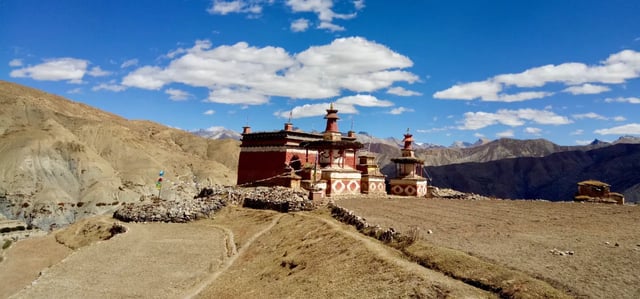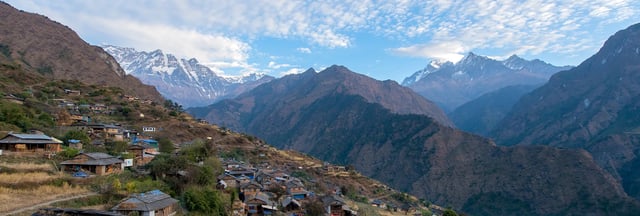
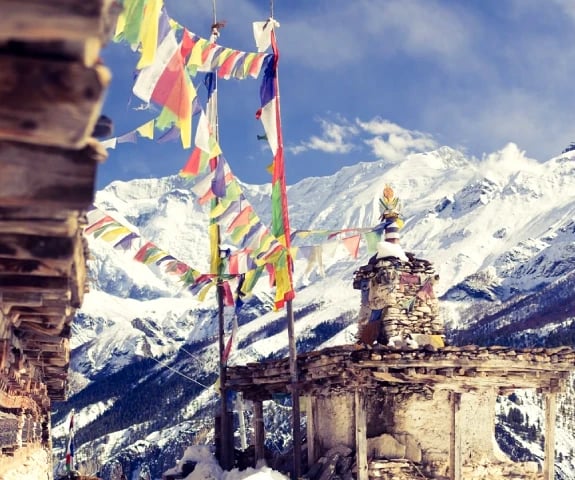
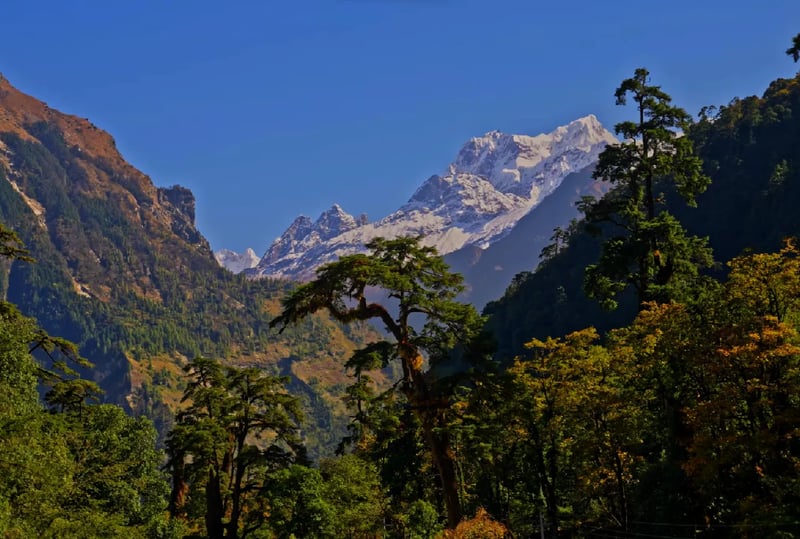
The circuit starts with a road to Besisahar or Jagat and walks the Marsyangdi through Tal, Chame, and Pisang to Manang. You gain height toward Yak Kharka and Thorong Phedi before the Thorong La crossing. Tal’s waterfall walls, Pisang’s painted houses, and Manang’s bakeries mark the climb to Thorong La.
The Mustang-side descent drops to Muktinath and Jomsom, with apple orchards in Marpha and a flight or drive back to Pokhara. Teahouses change from green valley lodges to dry-side rooms as you cross the massif. Muktinath’s 108 waterspouts and Marpha’s apple brandy sit on the dry-side descent before Jomsom.
A share of our profits supports school students in remote villages, including communities along this Marsyangdi corridor. You'll start from Besisahar or Jagat and walk through Tal, Chame, and Pisang to Manang. Our Kathmandu office files ACAP and TIMS before that road day.
Your guide keeps rest by Gangapurna so Thorong La is paced, then you cross to Muktinath and drop toward Jomsom and Marpha. We'll hold lodge lists from Chame to the Kali Gandaki exit. The finish is a flight or drive back to Pokhara on the dry side.
Hello and Welcome! After you leave the TIA gate, you will find our representative to receive you.
After assistance with your luggage, he will take you through the heavy traffic of Kathmandu towards your hotel in Kathmandu we have chosen for your comfort. After settling in, you can venture to Thamel and collect the essentials you may be needing for the Annapurna Circuit trek.
In the evening, our guide will gather all the trekkers for a briefing about our Annapurna Circuit itinerary. Please rest early and recover from jet lag as we have a long and exciting driving journey ahead of us in the early morning tomorrow.
Early morning, we are set to depart from Kathmandu by bus towards Jagat, our first mountain village for an overnight stay. The wide Kathmandu road will take us outside through Kalanki and Thankot after which the expansive Prithvi Highway will take us further passing by the rolling green hills and hugged by the enchanting Annapurna, Langtang, and Lamjung Himals. After we pass the small Dure town, we will take the scenic road that follows the Marshyangdi River to reach Besi Sahar.
Here, we will leave the bus and take a break for some stretching. We will then board the local sharing jeep to reach Jagat which lies perfectly cradled by the huge frame of the Annapurna and Manaslu range.
Here comes our inaugural day of hiking as we set forth towards Dharapani. From Jagat, that path will gently ascend along the steady hilltop of Bahun Danda. We will keep ascending towards Chamje from where the trail will elegantly rise through the serpentine mountain path running beside the marvelous current of the Marshyangdi River till we reach Tal.
Now the rich thickets of rhododendrons and bamboo will slowly usher us into the enchanting territory of the Manang Valley. The terrain from here transitions into typical Tibetan form, rugged, dusty, and dry as we pass through Karte.
From today, our journey will take us to the west, and after walking for around 60 minutes or so, we will arrive at the lovely town of Bagarchhap (2160 m). Surrounded by peach orchards, this lively town offers a prolific view of Lamjung and Annapurna II. Marching forward, we will encounter two more charming hamlets, Danakyu and Timang.
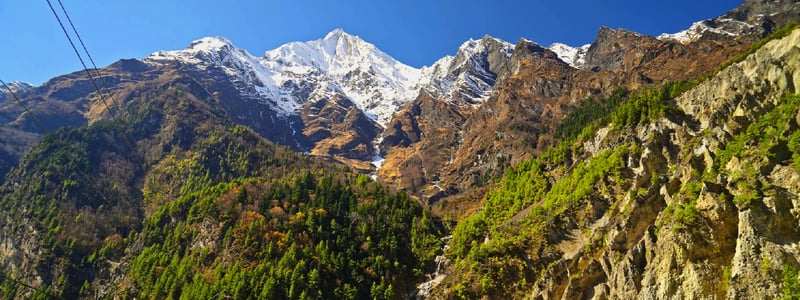
Now, hiking through the scattered treeline, we will cross a few bridges and walk past some marvelous waterfalls till we reach Lata Marang (2400 m). A gentle 200 m uprising trail will take us to Koto lying beside the Phu Khola.
We leave Chame and keep on walking through the fairy tale land. After around two hours, we will be in Bhratang Village where we can still see the remnants of old refugee camps. We will come across a quaint bridge which will forward us toward the uprising trail through the forest to imposing 1400 m high Paungdi Danda rock slab of Dhukur Pokhari.
From here, the landscape takes the dramatic form and we are now in the heart of the Manang Valley. The Tibetan landscape will truly enchant us as we make our way for around an hour and a half to arrive at Lower Pisang.
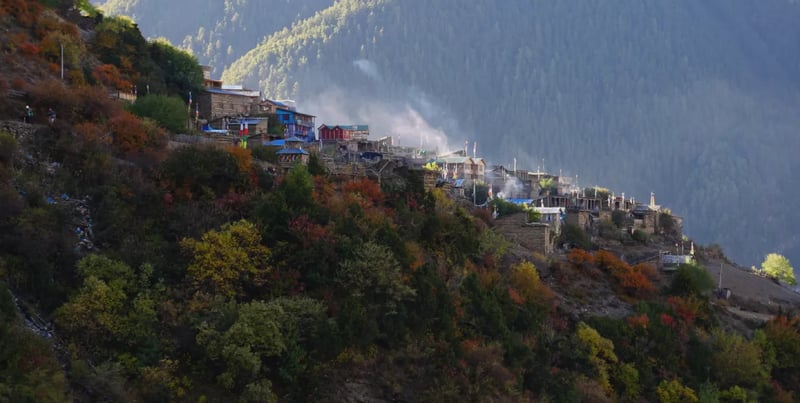
We will leave Pisang early and journey along the series of Mani Walls inscribed with sacred Buddhist text. The path ahead will dramatically rise and take us around 350 m high of Pisang to the Village of Ghyaru (3670 m). It is more remarkable than Pisang with its fortress-like art and colorful homes.
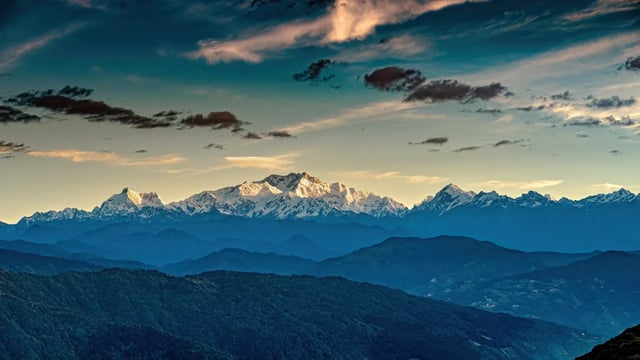
But the most wonderful is the huge Himalayas of Lamjung, Gangapurna, Tilicho, Annapurna II, III, and IV just staring at us at the horizon. The journey from here will be effortless as we proceed towards Ngawal (3657 m). Suddenly the striking features of the Chulu range will appear in front of us.
Now, we will walk down sharply and join the path to the main route that leads to Bragha (3450 m).
We will have our day reposing at Manang for our best acclimatization. The village itself although at a high elevation is situated on the flat sandy terrain which gives the enviable view of the spectacular Gangapurna. To see the mountain and its glacier kissed by the first morning rays, we will go to the 4130 m high Chongkor lookout point aka Bodzo Gompa.
Then after we had our lunch, we will hike for around 30 minutes to reach the peaceful Gangapurna Glacier lake that shimmers beneath the glacier. Later in the afternoon, we may also listen to the information related to the high altitude in the local health care center of the village.
Not long after leaving Manang, we will be climbing the trail that will direct us to Tengi Manang (3650 m). Now, our climbing will be much harder as the sheer trail goes on inclining as we make our way to 3890 m high Ghunsang Village.
Turning north, we will journey past several Mani walls and chortens as we gradually see the highland green pasture of Yak Kharka. The place is wonderfully situated along the wild highlands of Nepal with few lodges where we will rest for the evening.
We will have a splendid short journey today to take our time to adapt much better to the heights of the Annapurna region. From Yak Kharka, we will set forth towards the Upper Yak Kharka and then surge to Letder. Now, a slender trail will take us to the bridge spanning over the beautiful Thorong River.
The icy walls of the imposing Sagang, Gundang, and Khatungkan can be seen beautifully en route. Now, scaling the uprising trail, we will finally be at Thorong Phedi to a remote yet beautiful setting for the night to await the massive crossing of the Thorong La Pass.
The standout point of our Annapurna Circuit trek itinerary is here. We will be rising to the heights of the Thorong La Pass today. The journey is going to be arduous for the first hour.
After we are above the 5000 m elevation, we will come across numerous small glacial streams. The majestic trail embellished with the sea of five-colored prayer flags will keep us guiding till we are at the top of the spacious pass. Lamjung Himal, Annapurna I, Dhaulagiri, Fishtail, Hiunchuli, Manaslu, and Nilgiri can be seen extraordinarily close from here.
Now, we will get set for the long and sharp descent.
From Muktinath, we will start to go down through the rugged terrain. The barren land slowly starts to transition as we make our way from Ranipauwa. Once barren, the landscape is now colorfully adorned with the terraced fields and after 3 to 4 hours of comfortable trekking, we will be at the picturesque town of Kagbeni.
The monastery of Kag Choda Thupten Samphel and its school are worth our exploration after which we will get on with our journey to reach Jomsom via Kali Gandaki Valley. The hiking will however be easier as the path is really flat and inviting.
Yesterday was our final day of hiking part of the Annapurna circuit trek itinerary. From Jomsom, we will take a bus to Pokhara following the Beni Jomsosm Highway. We will traverse through Tukuche, Kowang, Lete, Dana, and Tatopani, and reach Beni.
From here, the large Beni Road will take us toward Baglung as we continue our journey along the magnificent Pokhara Baglung Highway. Along the way, we will have the pleasure of observing the vibrant Kushma Bazaar as we make our way to Pokhara.
We will have a brief moment to bask in the enchanting atmosphere of Pokhara after which we will set forth on the expansive Prithvi Highway towards Kathmandu. Our journey will once again lead us across the Trishuli River and soon we will meet again the same heavy traffic at Thankot and Kalanki before we proceed to our hotel in the capital.
In the evening, over a nice farewell dinner, we as a team will celebrate and rejoice in the enchanting memories we together formed during our long expedition to Annapurna.
You will leave the excellent Himalayan realm of Nepal and fly from Kathmandu to your onward destination.
One of our team will be with you to assist you with your luggage and then he will drop you off at the departure hall of TIA.
Most guests fly into Tribhuvan International Airport in Kathmandu. Share your arrival time ahead of travel so a Thamel hotel transfer can be arranged, or make your own way to the meeting hotel.
Many departures include a road transfer to Pokhara before walking starts from Nayapul or a nearby trailhead. Allow a little extra time after the trek before international flights home.
Twin or double rooms in a comfortable Kathmandu hotel cover your first nights and your return from the trail, with breakfast on those city stays when included in the package. Briefings happen at the hotel, and airport collection from Tribhuvan is available when flight times are shared in advance.
Family-run teahouses or lodges line the route with twin beds and a shared dining room. Rooms get simpler and colder as you climb, with shared bathrooms common at higher villages. Hot water, Wi-Fi, and charging are paid at the lodge when offered.
Stable trekking weather most often falls in pre-monsoon spring and post-monsoon autumn. Monsoon cloud sits lower on the hills while winter brings ice on steps above village level.
If your dates sit in winter or monsoon, pack rain and cold layers and accept that flight or pass days may move by a day when safety requires it. Weather can shift daily plans, so your guide keeps a steady pace with regular breaks.
You should be comfortable walking several hours a day on uneven paths with a daypack, including steady uphill sections as you gain height. Hill training and longer weekend walks in the months before travel help your legs and lungs on uphill trail days.
Hill training, stair climbing, and longer weekend hikes in the months before travel help your legs and lungs, even when acclimatisation days are built into the route. Break in boots before you fly and carry a light daypack on practice walks.
Guided trekking with licensed leaders, lodge nights on the trail, meals as described for walking days, and permits for the regions crossed are included when they are part of this trip. Domestic flights, porters, and airport transfers apply only when they are part of this trip.
Domestic flights, road transfers, porter support, and airport transfers apply only when they are part of this trip. Permits for the regions you cross are arranged in Kathmandu or Pokhara when included.
International flights to Nepal, visa fees, compulsory travel insurance, personal trekking clothing, snacks and drinks outside included meals, and tips for crew are not covered. Hot showers, Wi-Fi, and battery charging in lodges are usually paid locally when offered.
Charges for hot showers, Wi-Fi, or battery charging in lodges are paid locally when offered unless your trip notes say otherwise. International flights, visa fees, and personal insurance stay outside the trek package.
Thamel hotel meet after airport pickup is standard; confirm whether briefing is in Kathmandu, Pokhara, or both. Allow a little extra time after the trek before international flights home in case mountain roads or flights move.
Trailhead transport from Pokhara is timed so you reach Nayapul in daylight when possible. Trail conditions are checked each morning before the group moves.
Guides set a steady pace and watch for headache, nausea, or dizziness as you gain height. Your crew would rather wait for a safe window than rush marginal weather.
Tell your guide early if symptoms appear so tomorrow's stage can shorten or descent can start before conditions worsen. Thamel hotels are the usual meet point; drivers need flight numbers to meet you at the international terminal.
Road transfer from Kathmandu to Pokhara and a short drive to Nayapul or another start point are common when transport is included. Your guide confirms departure times at briefing.
Motion sickness medicine helps on winding mountain roads. Shoulder weeks need an honest weather call before high passes or dawn viewpoints.
Annapurna Conservation Area Permit and TIMS registration apply on this route. The team arranges paperwork in Kathmandu or Pokhara when you provide passport copies and trek dates.
Keep copies in your daypack for checkpoint stops. Your crew would rather wait for a safe window than rush marginal weather.
Families join when children can manage the daily hours and terrain on this specific route. Pace and daily hours can be adjusted on private departures, though that may extend the calendar.
Ask our Kathmandu team if you are planning with younger walkers. Private departures can shorten daily hours, though that may add a day or two to the calendar.
Comprehensive travel insurance that covers trekking to the highest altitude on your itinerary, medical evacuation, and helicopter rescue when applicable is essential. Many standard policies exclude high altitude by name.
Read the wording before you travel so you can adjust cover if trekking above 5,000 metres is not named. Many standard policies exclude high altitude by name, so read the wording before you fly.
We partner with Rewilding Britain to help protect our natural spaces for future adventures.
All centres are vetted for safety and quality. Your adventure is in good hands with adventuro.
About the centre
Kathmandu
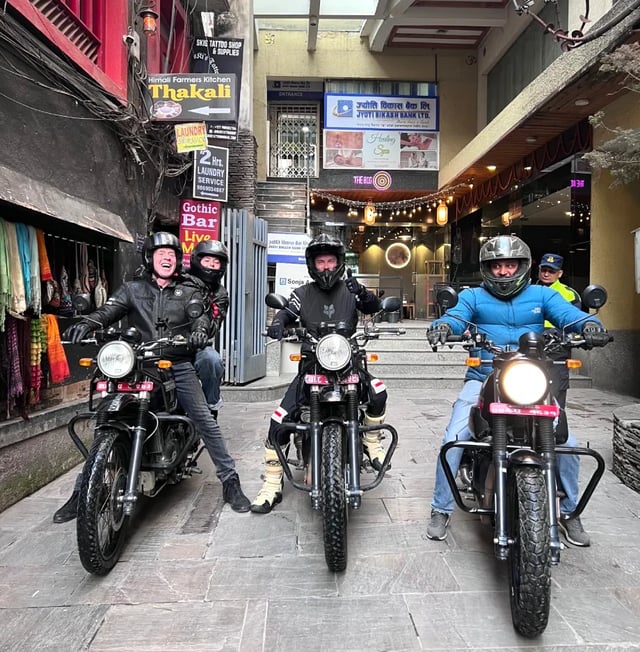
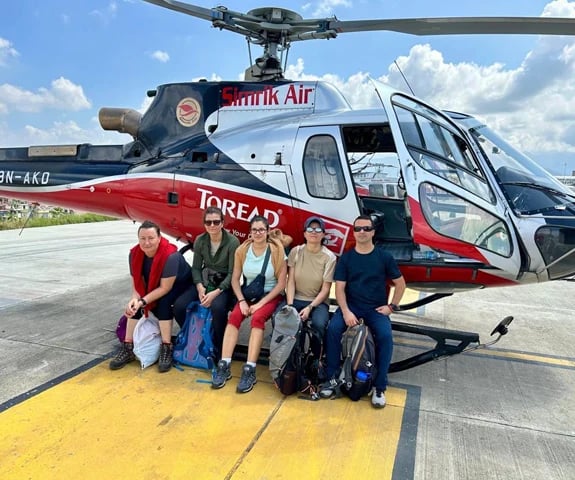
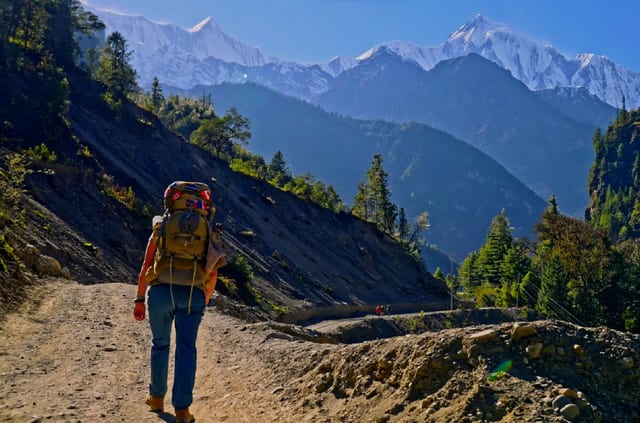
You'll travel with a Kathmandu-based team that plans treks, peak climbs, helicopter flights, motorbike journeys, and cultural trips across Nepal, Tibet, and Bhutan. Routes range from classic teahouse walks and high passes to luxury lodge itineraries and longer expedition-style climbs, with departures shaped around how you want to pace the mountains.
Licensed guides and office staff train regularly on mountain safety and guest care. Porters are insured, fairly paid, and equipped for the trail, with sensible load limits on lodge routes. We work with remote communities through sustainable tourism, including support for education in village areas, so your booking helps local people as well as your own adventure.
Operated by Himalayan Adventure Treks & Tours, a partner of adventuro.
Bagmati Province, Nepal
From $7000