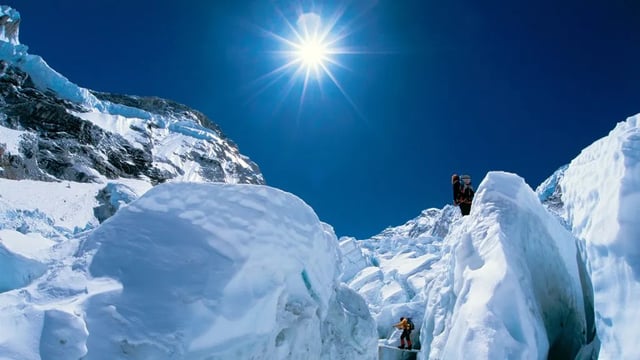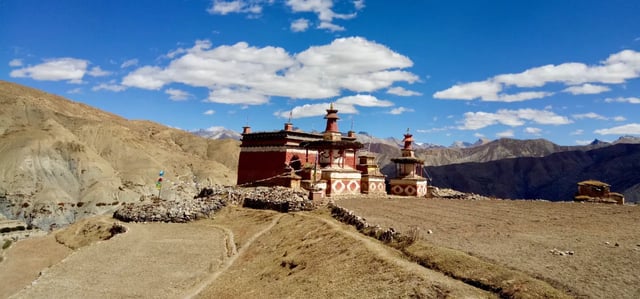
A restricted-area itinerary joins the Manaslu Circuit with Nar and Phu, crossing the Larkya La and the remote Nar Phu valleys under Kang Guru and Pisang Peak. You need extra permits and a licensed crew from the start in Kathmandu. Nar’s fortress lanes, Phu’s chortens, and Larkya La in one permit set is the remote circuit guests ask for.
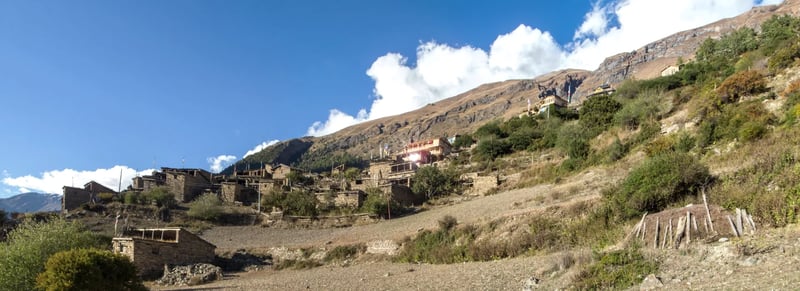
Tibetan-style villages, monasteries, and long jeep approaches set the tone. Teahouses are simpler than on busier trails; pass days are long and cold, with descent toward Besisahar or Dharapani. Kang Guru, Tibetan villages, and a long jeep approach make this feel far from the main Annapurna road.
A share of our profits helps village school students in remote Nepal, including valleys like the ones you'll walk from Machha Khola through Jagat, Deng, and Namrung to Sama Gaon. We'll arrange the restricted Manaslu permit, ACAP, and TIMS in Kathmandu before the private drive to the trailhead.
Your guide paces Larkya La from Larke Phedi to Bhimtang, then leads the Nar Phu side through Koto, Meta, Phu, and Nar before Kang La into Ngawal and Pisang. We'll keep daily updates from those side-valley nights when the phone signal thins.
Your Manaslu with Nar Phu Valley Trek starts when you land at Tribhuvan International Airport in Kathmandu. One of the representatives of the our team will receive you and take you to their hotel in the centre of the city. After checking in, you are free to either sleep or go to the busy streets of Thamel to explore the local market.
In the evening and be introduced to your trek guide, who will give you a brief of the adventure. Have a good night to be prepared for the journey into the Himalayas.
The day will be devoted to the cultural tour of Kathmandu and preparation for the trek. In the morning, you are taken on a guided tour of some of the UNESCO World Heritage Sites, the Monkey Temple (Swayambhunath Stupa) with its amazing views of the city, the holiest Hindu temple in Nepal (Pashupatinath Temple), the largest Buddhist stupa in the world (Boudhanath Stupa), and the former royal palace complex (Kathmandu Durbar Square). This is an interactive tour that provides knowledge of the rich history, architecture, and spiritual culture of Nepal.
Then you can spend time on trek preparations. You can purchase or hire the required equipment and pack your bags. You will have your guide check your permits and equipment.
Send in early tonight to tomorrow we drive to the trailhead.
We start early in the morning with breakfast in Kathmandu before proceeding in a private jeep to the West of Kathmandu on the Prithvi highway and into Gorkha. This is a scenic drive, though long, along rivers such as the Trishuli and the Budhi Gandaki, over terraced fields and hill-top villages. The tarmac road ends at a jeep trail past Arughat.
Towards the end of the afternoon, we reach Machha Khola (870 m), a little town on the banks of the Budhi Gandaki River. This is where we begin our hike. We settle into a simple lodge.
We start trekking on footfrom tomorrow morning.
The day of our initial trekking is along the Budhi Gandaki River upstream through a fertile subtropical land. The path ascends and descends in a mild way, going over a few ravines via long suspension bridges. We pass through the small villages and the riverside hot springs of Tatopani.
The road passes over a canopied valley and falls on the cliffs on the opposite side of the river. Lunch is followed by a stone staircase and a side route via a hillside to Jagat (1, 340 m). The official checkpoint of the Manaslu Conservation Area and the registration of our permits is at Jagat, a well-maintained village, paved with stones.
Overnight in a local lodge.
We pass Jagat and go down a narrow pass on the Budhi Gandaki. The path leads to Salleri and down to Sirdibas, where prayer flags of every colour indicate the increase of the Buddhist presence. We pass on to Philim (1,590 m), a large village made up of terraced fields.
Beyond Philim, the valley narrows into an exciting ravine. We cross a long suspension bridge and then walk a long way above the river, then cross to the east bank. The last strenuous climb is Deng (1,860 M), which is a small village where we enter the Nubri valley.
We camp in a primitive lodge, where we have all the tranquillity of a desert place.
We leave Deng after breakfast, and we cross the Budhi Gandaki again and slowly climb a steep bank of thick woods. The trail is going through small settlements where Gurung culture is mixed with new developing Buddhist traditions, with mani walls and chortens.
We have lunch at Ghap (2,160 m) and climb steadily with pine and rhododendron forests, here and there seeing grey langur monkeys in the trees. Towards the end of the afternoon, we arrive at Namrung (2,900 m), a stone-enclosed checkpoint village where there are several lodges.
In case of clear weather, one can see Ganesh Himal and Shringi Himal. We get ourselves into a teahouse and rest most delightfully.
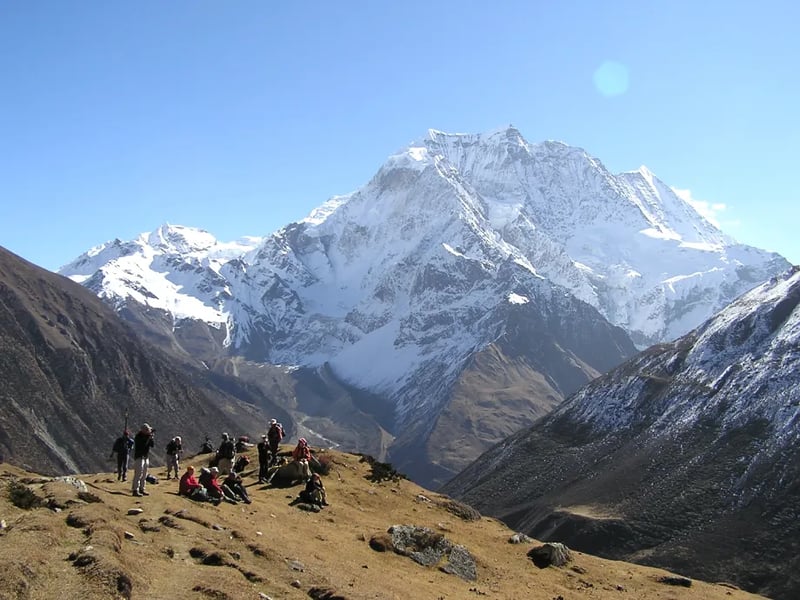
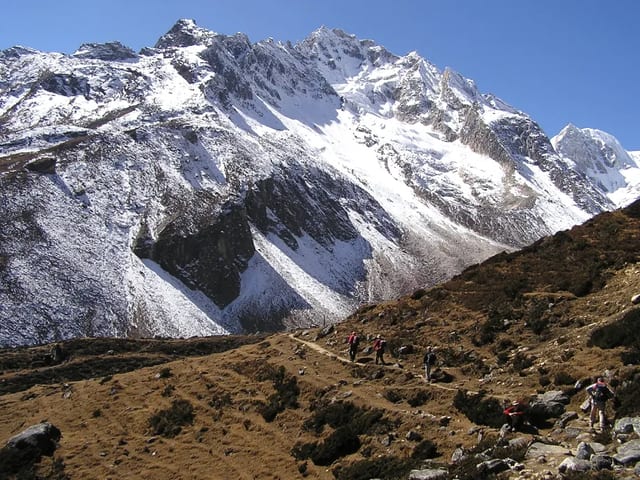
The current day hike is one of the most picturesque days since we are headed towards Mt. Manaslu. The path runs out of Namrung, up to the village of Lho (3,180 m), where we are granted our first sight of a spectacular view of Manaslu soaring far above.
The hilltop monastery of Lho is a good place to take a short tea break, gazing at the mountain. Then we go into woody paths till we reach Shyala (3520 m), a broad open valley between trees, with high mountains all around. Shyala is a small village, and we walk through some of the pastures before arriving at Sama Gaon (3,390 m), the principal village of the upper Nubri Valley.
This is a conventional Tibetan-style village that is located at the foot of the north face of Manaslu. Here we have two nights of acclimatisation time to spend in monasteries, village life, and superb mountain scenery.
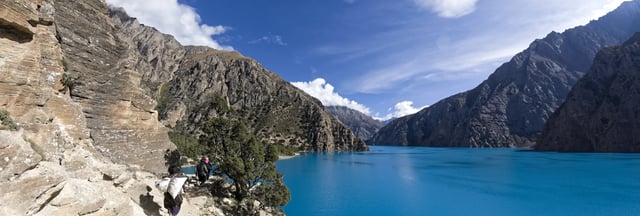
In order to facilitate the acclimatisation, we take a rest day at Sama Gaon and have a few exploration alternatives. An increase in elevation to a mild rise brings a glacial lake named Birendra Tal that is a calm glacial lake supplied with icefalls of Manaslu. More adventurous trekkers can walk to part way to Manaslu Base Camp (4800m) to have spectacular glacier and mountain views.
Pungyen Gompa, or the village monastery, is also an option to gain local spirituality. People who want to spend their day in a leisurely manner are able to enjoy the village life, butter tea, and mountain views. Keep hydrated and do not overstrain oneself to the aim is adequate altitude acclimatisation.
We spend the second night at Sama Gaon.
We get into the valley rejuvenated and move away from Sama Gaon. The path goes down to the Budhi Gandaki and up into the yak pastures and juniper scrub.
It has mountain panoramas and is a pleasant little stroll. About four hours later, we arrive at Samdo (3,690 m), which is the last permanent village before Larkya La and near the Tibet border.
Having registered in a plain lodge, there is time to make a light acclimatisation walk or to explore the village. This free afternoon makes your body ready to start the high pass ahead.
Today, we have a brief acclimatisation walk before getting across Larkya La. Out of Samdo we pass down at a small bridge, and back again up a sterile valley, by a slow, gradual way, which is entirely barren.
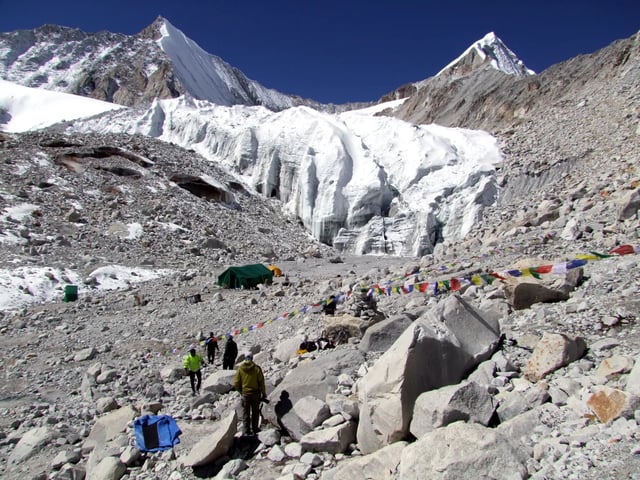
The path takes through tundra, moraines, and some herder shelters, and has the opportunity to see the blue sheep on the cliffs. By noon, after 3-4 hours, we arrive at Dharamsala (Larke Phedi, 4,460 m).
The afternoon will be spent on rest, hydration, and acclimatisation. We have an early dinner and sleep well, preparing to cross the pass at pre-dawn tomorrow.
Our day begins at about 4.00 am, when we cross Larkya La (5,160 m) before the strong winds arrive. Gazing at the sky by the headlamps and amid the stars, we start the great and gradual ascent through the rocky moraines and glacial land. With the dawn, the Himalayan mountains are dramatic as they receive the morning light.
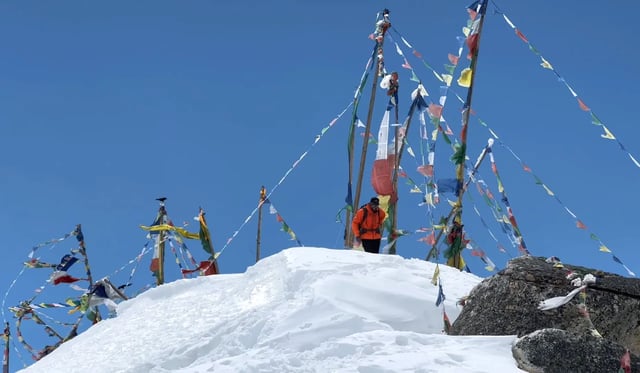
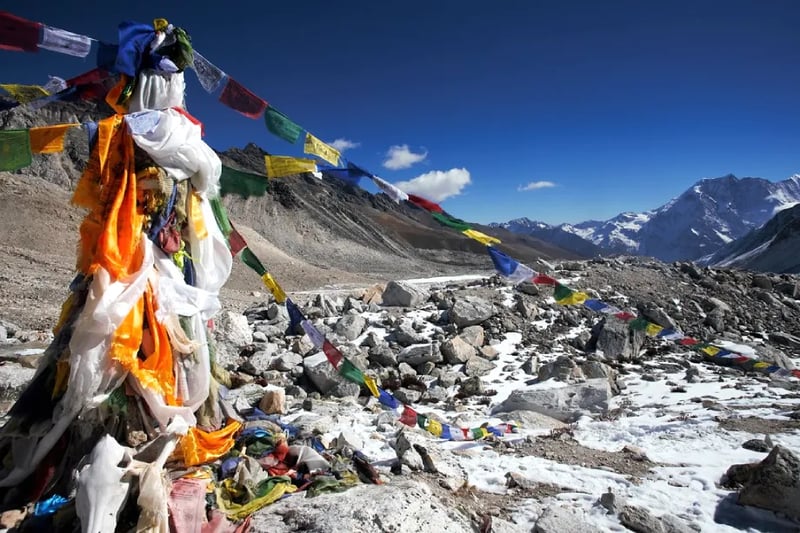
With persevering mountaineering, we arrive on the Larkya La peak, with prayer flags and a landmark, which is the top of the Manaslu with Nar Phu Valley Trek. Here, panoramic mountain sceneries run back from Mt. Manaslu and Himlung Himal up to Annapurna.
We then take a few photos and then climb down, taking great care over the scree and the snow that might have fallen. The scenery becomes softened slowly to grassy fields. Mid-afternoon, we reach Bhimtang (3,590 m), a lovely pasture valley, with excellent views of mountains, and we sleep and celebrate this big milestone.
It takes us all day to overcome the pass, during which time we are treated to the alternating scenery. The path, leaving Bhimtang, plunges into the Dudh Kholathrough the gloomy rhododendron and pine forests. The farther we descend in altitude, the more the air grows warm and rich, and it is a relief after the high alpine landscape.
Passing Yak Kharka and a small village, Karche (2,700 m), we see the terraced fields and the farm animals once again. Passing on to Gho and Tilje, we are indicated by prayer wheels and chortens that we are back in settled villages. By mid-afternoon, we arrive at Dharapani (1,860 m), the meeting point of the Manaslu Circuit and the Annapurna Circuit.
We check into the lodge and celebrate the accomplishment of our Manaslu part of the trek.
We again would be joining the Annapurna Circuit, walking downstream along the Marsyangdi River, from Dharapani to Koto, most likely via a dirt road. On entering the Manang area, we pass by Bagarchhap and the Danaque mani walls and a white stupa.
The skyline is soon taken over by Annapurna II and Annapurna IV. Another steep and short climb is to Timang (2,720 m), where Manaslu can be seen behind and Annapurna II in front.
Then we go down the pine forests to Koto (2,600 m) by the early afternoon. We head to this small Gurung village and get our Nar Phu permits before getting down to a teahouse, awaiting our departure to the remote valleys the following day.
There we are, leaving the great Annapurna Circuit today and starting the wilderness of Nar Phu in the remote wilderness. It tracks a long, narrow gully down the Nar Khola, penetrating through shaded pine woods, with the river raging miles beneath.
We pass over suspension bridges and have to walk on dramatic cliffside trails until we reach Dharamsala (3,230 m), where we eat lunch. It is at this point that a long and gradual ascent starts as the trees become thinner and the scenery more open.
Towards the end of the afternoon, we reach Meta (3,560 m), a small pastoral plateau, a few simple lodges, and a spectacular mountain landscape. It is anisolatedstop, actually, the beginning of our journey out of the trail.
We go further into the obscure Phu Valley, walking across extensive, desert-like landscapes and past ruins, which were the old, seasonal settlement camps of Jhunam and Chyaku. The trail is framed by white cliffs and far snow peaks on our way down to the river and onto a suspension bridge.
Up a sharp zigzag path brings us to the chortens of the Phu Gate, the entrance to this remote valley. Next, we see the stronghold village of Phu Gaon (4,080 m), which stands over the river.
We reach when it is mid-afternoon, and lodge in a lodge. The remaining day is left to research the narrow lanes and special Tibetan-inspired culture of Phu Valley.
This is a rest and exploration day in Phu, which can be used to acclimatise and immerse in the culture. We then climb for 45 minutes in the morning, after breakfast, to Tashi Lhakhang Monastery, which is a great pilgrimage place with a view of the whole valley and Phu village. We can greet the monks and be blessed on the way we are going.
The rest of the day after rejoining Phu is at leisure, possibly to visit old ruins of forts, caves, or to go to the river to see grazing yaks. Mingle with the locals and get to know their customs and trade paths.
We depart with Phu after breakfast and come down a little way towards Meta, before splitting off to Nar. On passing a bridge, the path starts a strenuous uphill run across a high ridge (approximately 5,300 m), which is the boundary between the Phu and Nar valleys. We climb at a steady pace up the steep ground, making a gradual slowness of Phu as he is slowly lost behind us, and the scenery more and more widens and magnifies itself.
In a few hours, we will be on the top of the ridge with prayer flags and cairns. Here, the scenery is on the back towards the Phu Valley and the front, over the Nar Valley. We then proceed very slowly on loose gravel and pass through grazing-lands by a little brook.
By the evening, when we come to Nar Village (4,200 m), find a teahouse and have a good rest after a hard but successful day.
Today is an acclimatisation and rest day in the picturesque village of Nar. Make a lazy morning of wandering through the paved lanes of the town, watching people spinning wool, watching them herd animals, and keeping up old stone-built houses.
Villagers are all very friendly and accommodating, and you can be offered Tibetan tea or local barley beer (chang). You might easily walk some distance to a nearby ridge and have panoramic views of Nar and other snow peaks around, or pay a visit to Nar Pulgon Chua Monastery right below the village.
Stick to light activities because Nar is above 4000 m, and before passing Kang La Pass tomorrow, it is necessary to rest. We spend the second night in Nar, and we drink in its own culture and hospitality.
Our last and most dramatic pass across is an early start that we make at Nar. As we pass by the headlamp in the silent valley, we slowly climb up Kang La (5,306 m).
The ascent is extensive yet gradual. And after hours, we are up on the summit of the prayer flags, and before us is an awe-inspiring view of the Annapurna range of Annapurna II, Annapurna IV, Gangapurna, and Tilicho Peak looming over the horizon, and the Marsyangdi Valley down below us.
Once we have partaken of a feast and made pictures, we start on a lengthy descent, at first steep, then growing lax in alpine scenery. By the afternoon, we are back on the Annapurna Circuit and relaxing in comfort in a warm lodge at Ngawal (3,660 m).
The walk of today is brief and easy, after many more adventurous days. Out of Ngawal, we are on a well-beaten track of the Annapurna Circuit, with an easy slope of pine woodland and terraced fields. We cross the lovely village of Ghyaru on top of the ridge and then start a series of switchbacks with the Annapurna range constantly being in sight.
As the altitude decreases, we have warm air and get more villages, chortens, and agricultural lands. At the end of the morning, we reach Lower Pisang (3,200 m), where our journey comes to an end. Free afternoon after lunch, either walk up to Upper Pisang and see the monastery, or spend the time at the lodge.
We stay the night at Pisang, where we sleep very comfortably at this lower altitude.
This morning we parted with the high Himalayas and started on the long, though picturesque journey back to Kathmandu. Then, we make our way by the 4×4 jeep that is privately operated by Pisang and go down the Marsyangdi Valley passing the villages which we are familiar with, such as Chame and Dharapani.
Whereas walking used to take days, driving takes only hours. At noon, we arrive at Besisahar (760 m) and change to a private vehicle, which is comfortable on the highway.
After the rivers and the moderate hills, we reach Kathmandu towards the end of the day. Having spent a night in your hotel, we have a special farewell dinner and have an trek in Manaslu and Nar Phu.
This is the time to say goodbye (at least to Nepal). Whether you have time to do last-minute shopping for some souvenirs or to take a leisurely walk in Thamel depends on your time in Kathmandu and the time at which you are flying. We will also organise your transportation to the airport located at Tribhuvan International Airport and ensure your departure on time.
We will even have one of our members send you off with a warm saying of Namaste and Dhanyabad. You come home full of indelible recollections of high passes, hidden valleys, and the sincerity of the people of the Himalayas. It is good to see you have trekked with our team.
Goodbye, and we hope to see you again. Pheri bhetaula to see you again!
Fly into Tribhuvan International Airport in Kathmandu unless the itinerary uses another regional hub. Airport or hotel pickup can be arranged when you share arrival details ahead of travel.
Briefings cover road or domestic travel to the trailhead. Build buffer time before onward international flights in case mountain weather shifts the schedule.
Twin or double rooms in a comfortable Kathmandu hotel cover your first nights and your return from the trail, with breakfast on those city stays when included in the package. Briefings happen at the hotel, and airport collection from Tribhuvan is available when flight times are shared in advance.
Family-run teahouses or lodges line the route with twin beds and a shared dining room. Rooms get simpler and colder as you climb, with shared bathrooms common at higher villages. Hot water, Wi-Fi, and charging are paid at the lodge when offered.
March to May rhododendron bloom and October to November crisp air are peak windows for this itinerary. July and August mean leeches and cloud on lower slopes; December to February can ice steps above village level.
Your guide reads the forecast before long cols or sunrise hikes. Shoulder weeks need an honest weather call before high passes or dawn viewpoints.
You should be comfortable walking several hours a day on uneven paths with a daypack, including steady uphill sections as you gain height. Hill training and longer weekend walks in the months before travel help your legs and lungs on uphill trail days.
Hill training, stair climbing, and longer weekend hikes in the months before travel help your legs and lungs, even when acclimatisation days are built into the route. Break in boots before you fly and carry a light daypack on practice walks.
Guided trekking with licensed leaders, lodge nights on the trail, meals as described for walking days, and permits for the regions crossed are included when they are part of this trip. Domestic flights, porters, and airport transfers apply only when they are part of this trip.
Domestic flights, road transfers, porter support, and airport transfers apply only when they are part of this trip. Permits for the regions you cross are arranged in Kathmandu or Pokhara when included.
International flights to Nepal, visa fees, compulsory travel insurance, personal trekking clothing, snacks and drinks outside included meals, and tips for crew are not covered. Hot showers, Wi-Fi, and battery charging in lodges are usually paid locally when offered.
Charges for hot showers, Wi-Fi, or battery charging in lodges are paid locally when offered unless your trip notes say otherwise. International flights, visa fees, and personal insurance stay outside the trek package.
Share your Tribhuvan arrival time ahead of travel for a Thamel hotel transfer, or make your own way to the meeting hotel in the capital. Thamel hotels are the usual meet point; drivers need flight numbers to meet you at the international terminal.
Briefings cover Lukla bag weight, porter duffle limits, and what to wear on the mountain flight. Weather can shift daily plans, so your guide keeps a steady pace with regular breaks.
Guides set a steady pace and watch for headache, nausea, or dizziness as you gain height. Trail conditions are checked each morning before the group moves.
Tell your guide early if symptoms appear so tomorrow's stage can shorten or descent can start before conditions worsen. Your crew would rather wait for a safe window than rush marginal weather.
Jeep or bus days to the remote trailhead are arranged when they are part of your package. Your guide confirms departure times at briefing.
Motion sickness medicine helps on winding mountain roads. Allow a little extra time after the trek before international flights home in case mountain roads or flights move.
National park or restricted-area permits apply depending on the valleys you cross. The team arranges paperwork in Kathmandu or Pokhara when you provide passport copies and trek dates.
Keep copies in your daypack for checkpoint stops. Monsoon cloud sits lower on the hills while winter brings ice on steps above village level.
Families join when children can manage the daily hours and terrain on this specific route. Pace and daily hours can be adjusted on private departures, though that may extend the calendar.
Ask our Kathmandu team if you are planning with younger walkers. Private departures can shorten daily hours, though that may add a day or two to the calendar.
Comprehensive travel insurance that covers trekking to the highest altitude on your itinerary, medical evacuation, and helicopter rescue when applicable is essential. Many standard policies exclude high altitude by name.
Read the wording before you travel so you can adjust cover if trekking above 5,000 metres is not named. Many standard policies exclude high altitude by name, so read the wording before you fly.
We partner with Rewilding Britain to help protect our natural spaces for future adventures.
All centres are vetted for safety and quality. Your adventure is in good hands with adventuro.
About the centre
Kathmandu
You'll travel with a Kathmandu-based team that plans treks, peak climbs, helicopter flights, motorbike journeys, and cultural trips across Nepal, Tibet, and Bhutan. Routes range from classic teahouse walks and high passes to luxury lodge itineraries and longer expedition-style climbs, with departures shaped around how you want to pace the mountains.
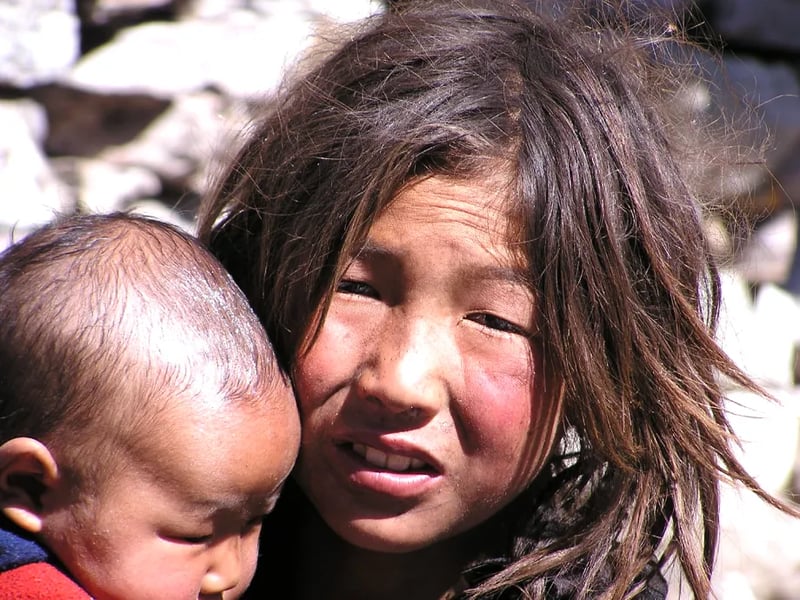
Licensed guides and office staff train regularly on mountain safety and guest care. Porters are insured, fairly paid, and equipped for the trail, with sensible load limits on lodge routes. We work with remote communities through sustainable tourism, including support for education in village areas, so your booking helps local people as well as your own adventure.
Operated by Himalayan Adventure Treks & Tours, a partner of adventuro.