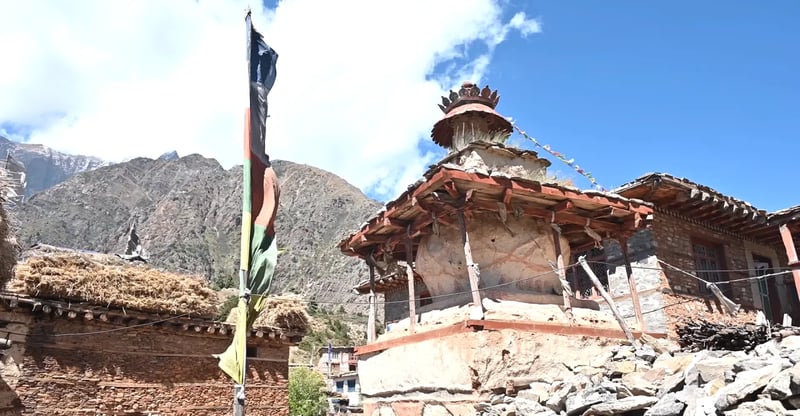
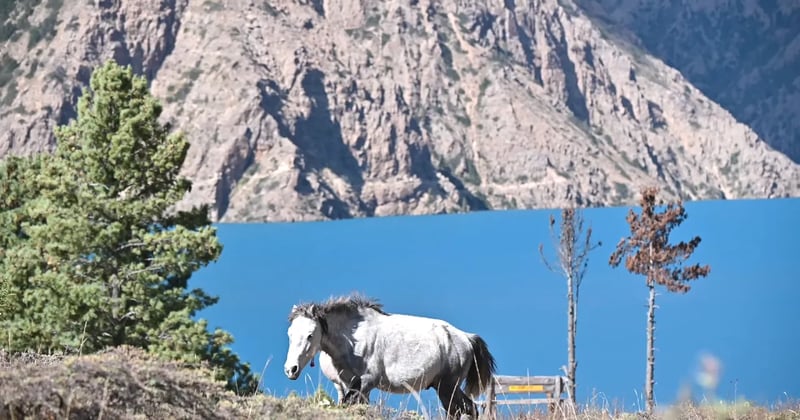
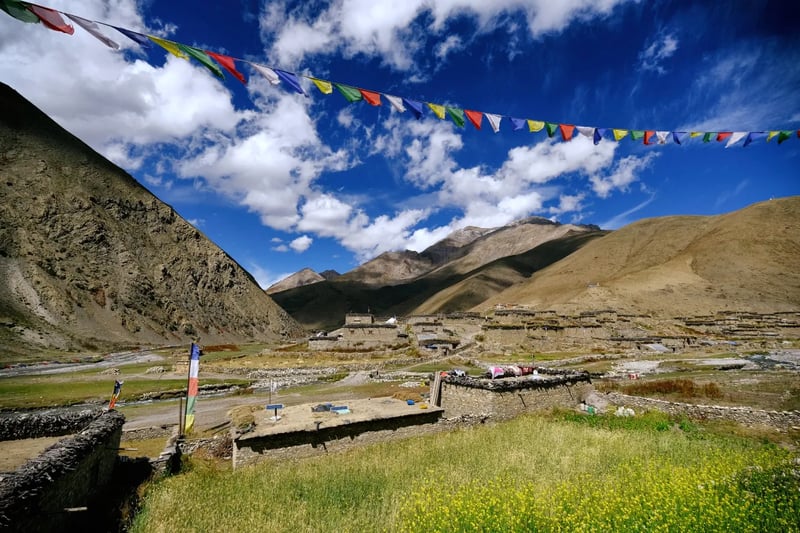
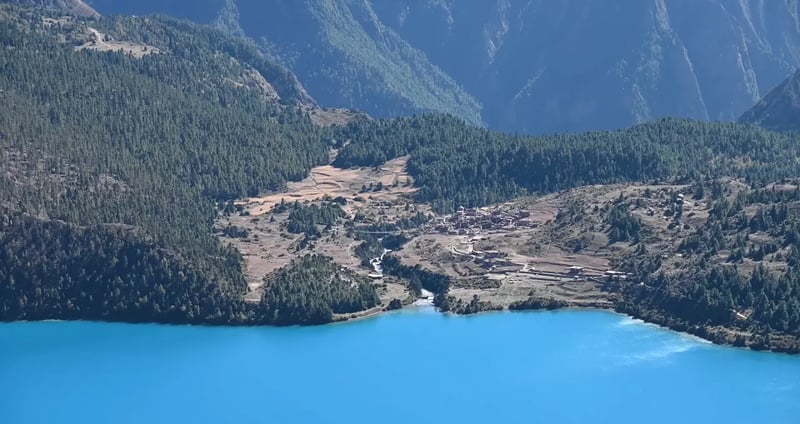
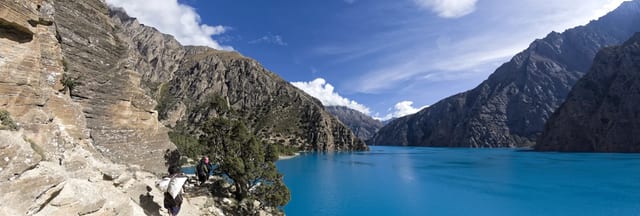
Lower Dolpo walks from Juphal or Dunai toward Phoksundo Lake, a deep turquoise lake under Kanjirowa. You cross passes into Bon and Buddhist villages with camping or simple lodges. Phoksundo’s deep turquoise water and Ringmo village under Kanjirowa are the Lower Dolpo postcard.
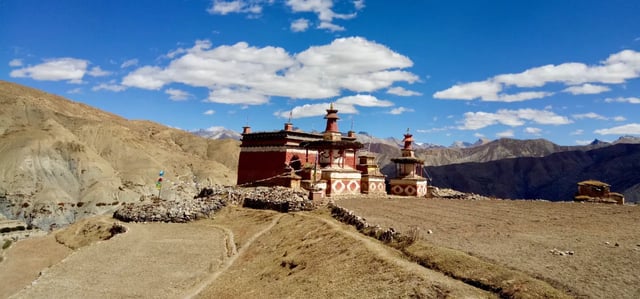
Ringmo, the lake shore, and remote ridges are the heart of the trip. Flights to Nepalgunj and Juphal bookend the wilderness week. Bon chortens above the lake and kitchen tents when lodges fill sit after the Juphal walk-in.
We'll choose a guide licensed through MOCTCA and NATHM who knows Dunai, Dho Tarap, and the Ringmo shoreline, and who has trained on altitude illness before Numa La and Baga La. You'll fly Kathmandu to Nepalgunj and on to Juphal with restricted Dolpo paperwork already in hand.
Our Kathmandu office books the lake night at Phoksundo so Ringmo is not left to chance after the two pass days. We'll share the next camp or lodge plan every evening, and your guide would rather add a rest in Dho Tarap than stack those cols without a buffer.
Day 1 of the Lower Dolpo Trek starts when your flight lands at Tribhuvan International Airport in Kathmandu. You move through immigration processing in about 60 minutes using Nepal's visa-on-arrival procedure. You require two passport photos and USD cash for visa fees.
Pay $30 for a 15-day visa or $50 for 30 days, as the Nepal government rates confirm. Collect your luggage and find our rep waiting in the arrivals hall holding your name sign. We drive you 5 kilometers to Thamel, Kathmandu’s trekking district.
The transfer takes 20 minutes through busy city streets.
Day 2 begins at 7:30 a. When you meet our team at your Thamel hotel entrance. We discuss today’s 8-kilometer walking route through UNESCO World Heritage Sites.
You wear sturdy shoes as Kathmandu’s stone paths demand light footing. You climb 365 steps to the Swayambhunath Stupa before 9 a. This fifth-century hilltop complex sits around 100 meters above the valley elevation.
You circle the white dome clockwise, touching prayer wheels. We explain the proper stupa circumambulation technique requiring three full rotations.
Day 3 starts at 9:30 a. When you leave your Thamel hotel for Tribhuvan International Airport. You travel 5 kilometers in a pre-arranged vehicle included in the Lower Dolpo Trek package.
Domestic terminals open 90 minutes before departure per CAAN regulations. You present your ticket and passport at the check-in counter. Baggage allowance totals 20 kilograms, including 5 kilograms for carry-on.
Flight duration lasts 75 minutes with cruising altitude at around 15,000 feet. You descend through the Terai region, observing rice paddies and irrigation canals below. Nepalgunj Airport sits at 150 meters.
The 4th day of the Lower Dolpo Trek begins before dawn, with our team meeting you at your Nepalgunj hotel. Mountain flights operate only in early morning hours, so we move fast. You feel the cool night air as we drive toward the airport.
Our guide might share stories while en route. We have even rerouted clients through alternative trails after flight cancellations due to bad weather. Flexibility saves trips when the weather intervenes.
You learn this region demands respect for nature’s schedule, not ours. At the airport, we handle your permits and baggage efficiently. You board the Twin Otter plane feeling secure with experienced pilots.
The next day starts at 6:15 a. With hot ginger tea in your Dunai room. You pack your daypack while checking water levels.
We confirm your oxygen saturation reads 90 to 96 percent using our pulse oximeter. This measurement meets Himalayan Rescue Association safety thresholds for today’s descent. The trail leaves Dunai village heading east along the Thuli Bheri River.
You walk 15 kilometers today with 305 meters of net elevation loss. River width narrows to 10 meters here. Trail surfaces shift between packed earth and river-smoothed stones, requiring careful foot placement.
The following day of the Lower Dolpo Trek starts with a gear inspection at a guesthouse at 5:55 a. We adjust your backpack strap for optimal breathing during ascent. Oxygen intake increases a certain percent with proper torso alignment. You ascend 625 meters over 14 kilometers through juniper forest corridors.
Trail gradients average 14 percent on the initial 2.5-kilometer climb above Tarakot. Juniper trees measure 3 to 5 meters tall. You identify Rhododendron trees once again at 2,800 meters. M., you navigate the first mani wall sequence.
Each stone structure contains 180 to 220 carved slats. Trail markers shift to red prayer flags where forest cover obscures painted blazes.
The 7th day of the Lower Dolpo Trek begins at 6:45 a. When you adjust your headlamp for the pre-dawn trail departure. We need you to verify your hydration status with urine color charts, matching standards.
Clear to pale yellow indicates proper fluid intake before ascending. The trail climbs steadily from Laini’s stone houses through terraced barley fields. You cover 10 kilometers today, gaining 375 meters of elevation to reach Nawarpani.
Rocky sections require precise foot placement on limestone fragments common in Dolpo’s arid landscape.
On the 8th day of the Lower Dolpo Trek, the trail demands immediate focus as you start the trek at 6:20 a. From Nawarpani. Your body processes oxygen at 80 percent efficiency compared to sea level at 3,545 meters elevation. You traverse 13.2 kilometers across Dolpo’s high desert plateau today.
Elevation gain totals 1,445 meters, reaching Dho Tarap’s 4,990-meter mark. Trail surfaces shift from packed earth to exposed bedrock, requiring ankle-stabilizing movements. You cross the first high-altitude stream at 10:10 a. Water temperature registers 4°C based on our digital thermometer.
We test each step using trekking poles before full weight transfer on makeshift bridges. Lunch occurs at 1:00 p. Near the village of Tshowa.
Day 9 of the Lower Dolpo Trek requires complete rest at Dho Tarap’s 4,990-meter elevation. Your blood carries 35 percent less oxygen here than at sea level.
We measure your resting heart rate at 78 beats per minute during 7:00 a. Rates above 85 necessitate additional rest.
You perform controlled movement exercises on flat ground near your guesthouse. Complete three sets of 10-minute walks at a 1.5 kilometers per hour pace.
Day 10 of the Lower Dolpo Trek requires precise trail navigation as you descend from Dho Tarap’s stone houses at 4:50 a. Trail conditions demand immediate attention: loose scree covers 60 percent of today’s 12.3-kilometer route to Numa La Base Camp. You lose 550 meters of elevation descending into the Numa Valley.
Griddy rocks create unstable footing with pebbles shifting under each step. We move in a single file using trekking poles horizontally for balance.
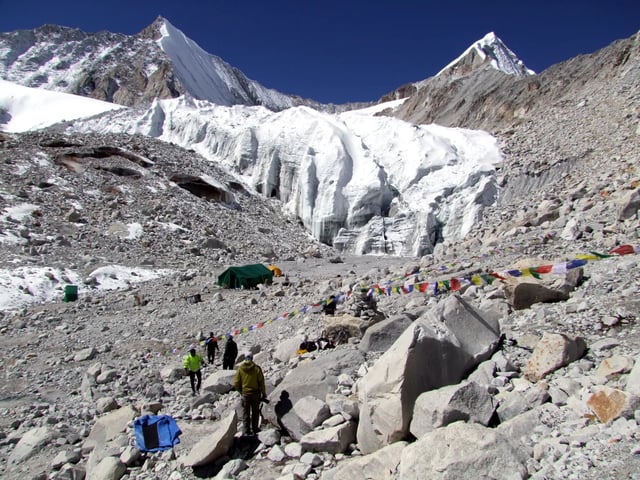
The following day of the Lower Dolpo Trek starts at 4:15 a. When we secure crampons to your boots for chilly trail sections. We distribute iodine tablets for immediate water treatment during the ascent. You climb 750 meters vertically over 3.8 kilometers to Numa La Pass.
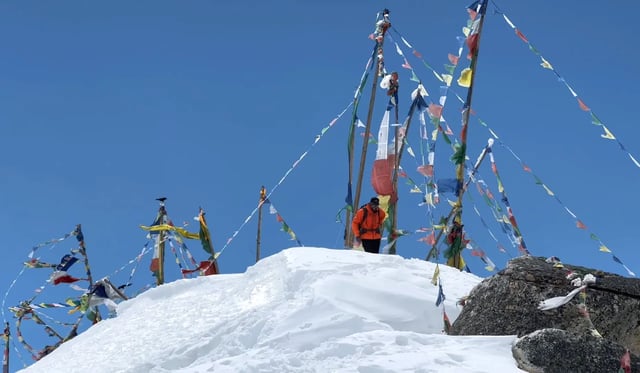
Trail surfaces shift from packed dirt trails to loose rocks. Stream bridges span 1.2-meter-wide gaps. You reach Numa La Pass summit at 8:25 a. Elevation confirms 5,190 meters as wind chill registers -12°C.
You perform a mandatory 20-minute rest with high-calorie snacks. The descent begins immediately after summit photography. You lose 745 meters of elevation over 5.2 kilometers to Pelung Tang.
The 12th day of the Lower Dolpo Trek demands immediate snow assessment as pre-dawn light reveals trail conditions at 4:00 a. You ascend 630 meters vertically over 4.1 kilometers to the Baga La Pass summit.
Trail gradients peak at 37 percent on the final 800-meter approach above 4,900 meters. M., you navigate steep trails on the pass’s north face.
Summit arrival occurs at 8:10 a. At precisely 5,070 meters elevation.
Day 13 of the Lower Dolpo Trek begins with a trail assessment at Dajok Tang’s stone courtyard at 5:50 a. We check your knee braces for proper tension before the descent. Joint stress increases significantly during downhill walking.
You descend 480 meters over 12.5 kilometers to Ringmo’s lakeside settlement. Loose shale covers 70 percent of this section, requiring controlled heel braking with each step.
Morning light reveals Phoksundo Lake’s turquoise waters at 3612 meters. Your boots touch the lakeshore by 7:00 a. To avoid afternoon winds. Glacial minerals create this distinctive color visible from 2 kilometers away.
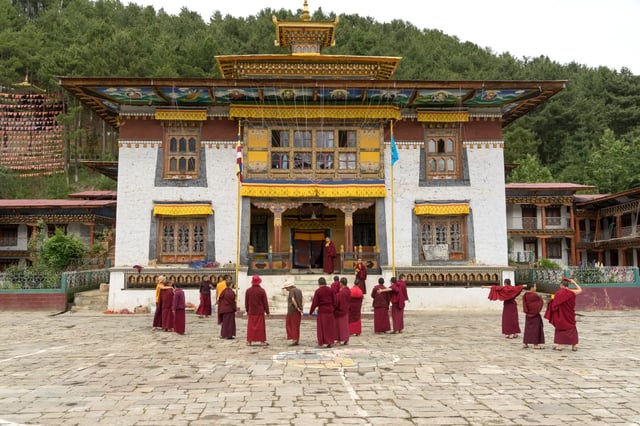
We follow the eastern shoreline trail for 3.2 kilometers round-trip. Loose stones cover 40 percent of the path. M., you reach Bon Po Monastery’s ancient stone steps. The 12th-century structure features 1.8-meter-thick walls built without mortar.
Monks perform water offering rituals using copper vessels filled from the lake. Each offering requires three clockwise circumambulations as per Bon religious texts.
The following day of the Lower Dolpo Trek requires knee brace adjustment at Ringmo Guesthouse before trail departure at 6:00 a. You descend 1,080 meters over 14.3 kilometers through Phoksundo Valley. M., you navigate the first Thuli Bheri River tributary crossing.
Water depth measures 35 centimeters. Lunch occurs at 12:40 p. Near Lamjin village.
You consume dal bhat with dried pickles. The final approach follows terraced barley fields carved into valley walls.
Day 16 starts with a trail inspection at Shyanta Guesthouse at 5:45 a. You cover 13.8 kilometers descending 55 meters net elevation to Juphal. The Thuli Bheri River width expands to 80 meters.
At around 10 in the morning. You observe traditional fishing methods in the river. Villagers use bamboo traps measuring 1.5 meters long with 10-centimeter mesh openings.
Each trap catches 200 to 300 grams of fish daily. Lunch occurs at 12:20 p. M., and you eat vegetable thukpa with dried fish.
Day 17 of the Lower Dolpo Trek requires permit verification at a nearby checkpoint. You transfer to Juphal Airport by 8:10 a. In a pre-arranged vehicle covering 1.2 kilometers.
Check-in completes by 9:40 a. Flight duration lasts 46 minutes, descending from 2,475 meters to Nepalgunj’s 150-meter elevation. You lose 2,325 meters of elevation during this segment, verified by flight logs.
Landing at Nepalgunj Airport happens at around 11 a. Baggage claim completes within minutes of arrival.
The ultimate day of the Lower Dolpo Trek begins with your final wake-up at the hotel at 6:30 a. You verify your flight confirmation number.
Departure gates close 45 minutes before scheduled takeoff per Tribhuvan International Airport regulations. You complete hotel checkout by 7:00 a.
Settle your bill using cash or credit. You can exchange your remaining Nepali currency at a 130 NPR per dollar exchange rate, which is subject to fluctuations.
Fly into Tribhuvan International Airport in Kathmandu unless the itinerary uses another regional hub. Airport or hotel pickup can be arranged when you share arrival details ahead of travel.
Briefings cover road or domestic travel to the trailhead. Build buffer time before onward international flights in case mountain weather shifts the schedule.
Twin or double rooms in a comfortable Kathmandu hotel cover your first nights and your return from the trail, with breakfast on those city stays when included in the package. Briefings happen at the hotel, and airport collection from Tribhuvan is available when flight times are shared in advance.
Family-run teahouses or lodges line the route with twin beds and a shared dining room. Rooms get simpler and colder as you climb, with shared bathrooms common at higher villages. Hot water, Wi-Fi, and charging are paid at the lodge when offered.
Spring from March to May and autumn from September to November usually bring the clearest views and stable walking conditions on this route. Winter is quieter but colder at altitude, while monsoon months bring cloud and wet trails at lower elevations.
Shoulder weeks need an honest weather call before high passes or dawn viewpoints. Monsoon cloud sits lower on the hills while winter brings ice on steps above village level.
You should be comfortable walking several hours a day on uneven paths with a daypack, including steady uphill sections as you gain height. Hill training and longer weekend walks in the months before travel help your legs and lungs on uphill trail days.
Hill training, stair climbing, and longer weekend hikes in the months before travel help your legs and lungs, even when acclimatisation days are built into the route. Break in boots before you fly and carry a light daypack on practice walks.
Guided trekking with licensed leaders, lodge nights on the trail, meals as described for walking days, and permits for the regions crossed are included when they are part of this trip. Domestic flights, porters, and airport transfers apply only when they are part of this trip.
Domestic flights, road transfers, porter support, and airport transfers apply only when they are part of this trip. Permits for the regions you cross are arranged in Kathmandu or Pokhara when included.
International flights to Nepal, visa fees, compulsory travel insurance, personal trekking clothing, snacks and drinks outside included meals, and tips for crew are not covered. Hot showers, Wi-Fi, and battery charging in lodges are usually paid locally when offered.
Charges for hot showers, Wi-Fi, or battery charging in lodges are paid locally when offered unless your trip notes say otherwise. International flights, visa fees, and personal insurance stay outside the trek package.
Pickup can be arranged from Tribhuvan International Airport or your hotel in Thamel when you share flight times ahead of travel. The pre-trek briefing is usually held at the hotel before the Lukla flight or helicopter sector.
Allow buffer days after the trek in case mountain flights move. Thamel hotels are the usual meet point; drivers need flight numbers to meet you at the international terminal.
Guides set a steady pace and watch for headache, nausea, or dizziness as you gain height. Weather can shift daily plans, so your guide keeps a steady pace with regular breaks.
Tell your guide early if symptoms appear so tomorrow's stage can shorten or descent can start before conditions worsen. Trail conditions are checked each morning before the group moves.
Jeep or bus days to the remote trailhead are arranged when they are part of your package. Your guide confirms departure times at briefing.
Motion sickness medicine helps on winding mountain roads. Your crew would rather wait for a safe window than rush marginal weather.
National park or restricted-area permits apply depending on the valleys you cross. The team arranges paperwork in Kathmandu or Pokhara when you provide passport copies and trek dates.
Keep copies in your daypack for checkpoint stops. Allow a little extra time after the trek before international flights home in case mountain roads or flights move.
Families join when children can manage the daily hours and terrain on this specific route. Pace and daily hours can be adjusted on private departures, though that may extend the calendar.
Ask our Kathmandu team if you are planning with younger walkers. Private departures can shorten daily hours, though that may add a day or two to the calendar.
Comprehensive travel insurance that covers trekking to the highest altitude on your itinerary, medical evacuation, and helicopter rescue when applicable is essential. Many standard policies exclude high altitude by name.
Read the wording before you travel so you can adjust cover if trekking above 5,000 metres is not named. Many standard policies exclude high altitude by name, so read the wording before you fly.
We partner with Rewilding Britain to help protect our natural spaces for future adventures.
All centres are vetted for safety and quality. Your adventure is in good hands with adventuro.

About the centre
Kathmandu
You'll travel with a Kathmandu-based team that plans treks, peak climbs, helicopter flights, motorbike journeys, and cultural trips across Nepal, Tibet, and Bhutan. Routes range from classic teahouse walks and high passes to luxury lodge itineraries and longer expedition-style climbs, with departures shaped around how you want to pace the mountains.
Licensed guides and office staff train regularly on mountain safety and guest care. Porters are insured, fairly paid, and equipped for the trail, with sensible load limits on lodge routes. We work with remote communities through sustainable tourism, including support for education in village areas, so your booking helps local people as well as your own adventure.
Operated by Himalayan Adventure Treks & Tours, a partner of adventuro.