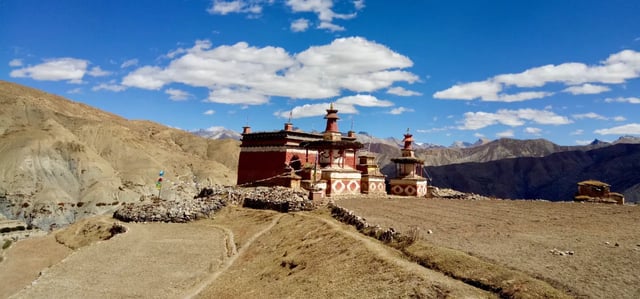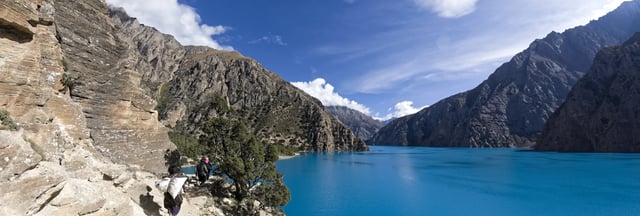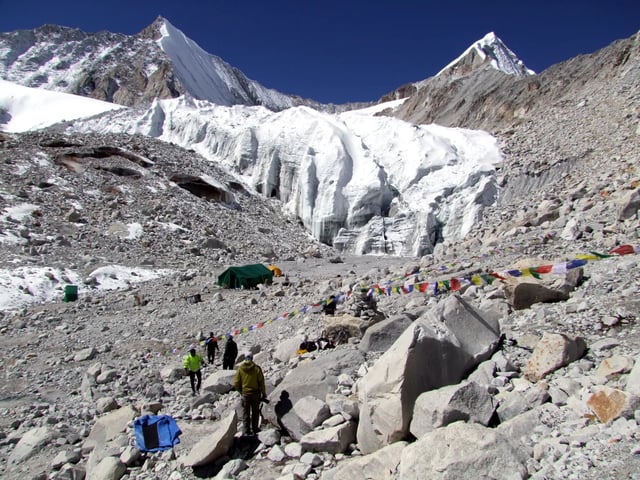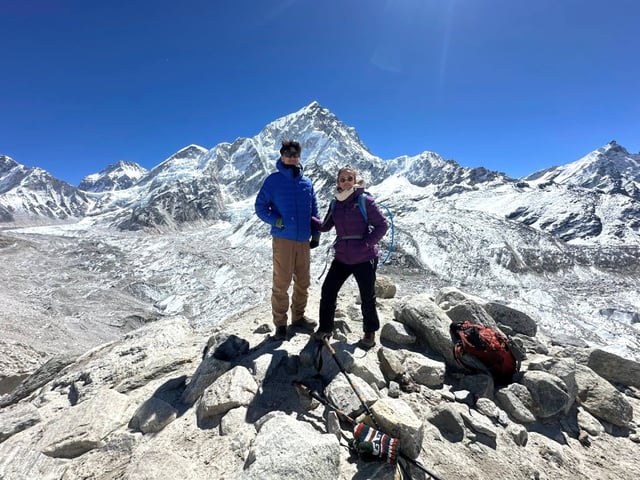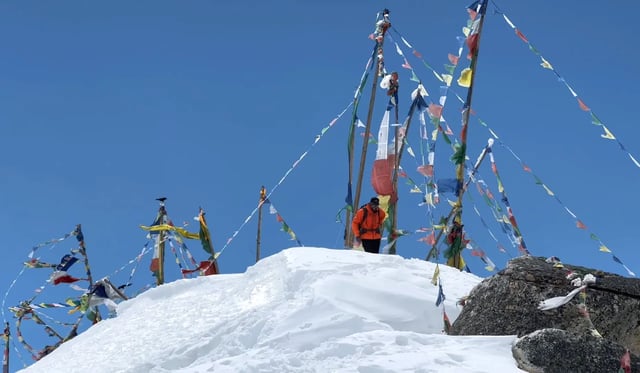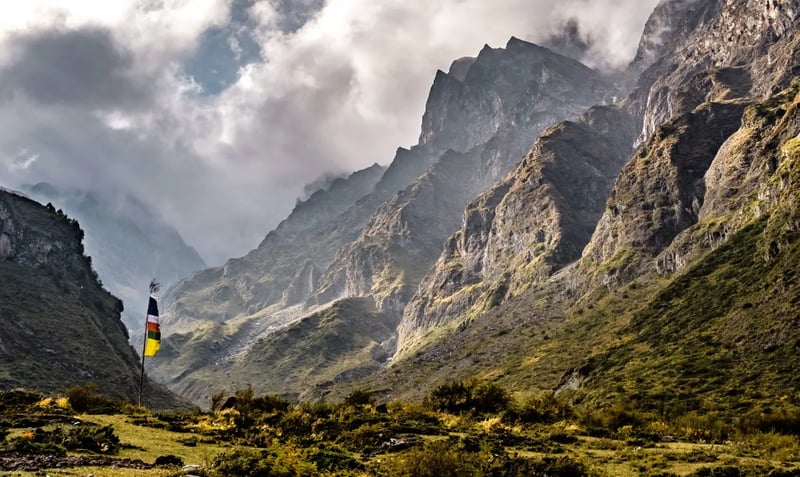
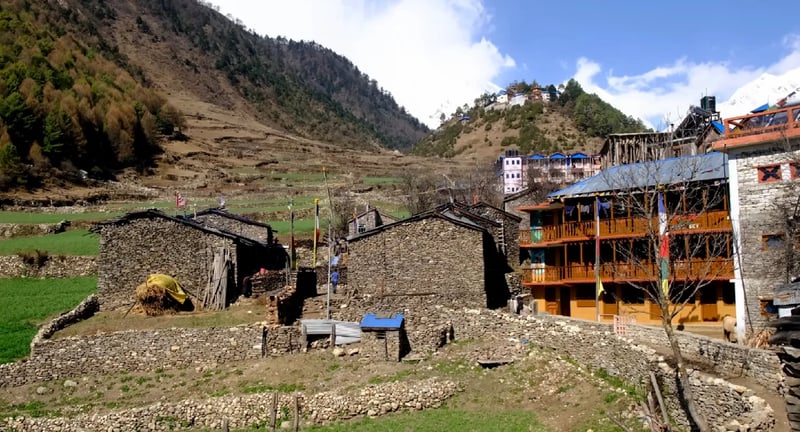
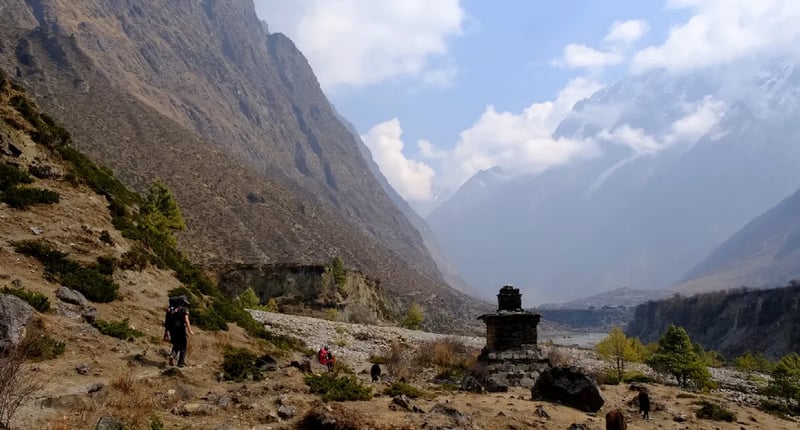
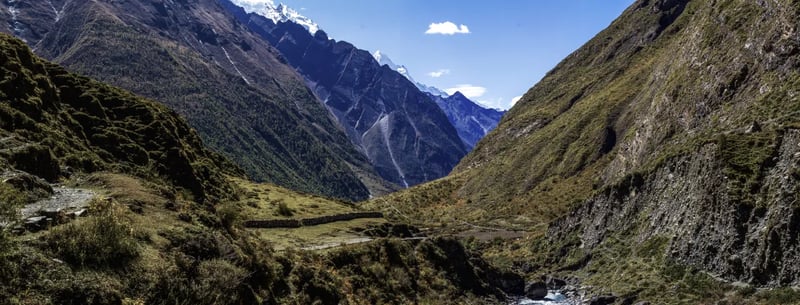
Tsum Valley is a Buddhist side valley off the Budhi Gandaki, reached via Lokpa, Chumling, and Nile to Mu Gompa. You need restricted permits and walk past mani walls, chortens, and nunnery courtyards. Mu Gompa, Nile, and the nunnery courtyards are the Buddhist heart of Tsum.
Ganesh Himal and Baudha Himal sit above the villages. The pace is cultural and mid-to-high altitude, with a walk back to the main river and a jeep toward Kathmandu. You walk out to the Budhi Gandaki and jeep toward Kathmandu without a Larkya La morning.
Our Kathmandu office is licensed with Nepal's Ministry of Culture, Tourism and Civil Aviation and the Nepal Tourism Board, and we file your Tsum restricted permits there before you pack. You'll leave the jeep at Machha Khola or Soti Khola and walk toward Lokpa and Chumling, not toward a high pass. This week stays in the Buddhist side valley all the way to Mu Gompa.
We'll brief you on nunnery etiquette and confirm lodge lists in Nile so those courtyard nights are held. Your guide keeps the Budhi Gandaki days steady so mani walls and gompa visits are the point. You will not be aiming at Larkya La on this itinerary.
Welcome everyone! After a warm welcome reception at the TIA Gate, we will escort you to your hotel on private transport.
This short half-hour drive will already give you the glimpses by which you will come to know exactly why Nepal is called the land of the Himalayas. Please take some time to get comfortable, and rest.
Meanwhile, we will wait for all our trekkers participating in our Tsum Valley trek. You can take a small stroll through the narrow, busy, and crowded streets of Kathmandu and delve into the culinary delights of the capital.
We hope you have a beautiful morning and a delightful breakfast on your first morning in Kathmandu. Our guide will be at your hotel in the morning to gather all and brief you about our 13 days Manaslu Tsum Valley trek itinerary.
Then, the rest of the day is free to take the sights of the capital and check the equipment and gear. If anything is lacking, feel free to tell our guide and he will help you get all the lacking items at a very affordable cost.
Kathmandu is a sanctuary for trekking and adventure. It is an enviable city surrounded by impressive mountains and green hills while its heritage has been enriched by the amazing craftsmanship of ancient Newars and Tibetans.
The early morning will see us getting on our bus to exit Kathmandu through the loaded traffic of Kalanki and Thankot. Then, slowly driving along the Trishuli Highway, we will approach the green surrounding of Dhading.
Taking the side road from here, we will advance towards Dhading Besi. Slowly, the pure natural air starts to breeze in with the impressive view of the green cliffs.
We will soon be in Arughat Bazaar from where we will progress forward along the Budhi Gandaki waves towards the north. With the more and more impressive landscapes covered by the evergreen vegetation, we will arrive at Sotikhola where most of the trekkers like to stop overnight.
We have the beginning of the wonderful hike from today. We will have to climb a little through the misty, humid, and cold forest of rhododendron and pine to reach Khorla Besi. Admiring the wildflowers and mosses distributed in various parts of the forest with the constant singing of the birds, we will soon be at Tatopani.
We will only admire its naturally formed hot spring from a distance and get on with our hike along the constantly bending path. Soon, we will be in front of Dobhan Khola where a suspended bridge will lead us across the river and take us to the beautiful settlement of Dobhan mainly inhabited by the Magars and Gurungs.
The day dawns in at Jagat with the beautiful outline of Manaslu rising up to the sky. From Jagat, we will walk into the natural park from where our route continues along the riverbank through the impressive gorges of Budhi Gandaki. Soon the proud villages of the Manaslu region, the Salleri and Sridibas to will be reached.
The dizzying peak of Shringi can be seen standing before us. Now gradually climbing through the verdant hills amidst a landscape of mysterious beauty, we will soon find ourselves at Philim (1600 m). Greeting the Gurung community, we will progress on our path and start to walk beneath the amazing waterfall.
We are marching inside the lower Tsum Valley now, it is a region of unique nature with an ecosystem that has developed over the years with unique flora and fauna.
After Lokpa, our route becomes very peaceful as we continue through nature along the southern trail of the Siyar Khola. Our pathway calmly rises up towards the small ridge known as Sardi Danda located deep inside the dense Tsum Valley. A gradual trek downhill from this small cliff will take us around 30 minutes after which we will reach the merciful Lungwa Khola.
Now, the ever-rising steep trail will challenge us as we march forward to reach Gumlung. An old hanging bridge will be ready to walk us over the Siyar Khola before we reach the sacred soil of Chumling. The slope of this village has housed numerous attractive monasteries such as Mani Dhungyur, Panago Gompa, and Gurwa Gompa.
The glacial world of Ganesh and Baudha will truly enchant us this evening.
Again, the calm waters of Siyar Khola will be our guidance which will lead us up along the slope rising above it. After we slowly make our way up, we will head west and walk upward to the 2460 m high Dumje Village. Here, we will come across a pathway that splits into two: one leading to the base camp of Ganesh and the other leading to our goal, Chekampar.
Next, another beautiful river named Serpu Khola will greet us. We will have the pleasure of crossing the river along a beautifully hung bridge. Now lace your boots and tackle the steep climb up to Gho.
The highland grassland will begin from here taking us to Chaurikharka to the ever-green pasture for the Yaks.
After we leave Chekampar, we will walk through the maze of a series of Mani Walls that are built from slate slabs. The handwritten Om Mani Padme Hum in large white letters can be seen on them.
Some even have hand-carved paintings of Milarepa sage. Our route has taken us inside the Lama Gaon where we will once more cross the solid-built steel bridge.
The pathway hereafter will take us to the beautiful Monastery known as Rachen Gompa, the only all-female nunnery in the region. Along the shore of the Siyar Khola, we will navigate through a series of small villages such as Ngakyu, Leru, Nga, Bursi, Lar, Phurbe, Chhule, and Pangdun, forming their own little kingdom.
From the Nile, we will engage in upward trekking towards the historical icon of Mu Gompa neighboring the Nile Village. This holiest monastery is steeped deep in legends according to which Guru Rinpoche once walked through its sacred ground.
Pushing our legs for approximately 3 to 4 hours of hard climb, we will finally be at this iconic location. This is one of the rare monasteries of Kagyupa which has its spiritual connection with the Kopan Gomba of Kathmandu.
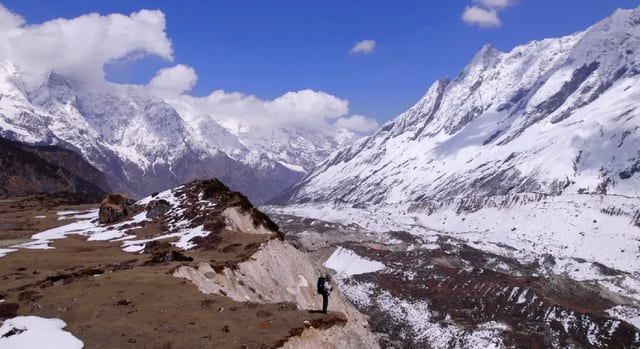
We will grab every opportunity to immerse ourselves in the profound knowledge of the monks living here. We will also spend some time watching the sun slowly hiding behind the enormous snowy curtains of Ganesh to the south, Himalchuli and Baudha on the west, and Shringi on the north.
The trek from Nile (3,361 m / 11,026 ft) to Chumling (2,386 m / 7,828 ft) is a long descent that takes about 7 to 8 hours, covering around 18 to 20 km (11 to 12 miles). The trail follows the Budhi Gandaki River, passing through villages, mani walls, and chortens that reflect the Buddhist culture of the Tsum Valley. As you descend, the air gets warmer, and the scenery changes from high, barren landscapes to lush forests of pine and rhododendron.
You will retrace parts of the trail, crossing suspension bridges and enjoying clear views of Ganesh Himal, Shringi Himal, and Himalchuli. Passing through Chhekampar and near Rachen Gompa, you may see locals working in fields and encounter mule caravans along the way. The final stretch brings you to Chumling, the gateway to Lower Tsum Valley, with stone houses, terraced farms, and monasteries.
The overnight stay here offers a more comfortable altitude and beautiful sunset views over the surrounding Himalayas.
Leaving behind the idyllic Chumling, we will prepare to journey back to Philim, traversing the quaint Lokpa hamlet. The Budhi Gandaki River seems to be delighted to welcome us back and once again will lead us along the route amidst the nature.
A gorgeous waterfall named Samba is admirable to watch for a moment. Finally, we are again at Philim, and the comforting lowland oxygen-rich air breezing through the Ganesh Peak is welcoming.
Waving goodbye to Philim, we will follow the calm forest trail that will usher us towards Dobhan Khola. The familiar pleasant-looking suspended bridge will lead us to the route that will redirect us toward Jagat and Tatopani.
Khorla Besi is not that far after which we will slowly walk down to Labu Besi. The waters of two beautiful waterfalls will tumble over our route as we travel towards Khursane.
Now, walking beside the evergreen hills of Nepal, we will reach Sotikhola which will ultimately direct us to Machha Khola. Here, we will end our trek and prepare to embark on a long road trip towards Kathmandu scheduled for tomorrow.
An early morning bus will take us in to travel us back to Kathmandu. Along the way, we are delighted to meet the charming green villages of Kuerepani and Arughat Bazaar once again. Now, our route will follow the long picturesque Prithvi Highway which will lead us through Trishuli, Thankot, and Kalanki to Kathmandu.
We will now accompany you to your capital’s accommodation. In the evening, the entire supporting team will come together to celebrate the success of our Tsum Valley trek.
After breakfast, you can head out to take one final tour of Kathmandu city.
We will now accompany you to TIA and offer you our warmest regards as you depart for your homeland voyage.
Fly into Tribhuvan International Airport in Kathmandu unless the itinerary uses another regional hub. Airport or hotel pickup can be arranged when you share arrival details ahead of travel.
Briefings cover road or domestic travel to the trailhead. Build buffer time before onward international flights in case mountain weather shifts the schedule.
Twin or double rooms in a comfortable Kathmandu hotel cover your first nights and your return from the trail, with breakfast on those city stays when included in the package. Briefings happen at the hotel, and airport collection from Tribhuvan is available when flight times are shared in advance.
Family-run teahouses or lodges line the route with twin beds and a shared dining room. Rooms get simpler and colder as you climb, with shared bathrooms common at higher villages. Hot water, Wi-Fi, and charging are paid at the lodge when offered.
March to May rhododendron bloom and October to November crisp air are peak windows for this itinerary. July and August mean leeches and cloud on lower slopes; December to February can ice steps above village level.
Your guide reads the forecast before long cols or sunrise hikes. Shoulder weeks need an honest weather call before high passes or dawn viewpoints.
You should be comfortable walking several hours a day on uneven paths with a daypack, including steady uphill sections as you gain height. Hill training and longer weekend walks in the months before travel help your legs and lungs on uphill trail days.
Hill training, stair climbing, and longer weekend hikes in the months before travel help your legs and lungs, even when acclimatisation days are built into the route. Break in boots before you fly and carry a light daypack on practice walks.
Guided trekking with licensed leaders, lodge nights on the trail, meals as described for walking days, and permits for the regions crossed are included when they are part of this trip. Domestic flights, porters, and airport transfers apply only when they are part of this trip.
Domestic flights, road transfers, porter support, and airport transfers apply only when they are part of this trip. Permits for the regions you cross are arranged in Kathmandu or Pokhara when included.
International flights to Nepal, visa fees, compulsory travel insurance, personal trekking clothing, snacks and drinks outside included meals, and tips for crew are not covered. Hot showers, Wi-Fi, and battery charging in lodges are usually paid locally when offered.
Charges for hot showers, Wi-Fi, or battery charging in lodges are paid locally when offered unless your trip notes say otherwise. International flights, visa fees, and personal insurance stay outside the trek package.
Share your Tribhuvan arrival time ahead of travel for a Thamel hotel transfer, or make your own way to the meeting hotel in the capital. Thamel hotels are the usual meet point; drivers need flight numbers to meet you at the international terminal.
Briefings cover Lukla bag weight, porter duffle limits, and what to wear on the mountain flight. Weather can shift daily plans, so your guide keeps a steady pace with regular breaks.
Guides set a steady pace and watch for headache, nausea, or dizziness as you gain height. Trail conditions are checked each morning before the group moves.
Tell your guide early if symptoms appear so tomorrow's stage can shorten or descent can start before conditions worsen. Your crew would rather wait for a safe window than rush marginal weather.
Jeep or bus days to the remote trailhead are arranged when they are part of your package. Your guide confirms departure times at briefing.
Motion sickness medicine helps on winding mountain roads. Allow a little extra time after the trek before international flights home in case mountain roads or flights move.
National park or restricted-area permits apply depending on the valleys you cross. The team arranges paperwork in Kathmandu or Pokhara when you provide passport copies and trek dates.
Keep copies in your daypack for checkpoint stops. Monsoon cloud sits lower on the hills while winter brings ice on steps above village level.
Families join when children can manage the daily hours and terrain on this specific route. Pace and daily hours can be adjusted on private departures, though that may extend the calendar.
Ask our Kathmandu team if you are planning with younger walkers. Private departures can shorten daily hours, though that may add a day or two to the calendar.
Comprehensive travel insurance that covers trekking to the highest altitude on your itinerary, medical evacuation, and helicopter rescue when applicable is essential. Many standard policies exclude high altitude by name.
Read the wording before you travel so you can adjust cover if trekking above 5,000 metres is not named. Many standard policies exclude high altitude by name, so read the wording before you fly.
We partner with Rewilding Britain to help protect our natural spaces for future adventures.
All centres are vetted for safety and quality. Your adventure is in good hands with adventuro.
About the centre
Kathmandu
You'll travel with a Kathmandu-based team that plans treks, peak climbs, helicopter flights, motorbike journeys, and cultural trips across Nepal, Tibet, and Bhutan. Routes range from classic teahouse walks and high passes to luxury lodge itineraries and longer expedition-style climbs, with departures shaped around how you want to pace the mountains.
Licensed guides and office staff train regularly on mountain safety and guest care. Porters are insured, fairly paid, and equipped for the trail, with sensible load limits on lodge routes. We work with remote communities through sustainable tourism, including support for education in village areas, so your booking helps local people as well as your own adventure.
Operated by Himalayan Adventure Treks & Tours, a partner of adventuro.