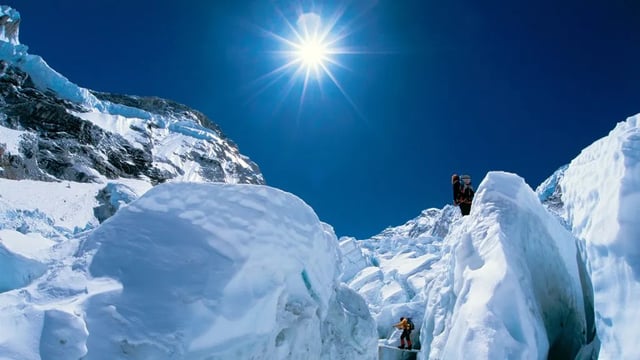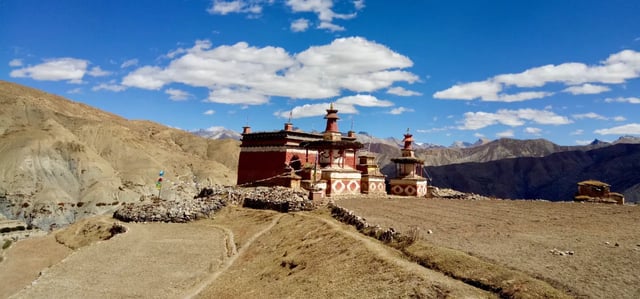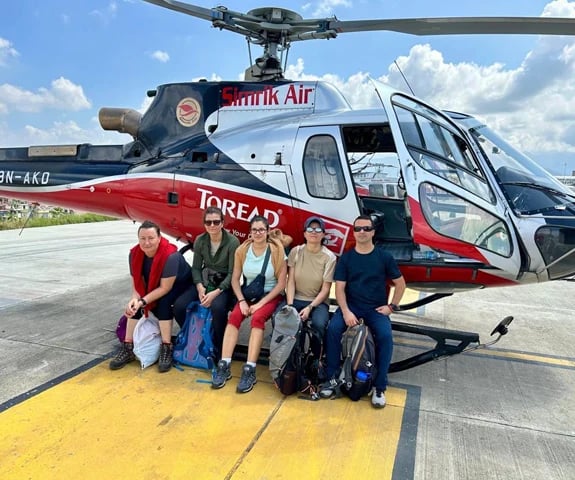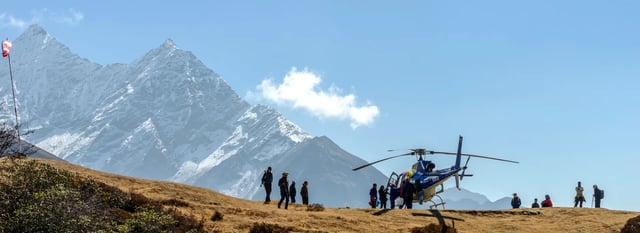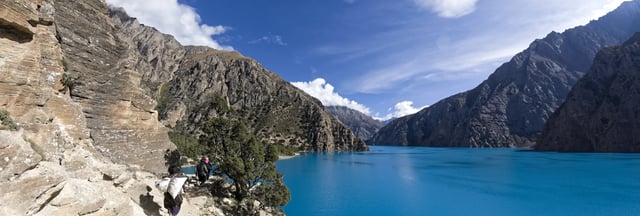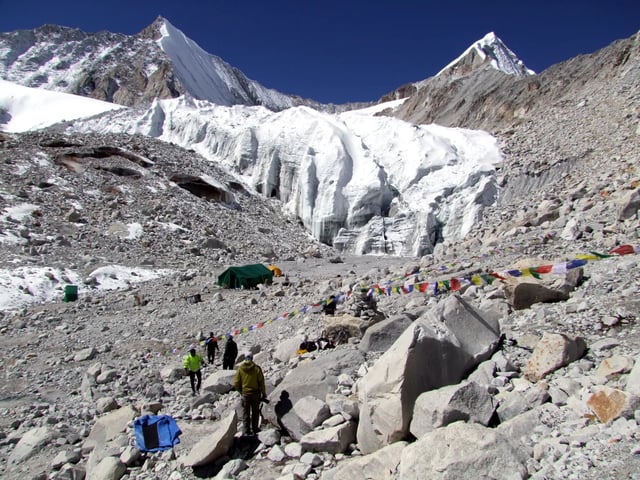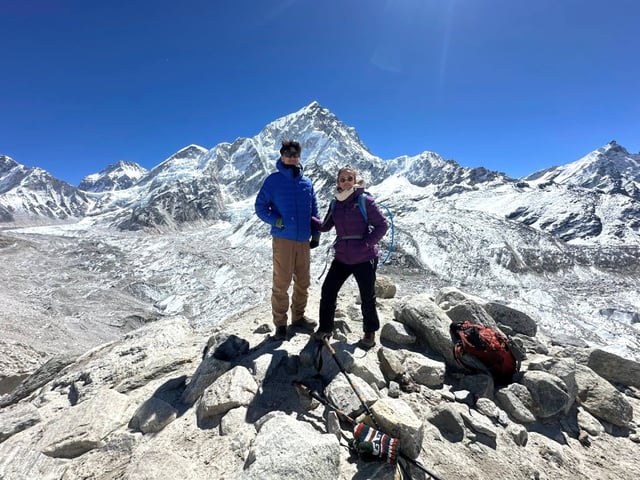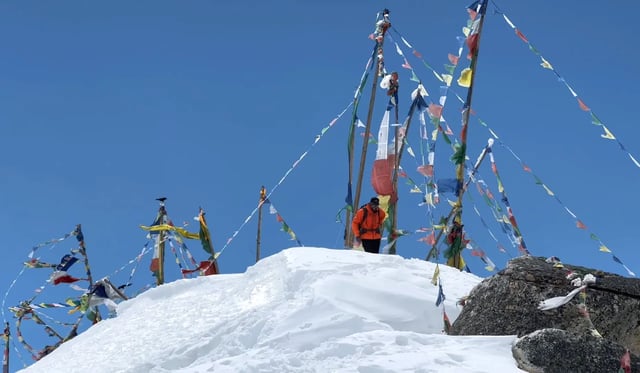
You trek from Lukla through Namche and the monastery ridge to Everest Base Camp and Kala Patthar on foot, with teahouse meals and porter support on walking days. Acclimatisation in Namche and Dingboche is part of the plan before the icefall. The icefall, Kala Patthar, and the Sherpa trail remain the heart of the trip; the rotor only shortens the walk-out.
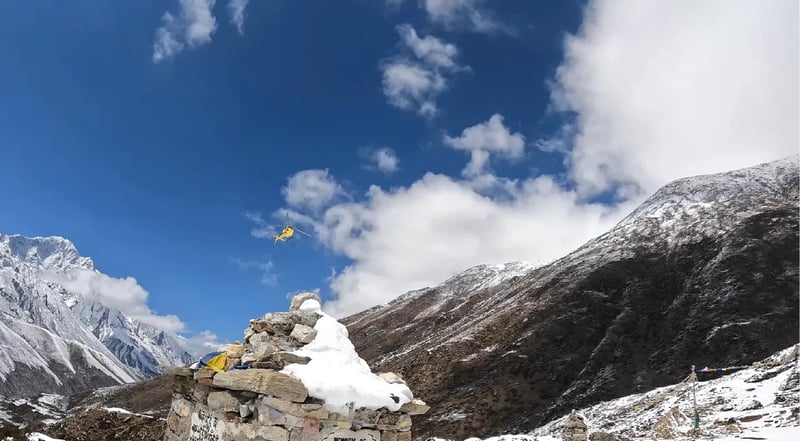
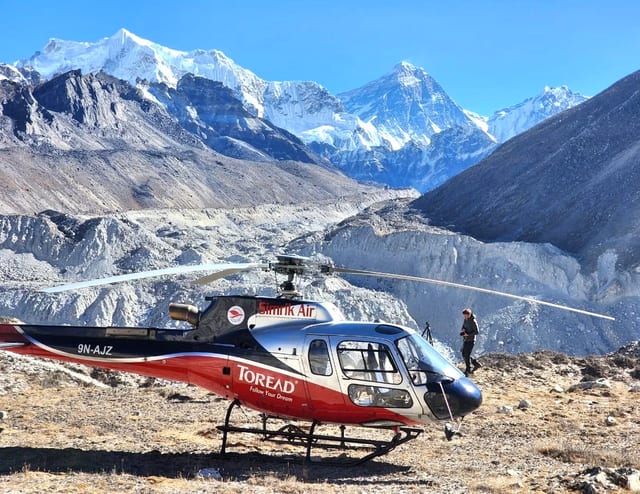
The return helicopter drops you at Lukla rather than Kathmandu, so you still fly the mountain airstrip home after the high point. Weather can hold rotors; your crew times the flight around lodge checkout at Gorak Shep. Landing back at Lukla after Base Camp lets you keep the mountain airstrip as part of the story.
Your guide times the helicopter from Gorak Shep back to Lukla so you still fly the mountain airstrip home after Everest Base Camp and Kala Patthar. You'll brief in Kathmandu on bag weights and the walk through Namche and Dingboche, and we update the plan each evening if you need a slower hour before the icefall.
Porters carry the lodge loads, about 25 to 30 kg, one porter for every two guests or a dedicated porter if you travel solo, and we pay them fairly with insurance in place. Lodge checkout at Gorak Shep waits on the weather window rather than a fixed clock.
The Kingdom of Everest is delighted to extend its warm welcome to you. Once you exit the TIA Arrival Gate, you will find our cordial representative patiently waiting for you. After a friendly reception, he will assist you in your transfer to the approved hotel in the capital.
You can now get some rest and freshen up. Later in the afternoon, all trekkers heading to the Everest base camp trek with helicopter return to Lukla will gather around with our guide for a travel discussion. If you need any type of hiking gear, our guide will be available to help you out.
In the evening, you can explore and discover your first Nepali dinner.
We will head early morning to the respective airport to check in for our flight to Lukla. The short half-hour flight will take us to the airport patronized by the great Hilary and Tenzing to the legendary first conquerors of Everest.
The flight goes by quickly giving us the impressive glances of Kanchenjunga, Everest, and Makalu. Here comes the landing part on one of the most unusual and short runways just over half a km built on the slope.
Once we arrive, we will meet our other crew members and set off on an adventure of hiking. For one hour, we will continue following the Dudh Koshi water and arrive at Chheplung.
Today we will walk through the pine jungle up the Benkar Valley towards the north. We will cross the Dudh Koshi River, walk past Chumoa reach Monjo, and step inside the preserved land of the Everest National Park.
We will hike across the bridge one more time and pass through Jorsalle walking side by side with Dudh Koshi. Now a 30-minute climb will bring us to the iconic Hilary Bridge over the Dudh Koshi and Bhote Koshi Rivers.
Admiring the Taboche Peak (6495 m), we will traverse the Upper Khumbu and continue to walk upstream to the Everest View Point. Enjoy the personal moment with Lhotse (8516 m), Thamserku (6608 m), Everest (8848 m), Nuptse (7861 m), and Kangtega (6782 m).
We have an acclimatization day today after all, we have already crossed 3000 m and soon exceed 4000 m in the coming days. We will go up by around 350 m towards Khumjung Village admiring the small runway of Syangboche.
Atop the 3868 m high Khumjung La Pass, we will have some astounding visuals of Mount Everest, Lhotse, Nuptse, Ama Dablam, Thamserku, Kongde, and many more. In this village, we can visit one of the highest galleries and a Buddhist Monastery where we will sit for a while silently contemplating the extraordinary views that surround us.
It is the fifth day of our Everest Base Camp trek with helicopter return journey. From Namche, we will ascend alongside the wild water of Dudh Koshi for a while.
Then, we will walk down to cross a hanging bridge to step into the Imja Khola valley. Now, a beautiful climbing trail through the rhododendron forest will take us to 3250 m altitude at Phungi Thanga.
Two more hours of an upward hike will finally take us to the renowned Gompa (Monastery) of Tengboche, where every autumn the Mani Rimdu Buddhist Festival takes place. We will spend our evening increasingly higher mountains of Kwangde (6,187 m), Thamserku, Everest, Tawache, Lhotse, Ama Dablam, and Kangtega.
Continuing with our Everest Base Camp trek with helicopter return trip, we will climb for about an hour to reach Debuche. Another hour of ascent will then bring us to 3900 m high Pangboche Village where we can fully admire the beauty of Ama Dablam.
We can also take a short moment to explore its local Gompa. Resuming, we will soon be inside Imja Valley and find the Lobuche River guiding us across its water.
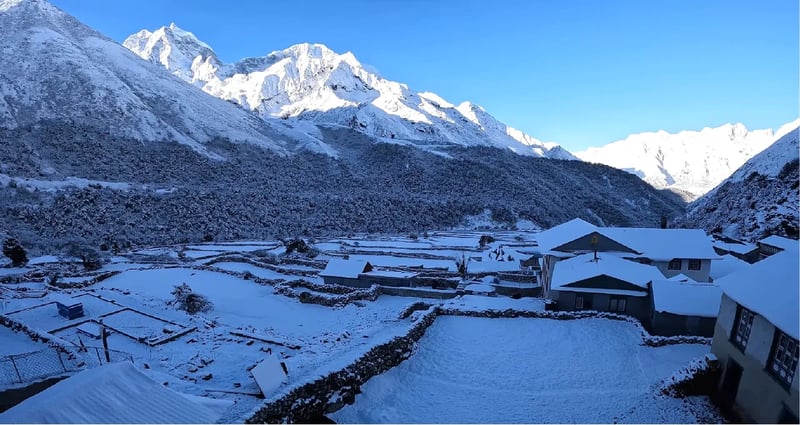
We will be ascending again towards Dingboche, which is now not too far. It is worth spending the evening here watching the sunset, t painting the southern wall of Lhotse red.
We will dedicate this day to adjusting to 4000 m height before we get on with our Everest base camp trek with helicopter return trip. We will take some moments to explore the scenic fields of the village, then we will set off for a three-hour upward trek towards 5100 m high Nangkartshang Hill or Nagarjun Hill.
Atop, we can look at the glorious mountains of Nirekha, Thamserku, Lobuche, Cholatse, Ama Dablam, Baruntse, Island Peak, Makalu, Taboche, and Cho Polu. After detailing the peaks, we will head down from the hill and make our way back to our peaceful lodge.
After breakfast in Dingboche, we will now make our way up to Dusa Village, which is mainly a home to many yak herders. Then, we will traverse the hanging bridge and arrive at Dughla Village (4620 m).
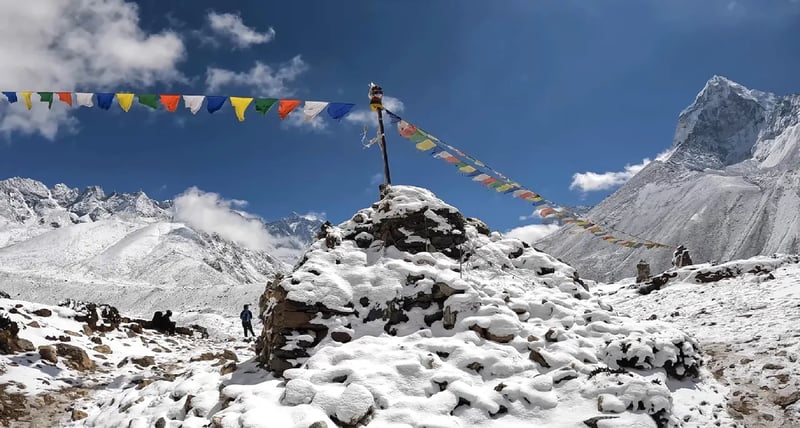
A one-more-hour steep climb will now lead us atop the Thukla Pass (4830 m). In its vicinity, we can see a collection of tombstones symbolic of Everest victims.
Shortly after, we will step onto the Khumbu Glacier, which begins on Everest's southern slopes. Walking along its moraine surrounded by peaks like Khumbutse, Lingtren, Pumori, and Mahalangur Himal, we will finally reach Lobuche, the penultimate village before the Everest base camp.
Today, the Everest trek will show its full meaning and essence. From Lobuche, we will set off uphill along the moraine surrounding the Khumbu glacier and reach Lobuche Pass (Thangma Riju).
Then, we will come across the steep slope of the Changri Glacier from where we can see the clearest view of the Pumori and Kala Patthar. Then, we will have a more steeper ascent to the town of Gorakshep, often considered the highest settlement in the world.
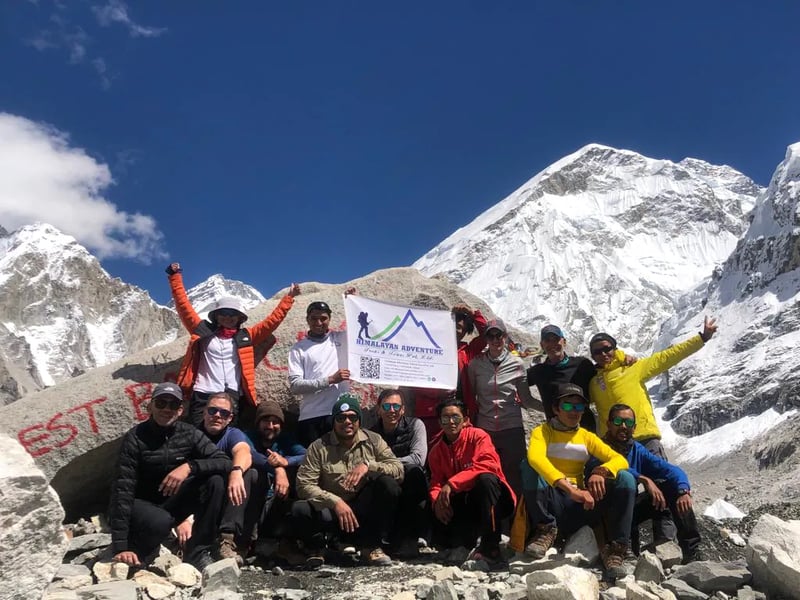
Here, we will leave our luggage and get some meals. Then, we will set off to trek along the rocky terrain followed by some streams and moraines till we make it to the great Everest Base Camp.
Today, we will set forth to reach the highest elevation of our entire Everest base camp trek with helicopter return to Lukla expedition, the great black stone, Kala Patthar. Beginning the journey at around 4 am, we will ascend along the rocky and glacial landscape.
En route, we can already start to see the dim profiles of Changtse, Khumbutse, Lingtren, and many more. After around two to three hours of vertical ascension, we will be atop Kala Patthar on time to witness the glittering sun rays radiating the snow walls of Changtse, Ama Dablam, Everest, Lobuche, Nuptse, Pumori, Khumbutse, Lhotse, and Lingtren.
After your final mountain breakfast, you will go to the exciting Lukla Airport and check in to fly back to either Kathmandu to Ramechhap. In the case of Ramechhap landing, we will transfer you back to Kathmandu within 4 to 5 hours.
Depending on the available time you have, you can go to the Bagmati River and admire Pashupatinath Temple from outside or you can move on to Swayambhunath as well. In the evening, you will have an incredible final dinner at the capital awaiting you with our team.
After you have your final breakfast in Kathmandu, we will come with you and together we will go to TIA where after check in you will return to your homeland.
This will be the end of your Everest Base Camp trek with helicopter return trip in Nepal.
Most guests fly into Tribhuvan International Airport in Kathmandu. Share your arrival time ahead of travel so a Thamel hotel transfer can be arranged, or make your own way to the meeting hotel.
Pre-trek briefings usually take place in Kathmandu before the Lukla flight or helicopter sector. Allow extra days after the trek in case mountain flights are postponed by weather.
Twin or double rooms in a comfortable Kathmandu hotel cover your first nights and your return from the trail, with breakfast on those city stays when included in the package. Briefings happen at the hotel, and airport collection from Tribhuvan is available when flight times are shared in advance.
Family-run teahouses or lodges line the route with twin beds and a shared dining room. Rooms get simpler and colder as you climb, with shared bathrooms common at higher villages. Hot water, Wi-Fi, and charging are paid at the lodge when offered.
Spring from March to May and autumn from September to November usually bring the clearest views and stable walking conditions on this route. Winter is quieter but colder at altitude, while monsoon months bring cloud and wet trails at lower elevations.
Shoulder weeks need an honest weather call before high passes or dawn viewpoints. Monsoon cloud sits lower on the hills while winter brings ice on steps above village level.
You should be comfortable walking several hours a day on uneven paths with a daypack, including steady uphill sections as you gain height. Hill training and longer weekend walks in the months before travel help your legs and lungs on uphill trail days.
Hill training, stair climbing, and longer weekend hikes in the months before travel help your legs and lungs, even when acclimatisation days are built into the route. Break in boots before you fly and carry a light daypack on practice walks.
Guided trekking with licensed leaders, lodge nights on the trail, meals as described for walking days, and permits for the regions crossed are included when they are part of this trip. Domestic flights, porters, and airport transfers apply only when they are part of this trip.
Helicopter sectors, domestic flights, and airport transfers apply only when they are listed on the trip; porter support follows the ratio arranged in Kathmandu. Permits for the regions you cross are arranged in Kathmandu or Pokhara when included.
International flights to Nepal, visa fees, compulsory travel insurance, personal trekking clothing, snacks and drinks outside included meals, and tips for crew are not covered. Hot showers, Wi-Fi, and battery charging in lodges are usually paid locally when offered.
Charges for hot showers, Wi-Fi, or battery charging in lodges are paid locally when offered unless your trip notes say otherwise. International flights, visa fees, and personal insurance stay outside the trek package.
Pickup can be arranged from Tribhuvan International Airport or your hotel in Thamel when you share flight times ahead of travel. The pre-trek briefing is usually held at the hotel before the Lukla flight or helicopter sector.
Allow buffer days after the trek in case mountain flights move. Thamel hotels are the usual meet point; drivers need flight numbers to meet you at the international terminal.
The itinerary builds rest days and climb-high, sleep-low hikes where the route requires them. Your crew would rather wait for a safe window than rush marginal weather.
Tell your guide early if symptoms appear so tomorrow's stage can shorten or descent can start before conditions worsen. Trail conditions are checked each morning before the group moves.
Helicopter legs are scheduled around lodge checkout when transport is part of the trip. Weight limits and weather holds apply, and the crew may shift timing to the next clear window.
Dress warmly for open-door loading zones and keep passport and permits in your daypack. Buffer days in Kathmandu after the trek reduce stress if the flight moves.
Sagarmatha National Park and Khumbu municipality permits apply in the Everest region. The team arranges paperwork in Kathmandu or Pokhara when you provide passport copies and trek dates.
Keep copies in your daypack for checkpoint stops. Weather can shift daily plans, so your guide keeps a steady pace with regular breaks.
Families join when children can manage the daily hours and terrain on this specific route. Pace and daily hours can be adjusted on private departures, though that may extend the calendar.
Ask our Kathmandu team if you are planning with younger walkers. Private departures can shorten daily hours, though that may add a day or two to the calendar.
Comprehensive travel insurance that covers trekking to the highest altitude on your itinerary, medical evacuation, and helicopter rescue when applicable is essential. Many standard policies exclude high altitude by name.
Read the wording before you travel so you can adjust cover if trekking above 5,000 metres is not named. Many standard policies exclude high altitude by name, so read the wording before you fly.
We partner with Rewilding Britain to help protect our natural spaces for future adventures.
All centres are vetted for safety and quality. Your adventure is in good hands with adventuro.
About the centre
Kathmandu
You'll travel with a Kathmandu-based team that plans treks, peak climbs, helicopter flights, motorbike journeys, and cultural trips across Nepal, Tibet, and Bhutan. Routes range from classic teahouse walks and high passes to luxury lodge itineraries and longer expedition-style climbs, with departures shaped around how you want to pace the mountains.
Licensed guides and office staff train regularly on mountain safety and guest care. Porters are insured, fairly paid, and equipped for the trail, with sensible load limits on lodge routes. We work with remote communities through sustainable tourism, including support for education in village areas, so your booking helps local people as well as your own adventure.
Operated by Himalayan Adventure Treks & Tours, a partner of adventuro.