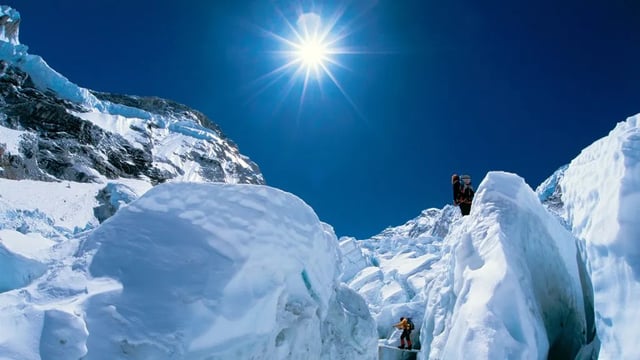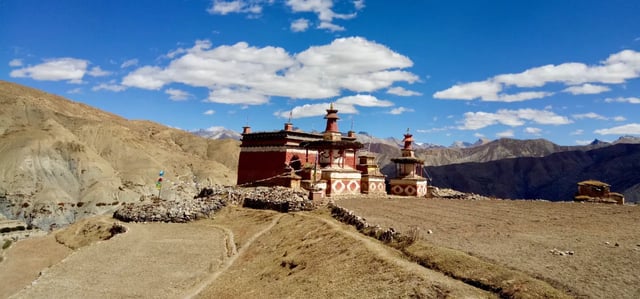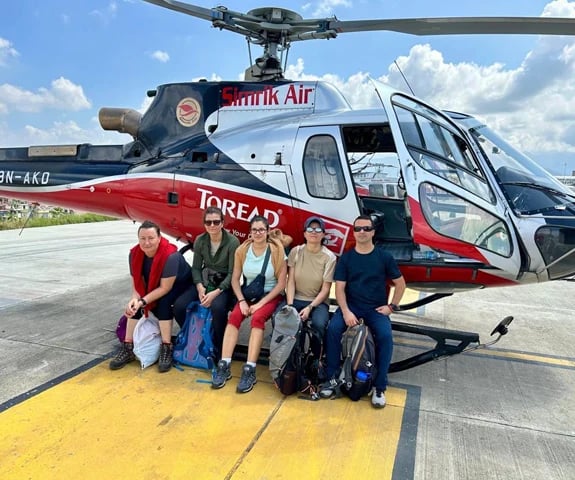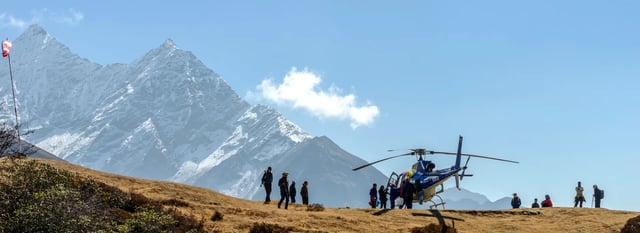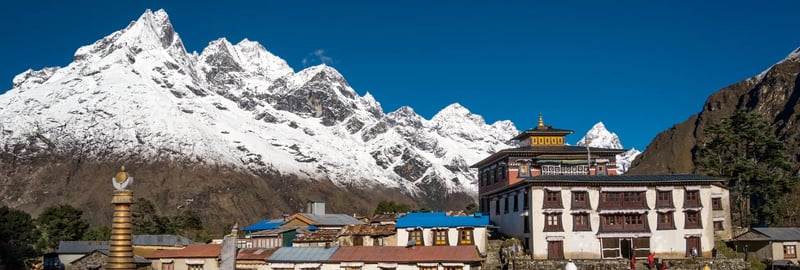
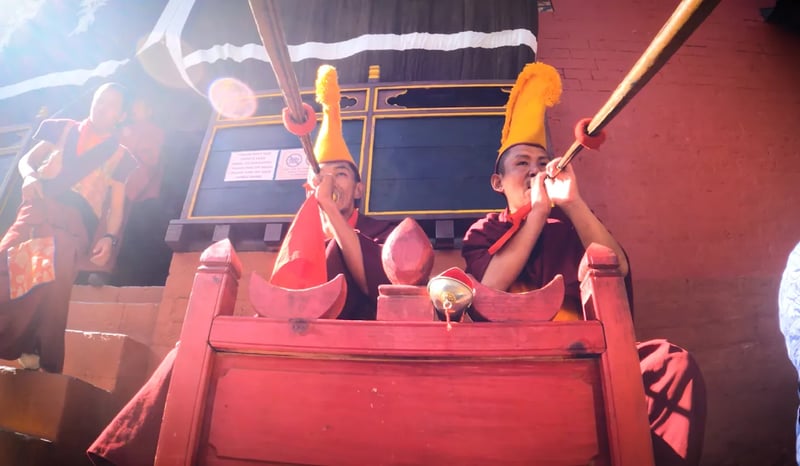
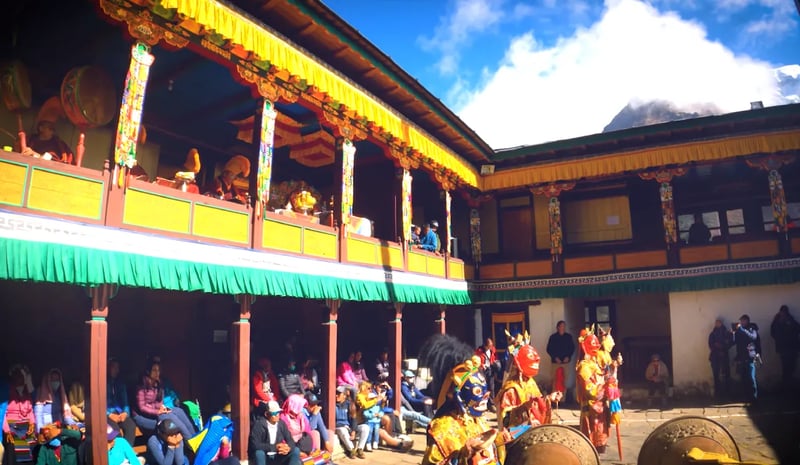
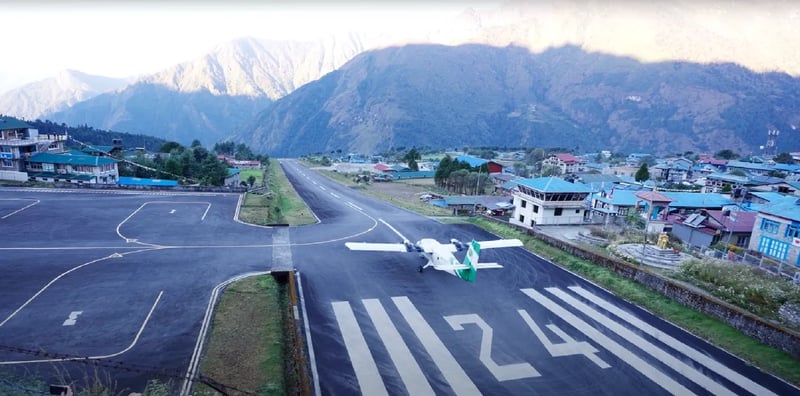
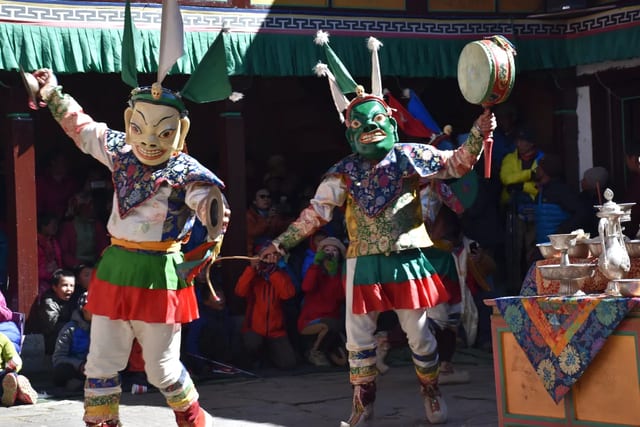
Timed for Mani Rimdu at Tengboche, you fly to Lukla and walk through Phakding and Namche to the monastery ridge as masked dances, music, and blessings fill the courtyard. Sherpa families from the valley gather for the festival days. Masked dances, horns, and blessings in Tengboche’s courtyard are the dates this departure is built around.
Between ceremonies you walk to nearby villages and viewpoints with Everest and Ama Dablam on the skyline. Lodge nights in Namche and Tengboche keep you close to the gompa without a Base Camp push. Cham dances run across several festival days, and lodge nights in Namche keep the gompa walk short.
We try to match a guide who is local to this Khumbu valley, licensed through MOCTCA and NATHM, and trained on altitude illness on the climb to Tengboche. You'll fly to Lukla and walk Phakding and Namche so you reach the monastery ridge for Mani Rimdu. Masked dances, music, and courtyard blessings are the reason those nights are held early.
Our Kathmandu office books Tengboche and Namche rooms before festival week fills the gompa. Your guide knows courtyard etiquette and when to give the monks space. Between ceremonies you'll walk nearby villages with Everest and Ama Dablam on the skyline.
After landing in Nepal’s vibrant capital city, our team will welcome you with a cordial reception. Then we'll assist you with your immigration and visa applications, followed by a drive to the 3-star hotel in Thamel.
You can relax after a long flight. In the evening, you can join us in our office to get a brief overview of the 11-day Mani Rimdu Festival Trek itinerary.
Afterward, you may stroll around Thamel’s streets and explore cozy cafes and colorful markets. If you need to shop, you can also purchase some trekking gear to be prepared if you don’t have any.
The next day of the Mani Rimdu Festival Trek package, you will be flying from Kathmandu to Lukla early in the morning. We will come to pick you up at the airport, where we will also board a plane for a short flight to Lukla, offering aerial views of the Himalayas. After we get off the plane, we'll meet with the rest of the team to complete final preparations.
Now, we will start the journey heading northwest from Lukla to reach the Sherpa village of Phakding. On the route, we'll pass via the charming villages of Chheplung and Thado Koshi, surrounded by Himalayan views. We will walk on the route following the sides of the Dudh Khola River.
When we get at the village, we will relax into a nice teahouse to prepare for the trek ahead in the following days.
After having a mouth-devouring breakfast in our mountain lodge in Phakding, we will continue our journey toward the bustling hub of the Everest region, Namche Bazaar. We'll cross the swift-moving Dudh Koshi River on a lengthy hanging bridge.
We will finally arrive at Monjo's Sagarmatha National Park entrance as we continue to hike. Moving on, we will cross another hanging bridge at Larja Dobhan, followed by a steep climb through dense pine forest.
After hiking for six to seven hours, we will arrive in Namche Bazaar, where a lively ambiance will greet you. This town is also called the gateway to the legendary Everest Base Camp.
Day 4 in the Everest region is our acclimatization day in Namche Bazaar. Having an acclimatization day does not imply complete rest and doing nothing; the easiest way to adjust is through mild activity, such as exploring and taking short side trips.
The popular side trip is a climb to the Everest View Hotel at 3880 meters for panoramic views of the majestic Himalayas and other spectacular scenery. When you return from this hotel, you can explore the surrounding Sherpa settlements of Khumjung and Kunde, which are home to the Hillary School, Khumjung Monastery, and Kunde Hospital.
Then you'll return to Namche for lunch. You can spend the rest of your day exploring the colorful marketplaces or having a glass of coffee or tea while admiring the natural surroundings.
On the fifth day of the Mani Rimdu festival Trek package, we will leave the bustling town of Namche Bazaar and head to Tengboche Village to see the remarkable, one-of-a-kind event. Our trail begins with a gentle uphill climb, offering a winding route that provides beautiful vistas of the landscape.
We will also wander through the pine and rhododendron forests to the Dudh Koshi River at Phungi Thenga. From here, we will continue for another two hours through dense woodland, where you may see colorful birds and musk deer.
Finally, within 5 to 6 hours of Namche, we will arrive in Tengboche, home to the famous Tengboche Monastery. Then, we will find a cozy teahouse to stay in for the three nights on this 11-day Mani Rimdu Festival Trek itinerary.
Today is the day you have been waiting for during the entire Mani Rimdu Festival Trek adventure to have an experience, held at Tengboche Monastery. We will visit the festival after having a hearty breakfast at the trekking lodge. This festival celebrates the triumph of good over evil forces.
You can see the beautiful masked holy dances, which are believed to bring blessings, peace, and protection in an individual’s life from evil spirits. Participating in the Mani Rimdu festival will give you a spiritual connection, as well as a soul-stirring experience and a moment of a lifetime that will always be refreshing when you reflect on this 11-day journey.
Today, you will spend one more day at Tengboche Village to witness the second day of the vibrant Mani Rimdu festival. As soon as we finish our delicious breakfast, we will head to Tengboche Monastery and enjoy the festivity. This revered festival continues with more traditional masked dances, chanting, and symbolic performances by the lamas, who represent the stories of Buddhist teachings and the triumph of good over evil.
You will witness the monks wearing colorful robes and intricate masks giving a spiritual performance accompanied by the sound of horns and drums. While the first day of the festival focuses on blessings and prayers, the second day brings the festival to life with elaborate masked dances and performances, with each movement and gesture representing Buddhist deities, spirits, and the eternal battle between negative and positive forces. As the sun sets, you can feel the chants continue softly inside the monastery.
This day is the visually part of the festival, which will be the most significant highlight that you will take away from this 11-day Mani Rimdu Festival Trek itinerary. Tomorrow, the third day of the festival, focuses on prayers, gatherings, and blessings to conclude this occasion.
The Mani Rimdu festival concludes on the eighth day. However, before we walk back to Monjo, we will still enjoy the festival in the morning before leaving the Tengboche Village. In the morning, Lamas performs closing rituals and offers blessings to locals, visitors, and monks.
You will also be able to witness the Wong ceremony, in which people receive holy water and protective threads, followed by the fire puja, which symbolizes the bringing of peace. After enjoying the final moments of the festival, we will then begin our descent from Tengboche Monastery through the lush rhododendron and pine forests. On the way, we will pass through prayer flags, mani walls, and swinging hanging bridges that cross the Dudh Koshi.
By the afternoon, we are going to be at Monjo Village, where we will stay overnight, and then leave for Lukla town the next day.
The ninth day will be your last day of hiking on this 11-day Mani Rimdu Festival Trek itinerary. We will depart from Monjo after having a substantial breakfast in the teahouse. We will walk down the trail, which runs south along the Dudh Koshi River, passing through deep forests of oak, pine, and rhododendron.
You will see the familiar villages, including Phakding, where we spent our first overnight stay in the Khumbu region of Nepal. We'll take a quick break here to eat lunch and refuel before continuing on our journey. By the mid to late afternoon.
We will reach Lukla town, marking the ending point of the hiking adventure in the heart of the mountains. We will celebrate the successful Mani Rimdu Festival Trek with a delicious dinner in the evening, accompanied by your guides, porters, and fellow trekkers as we share our experiences. The next day, we'll travel back to Kathmandu and bid farewell to the Everest region.
In the early morning, we will walk to Tenzing Hillary Airstrip after having one last breakfast in the Khumbu region. While flying on the plane, you can catch the final views of gigantic peaks such as Ama Dablam, Everest, Lhotse, and other surrounding ice-clad peaks. After reaching Kathmandu, we shall drive you to your 3-star hotel for an overnight stay.
The rest of the day is free to relax, explore, or do both without wasting your time in Nepal. You can even purchase souvenirs, such as handicrafts, thangka paintings, and textiles, to take home. In the evening, you can visit Basantapur to enjoy a lively evening exploring the temples and courtyards (option).
Evening farewell dinner at Nepalese cultural restaurant with cultural dance program. Tomorrow, you will fly back home, marking the completion of the Mani Rimdu Festival Trek package.
On your final day, you will be transferred to Tribhuvan International Airport situated in Kathmandu according to your flight schedule time. For one last time, you will go through the streets of a vibrant city, narrow alleys, and remember, from the first day to the present, that creating memories is genuinely a good thing.
You may feel emotional while going back, but experiencing the authentic taste for the first time in a new place and being curious about everything is a unique experience. As you witness things you have never seen before, that’s what makes it an experience.
Most guests fly into Tribhuvan International Airport in Kathmandu. Share your arrival time ahead of travel so a Thamel hotel transfer can be arranged, or make your own way to the meeting hotel.
Pre-trek briefings usually take place in Kathmandu before the Lukla flight or helicopter sector. Allow extra days after the trek in case mountain flights are postponed by weather.
Twin or double rooms in a comfortable Kathmandu hotel cover your first nights and your return from the trail, with breakfast on those city stays when included in the package. Briefings happen at the hotel, and airport collection from Tribhuvan is available when flight times are shared in advance.
Family-run teahouses or lodges line the route with twin beds and a shared dining room. Rooms get simpler and colder as you climb, with shared bathrooms common at higher villages. Hot water, Wi-Fi, and charging are paid at the lodge when offered.
Stable trekking weather most often falls in pre-monsoon spring and post-monsoon autumn. Monsoon cloud sits lower on the hills while winter brings ice on steps above village level.
If your dates sit in winter or monsoon, pack rain and cold layers and accept that flight or pass days may move by a day when safety requires it. Weather can shift daily plans, so your guide keeps a steady pace with regular breaks.
You should be comfortable walking several hours a day on uneven paths with a daypack, including steady uphill sections as you gain height. Hill training and longer weekend walks in the months before travel help your legs and lungs on uphill trail days.
Hill training, stair climbing, and longer weekend hikes in the months before travel help your legs and lungs, even when acclimatisation days are built into the route. Break in boots before you fly and carry a light daypack on practice walks.
Guided trekking with licensed leaders, lodge nights on the trail, meals as described for walking days, and permits for the regions crossed are included when they are part of this trip. Domestic flights, porters, and airport transfers apply only when they are part of this trip.
Domestic flights, road transfers, porter support, and airport transfers apply only when they are part of this trip. Permits for the regions you cross are arranged in Kathmandu or Pokhara when included.
International flights to Nepal, visa fees, compulsory travel insurance, personal trekking clothing, snacks and drinks outside included meals, and tips for crew are not covered. Hot showers, Wi-Fi, and battery charging in lodges are usually paid locally when offered.
Charges for hot showers, Wi-Fi, or battery charging in lodges are paid locally when offered unless your trip notes say otherwise. International flights, visa fees, and personal insurance stay outside the trek package.
Hotel meet in Thamel is typical; send flight numbers so pickup can meet you at the international terminal. Allow a little extra time after the trek before international flights home in case mountain roads or flights move.
Rest day buffer after the trek helps if Lukla or helicopter sectors slip by a day. Trail conditions are checked each morning before the group moves.
The itinerary builds rest days and climb-high, sleep-low hikes where the route requires them. Your crew would rather wait for a safe window than rush marginal weather.
Tell your guide early if symptoms appear so tomorrow's stage can shorten or descent can start before conditions worsen. Thamel hotels are the usual meet point; drivers need flight numbers to meet you at the international terminal.
Mountain weather can delay or postpone Lukla flights even in peak season, and Ramechhap diversions happen when the airstrip is congested. Shoulder weeks need an honest weather call before high passes or dawn viewpoints.
Build buffer days after the trek for international connections, and follow crew advice if schedules change or flights shift to Ramechhap. Keep a spare day in Kathmandu after the trek if Lukla or Ramechhap flights move.
Sagarmatha National Park and Khumbu municipality permits apply in the Everest region. The team arranges paperwork in Kathmandu or Pokhara when you provide passport copies and trek dates.
Keep copies in your daypack for checkpoint stops. Your team files the paperwork in Kathmandu or Pokhara once you share passport copies and dates.
Families join when children can manage the daily hours and terrain on this specific route. Pace and daily hours can be adjusted on private departures, though that may extend the calendar.
Ask our Kathmandu team if you are planning with younger walkers. Private departures can shorten daily hours, though that may add a day or two to the calendar.
Comprehensive travel insurance that covers trekking to the highest altitude on your itinerary, medical evacuation, and helicopter rescue when applicable is essential. Many standard policies exclude high altitude by name.
Read the wording before you travel so you can adjust cover if trekking above 5,000 metres is not named. Many standard policies exclude high altitude by name, so read the wording before you fly.
We partner with Rewilding Britain to help protect our natural spaces for future adventures.
All centres are vetted for safety and quality. Your adventure is in good hands with adventuro.
About the centre
Kathmandu
You'll travel with a Kathmandu-based team that plans treks, peak climbs, helicopter flights, motorbike journeys, and cultural trips across Nepal, Tibet, and Bhutan. Routes range from classic teahouse walks and high passes to luxury lodge itineraries and longer expedition-style climbs, with departures shaped around how you want to pace the mountains.
Licensed guides and office staff train regularly on mountain safety and guest care. Porters are insured, fairly paid, and equipped for the trail, with sensible load limits on lodge routes. We work with remote communities through sustainable tourism, including support for education in village areas, so your booking helps local people as well as your own adventure.
Operated by Himalayan Adventure Treks & Tours, a partner of adventuro.