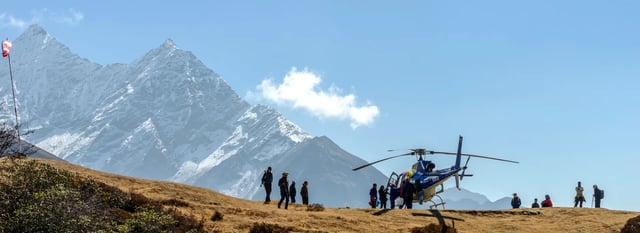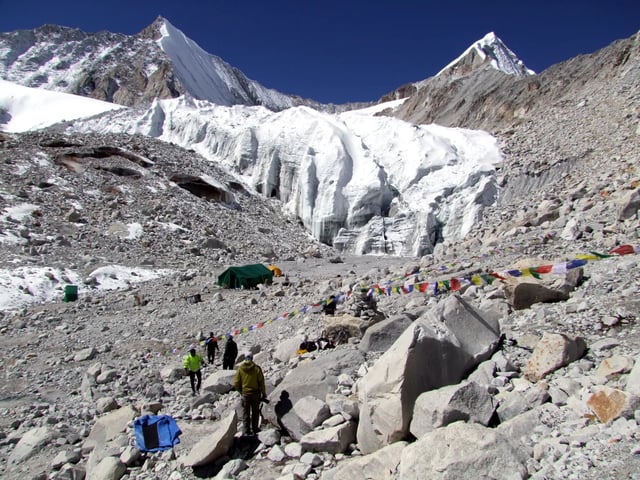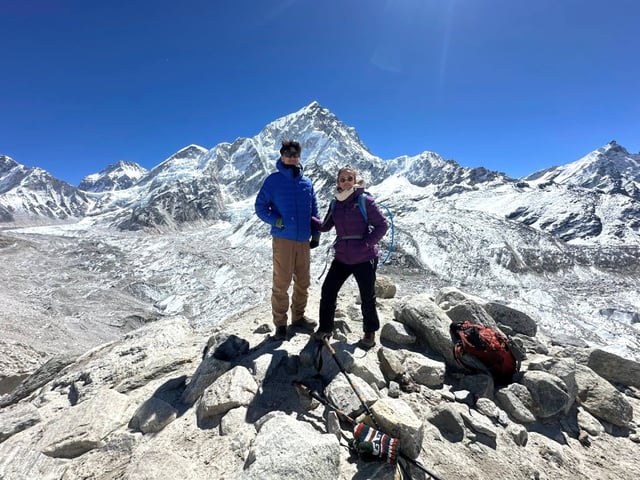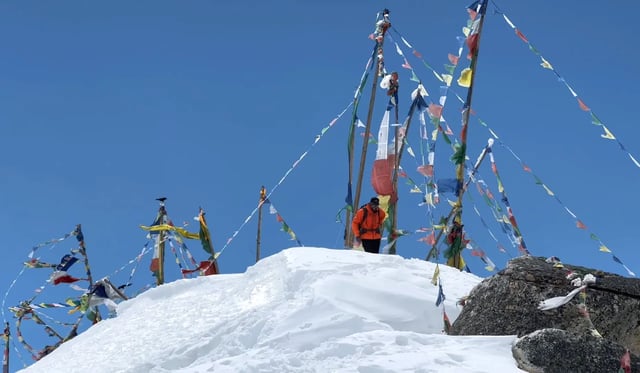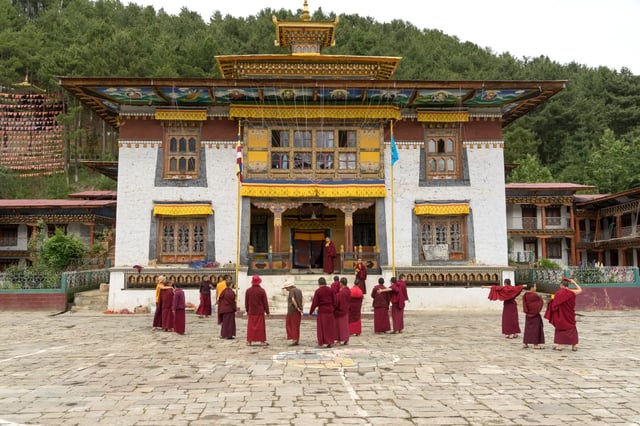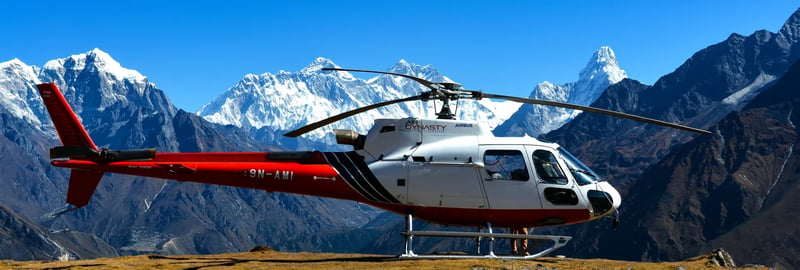
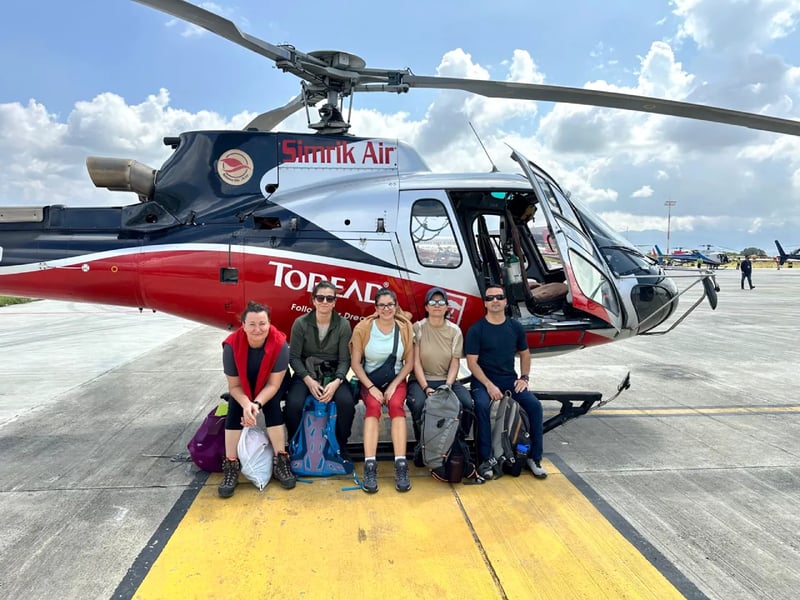
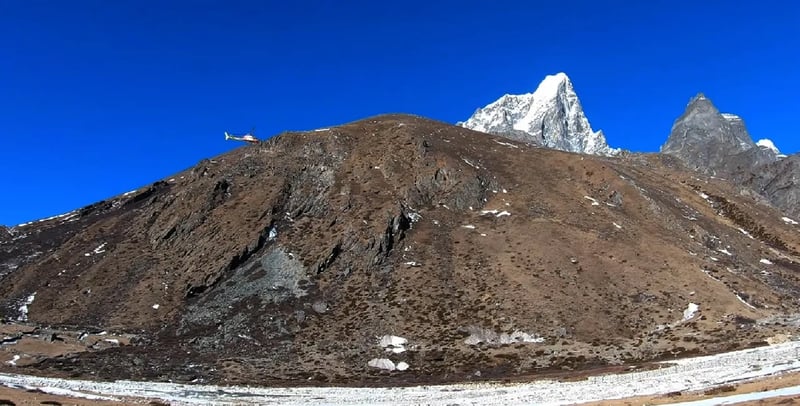
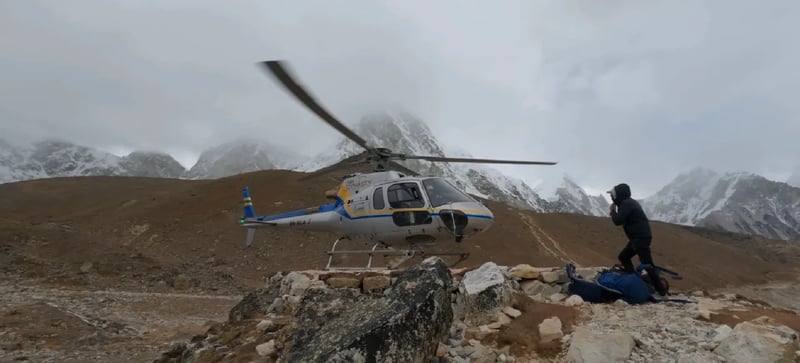
This Khumbu itinerary still walks you to Everest Base Camp and Kala Patthar, with upgraded lodges, warmer rooms, and helicopter sectors between Kathmandu, Lukla, and the high trail when they are part of the plan. You brief in Thamel, then move into Namche, Tengboche, and Dingboche with more comfort at the end of stair-heavy days. Warmer beds and a rotor sector take the sting out of the longest days while you still earn Everest Base Camp on foot.
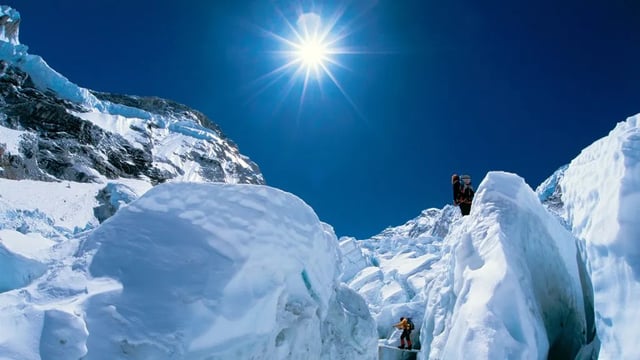
Porters carry duffles while you walk with a daypack on the classic icefall approach. Helicopter windows can shift with mountain weather, so buffer time after Base Camp helps you enjoy the flight home over the Khumbu rather than racing an international connection. Kala Patthar at dawn and a helicopter finish over the Khumbu are the two photographs most guests come home talking about.
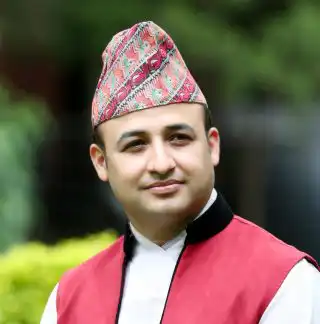
Our founder Bhagwat started as a porter in 1998, is a licensed guide, studied travel and hospitality in the UK, and still leads groups when he can, including on this upgraded Base Camp calendar. You'll sleep in warmer lodge rooms through Namche, Tengboche, and Dingboche, and our office books those beds before you fly.
We send one porter for every two guests on this lodge route, or a dedicated porter if you travel solo, with loads around 25 to 30 kg, insurance, fair pay, and kit renewed each year. Your guide watches height toward Everest Base Camp and Kala Patthar, and we'll time any helicopter sector between Kathmandu and Lukla around weather rather than rushing you off the icefall.
Namaste and Tashi Delek! Greetings from the capital of world Himalayan trekking and tourism, the town of Kathmandu. Our correspondent with the signboard of our company name will wait for your arrival at TIA.
After greeting you, he will then drive you to the luxurious accommodation in a private transport we have arranged just for you. Please make yourself comfortable and stretch your body after a tiring flight. After the whole group arrives at the hotel, our tour guide will meet everyone and organize a small meeting to explain about the travel program of our luxury Everest Base Camp trek.
If you need to buy the missing tourist equipment, Thamel trekking shops and an experienced shopping instructor in the person of our guide are at your complete disposal.
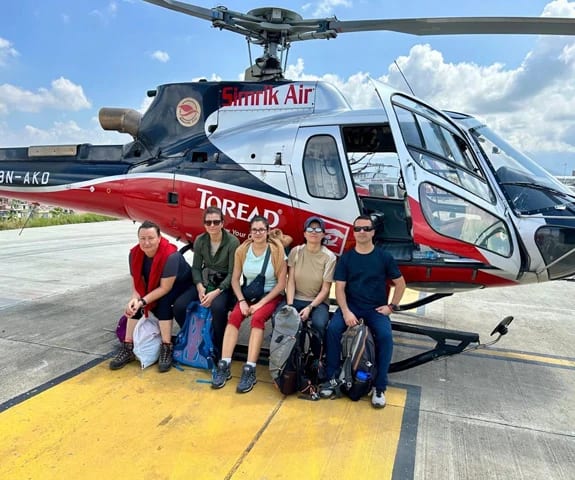
An early awakening and we take adventure Helicopter flight over mountains toward Lukla. After collecting our luggage short tea, coffee break at Lukla and continue our journey to EBC.
Apart from this chaos, prepare to greet the silently standing 6187 m high Kongde Ri Peak. Following the refreshing breakfast, we will now head with our team of guides and porters for a short transition to Phakding.
Our short walk will take us side by side with the amazing Dudh Koshi River. The Sherpa settlements of Chheplung, Chaurikharka, and Thadokoshi will give us glimpses of remarkable Tibetan culture along with the 6367 m high Kusum-Kangaru Peak.
Walking beside the fierce currents of Dudh Koshi, we will meet the long swaying metal bridge that will take us to the other side of the river. The path from here now steadily climbs and descends till we reach Benkar.
6609 m silhouette of Thamserku is an exceptional highlight of this small town. Now, we will press onward to Monjo, the gate that allows us inside the protected territory of Everest National Park.
Our permits will be reviewed after which we will take our steps forward towards Jorsalle. The fabulous landscape opens up as we keep on ascending for 30 more minutes and reach 60 m long Sir Edmund Hilary Bridge.
To complete our luxury Everest Base Camp trek as comfortably and simply as possible, we will stay overnight in Namche today. Instead of relaxing, we will take the radial descending walk along the green path towards the Khumjung Sherpa Village (3790 m). It has the museum of climbers and the main attraction to the scalp of a snowman in the local monastery located on the edge of a 500-year-old juniper grove.
Next, we will radially climb up to 3880 m high Everest View Hotel, renowned as the highest luxury hotel in the world. From its every corner, you can see the marvelous outlines of Thamserku, Taboche, Cholatse (6440 m), Nuptse, Lhotse, and the royal highness of Everest.
We will slowly walk by the gorge of the Dudh Koshi River. Shortly, a long bridge crossing will take us further from Dudh Koshi and nearer to the valley formed by the sparkling waters of Imja Khola. The road on the other side of the bridge rises sharply taking us to the impressive 3250 altitude of Phungi Thanga.
The two-hour-long stretch awaits us from here which will direct us to the main Sherpa monastery of Tengboche. Directly ahead of this Gompa, we can see the heads of Everest, Thamserku, Kangtega, Lhotse, Nuptse, and Ama Dablam. You will the see the Tangboche Monastery from your window.
Where we will rest our legs for the night.
After Tangboche, we will gradually down towards to Diboche village and rise further to meet yet another suspended metal bridge hanging over the Imja Khola. After we step onto the bridge, we will begin to climb towards 3900 m Pangboche which has its own little charming monastery. It once protected the real Yeti Scalp but now it only displays its replica.
You may also get to feel the environment of the high altitude, the vegetation starting to thin out and replaced by scattered tundra trees. Walking deep into the Imja Valley, Lobuche River will meet us to direct our path towards Dingboche. Everything here is made of stones, the houses, the farm borders, the streets, charming in its own way.
6812 m Ama Dablam, Lhotse walls, and 6165 m Island Peak will not shy away from us but Everest will momentarily hide behind their walls.
After Namche, Dingboche is another amazing place to spend the moment of relaxation and increase the chances of adaptation. There are larger options for you to spend the day here, you can engage in billiards, taste hot coffee, and eat hot French pastries in front of mountains.
But we suggest you take a climb of 700 m to the tip of 5100 m high Nangkartshang/Nagarjung Hill. You may need to give 3 to 4 hours of your time to ascend and walk down from this massive hill.
Climbing along the rocky landscape dotted with huge boulders will not be easy but it will not be hard as well. All your hardships however will be rewarded with the fantastically unbelievable views of Cholatse, Ama Dablam, Lobuche, Baruntse (7129 m), Thamserku, Tawache, and Island, along with the towering Makalu (8485 m).
After Dingboche, we will take the trail that rises steeply by 100 m and head to Dusa. The trail now heads to the terminal moraine of Khumbu Glacier taking us ahead to Dughla (4500 m). Now begins a steep ascension to the moraine that will lead us to the sacred place of climbers, the Dughla Pass elevated at 4830 m.
This Pass acts as the memorial to the brave mountaineers who lost their souls and lives to the Himalayas. After taking a moment to relish the views of Lobuche, Ama Dablam, and Lobuche Base Camp, we will head to Lobuche, our overnight destination- 2.5 km away from the pass, just a one to two-hour walk will be needed to reach Lobuche.
Our long-awaited moment has arrived when we will finally gaze at Everest Base Camp. Starting before dawn, with the aid of deeming lights of our headlamps, we will march along the edge of the Khumbu Glacier.
Soon, Lobuche Pass will arrive from where the grand spectacle of Khumbutse, Pumori, Lhotse, and Everest open up. One more steady ascent from the Pass will take us along the edges of the Changi Glacier.
Here we are, at Gorakshep, the Kingdom of sand, rocks stones, and ice. It is also the last village offering overnight lodging to the guests of Everest.
The day has finally arrived to spectacularly conclude our luxury Everest base camp trek. In the dark shadows of the early morning hours, we will start our climbing along the treacherous, icy slopes to reach the tip of Kala Patthar. Based on your skill and effort, the journey can take around 2 to 3 hours but just at the right moment to see the white snowy walls of the Pumori, Lhotse, Ama Dablam, Everest, Khumbutse (6636 m), Lobuche, Changtse, Nuptse, and Lingtren (6749 m) under the shimmering orange hue of the first rising sun.
Having absorbed the majesty of the moment, it's time to take the route back to Gorakshep. While we have our hot meal, our helicopter will arrive to take us back to the buzzing city of Kathmandu.
The days of traveling have come to an end. We hope the amazing experience you gained on this trip will change your minds and your lives.
We will see you off at the airport three hours before your departure time. Nepal is hoping to see you again!
Most guests fly into Tribhuvan International Airport in Kathmandu. Share your arrival time ahead of travel so a Thamel hotel transfer can be arranged, or make your own way to the meeting hotel.
Pre-trek briefings usually take place in Kathmandu before the Lukla flight or helicopter sector. Allow extra days after the trek in case mountain flights are postponed by weather.
Twin or double rooms in a comfortable Kathmandu hotel cover your first nights and your return from the trail, with breakfast on those city stays when included in the package. Briefings happen at the hotel, and airport collection from Tribhuvan is available when flight times are shared in advance.
Family-run teahouses or lodges line the route with twin beds and a shared dining room. Rooms get simpler and colder as you climb, with shared bathrooms common at higher villages. Hot water, Wi-Fi, and charging are paid at the lodge when offered.
March to May rhododendron bloom and October to November crisp air are peak windows for this itinerary. July and August mean leeches and cloud on lower slopes; December to February can ice steps above village level.
Your guide reads the forecast before long cols or sunrise hikes. Shoulder weeks need an honest weather call before high passes or dawn viewpoints.
You should be comfortable walking several hours a day on uneven paths with a daypack, including steady uphill sections as you gain height. Hill training and longer weekend walks in the months before travel help your legs and lungs on uphill trail days.
Hill training, stair climbing, and longer weekend hikes in the months before travel help your legs and lungs, even when acclimatisation days are built into the route. Break in boots before you fly and carry a light daypack on practice walks.
Guided trekking with licensed leaders, lodge nights on the trail, meals as described for walking days, and permits for the regions crossed are included when they are part of this trip. Domestic flights, porters, and airport transfers apply only when they are part of this trip.
Domestic flights, road transfers, porter support, and airport transfers apply only when they are part of this trip. Permits for the regions you cross are arranged in Kathmandu or Pokhara when included.
International flights to Nepal, visa fees, compulsory travel insurance, personal trekking clothing, snacks and drinks outside included meals, and tips for crew are not covered. Hot showers, Wi-Fi, and battery charging in lodges are usually paid locally when offered.
Charges for hot showers, Wi-Fi, or battery charging in lodges are paid locally when offered unless your trip notes say otherwise. International flights, visa fees, and personal insurance stay outside the trek package.
Share your Tribhuvan arrival time ahead of travel for a Thamel hotel transfer, or make your own way to the meeting hotel in the capital. Thamel hotels are the usual meet point; drivers need flight numbers to meet you at the international terminal.
Briefings cover Lukla bag weight, porter duffle limits, and what to wear on the mountain flight. Weather can shift daily plans, so your guide keeps a steady pace with regular breaks.
The itinerary builds rest days and climb-high, sleep-low hikes where the route requires them. Your crew would rather wait for a safe window than rush marginal weather.
Tell your guide early if symptoms appear so tomorrow's stage can shorten or descent can start before conditions worsen. Trail conditions are checked each morning before the group moves.
Mountain weather can delay or postpone Lukla flights even in peak season, and Ramechhap diversions happen when the airstrip is congested. Allow a little extra time after the trek before international flights home in case mountain roads or flights move.
Build buffer days after the trek for international connections, and follow crew advice if schedules change or flights shift to Ramechhap. Monsoon cloud sits lower on the hills while winter brings ice on steps above village level.
Sagarmatha National Park and Khumbu municipality permits apply in the Everest region. The team arranges paperwork in Kathmandu or Pokhara when you provide passport copies and trek dates.
Keep copies in your daypack for checkpoint stops. Your crew would rather wait for a safe window than rush marginal weather.
Families join when children can manage the daily hours and terrain on this specific route. Pace and daily hours can be adjusted on private departures, though that may extend the calendar.
Ask our Kathmandu team if you are planning with younger walkers. Private departures can shorten daily hours, though that may add a day or two to the calendar.
Comprehensive travel insurance that covers trekking to the highest altitude on your itinerary, medical evacuation, and helicopter rescue when applicable is essential. Many standard policies exclude high altitude by name.
Read the wording before you travel so you can adjust cover if trekking above 5,000 metres is not named. Many standard policies exclude high altitude by name, so read the wording before you fly.
We partner with Rewilding Britain to help protect our natural spaces for future adventures.
All centres are vetted for safety and quality. Your adventure is in good hands with adventuro.
About the centre
Kathmandu
You'll travel with a Kathmandu-based team that plans treks, peak climbs, helicopter flights, motorbike journeys, and cultural trips across Nepal, Tibet, and Bhutan. Routes range from classic teahouse walks and high passes to luxury lodge itineraries and longer expedition-style climbs, with departures shaped around how you want to pace the mountains.
Licensed guides and office staff train regularly on mountain safety and guest care. Porters are insured, fairly paid, and equipped for the trail, with sensible load limits on lodge routes. We work with remote communities through sustainable tourism, including support for education in village areas, so your booking helps local people as well as your own adventure.
Operated by Himalayan Adventure Treks & Tours, a partner of adventuro.