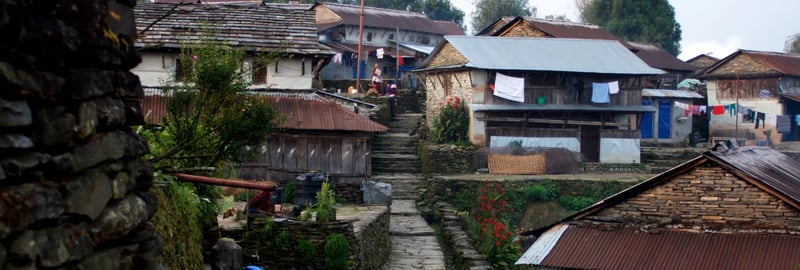
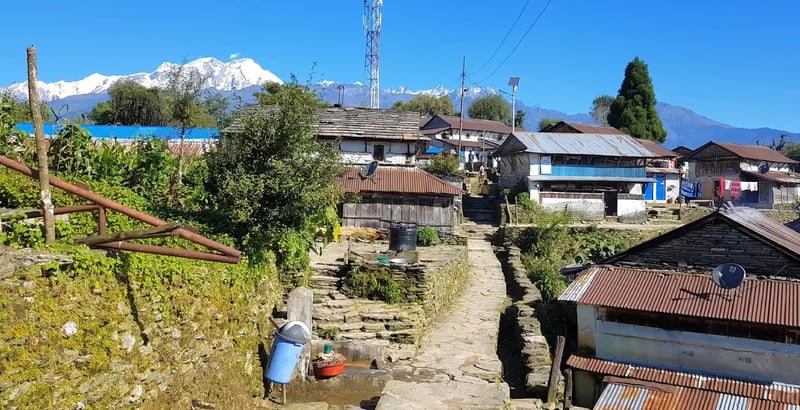
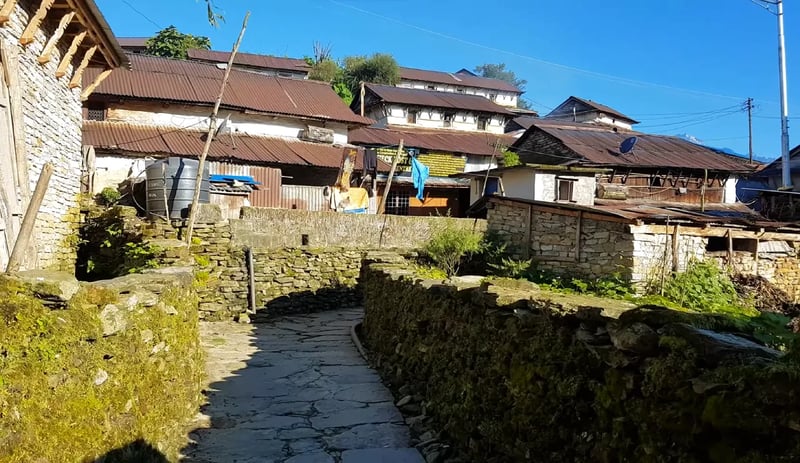
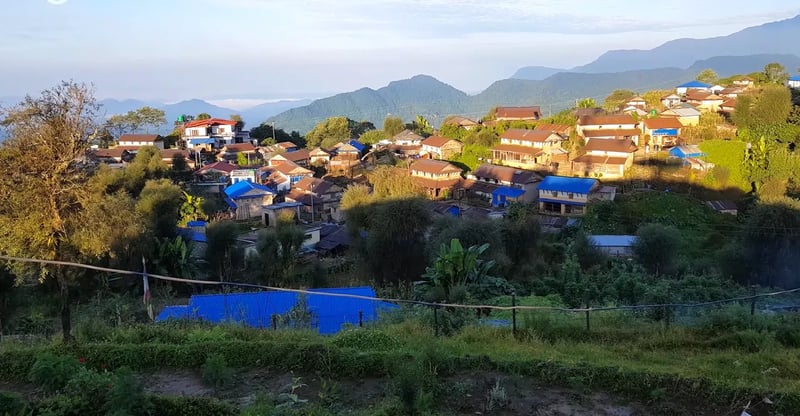
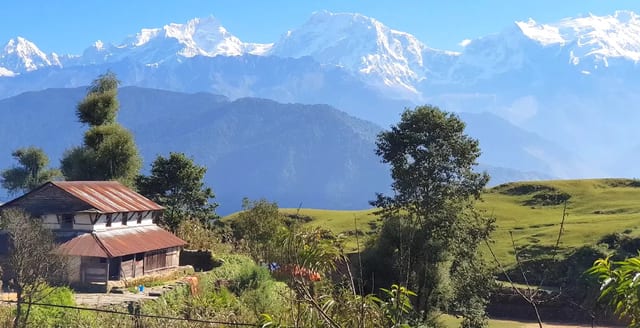
Ghalegaun is a Gurung homestay village on the mid-hills above Besishahar, reached by a drive and a short walk through terraces and forest. You eat with host families and walk to local viewpoints at dusk. Host-family meals, millet fields, and a dusk viewpoint over Annapurna South are the stay.
Cultural dances, millet fields, and Annapurna South on the horizon are the draw. You return to the road and Pokhara or Kathmandu after a village-paced stay. A cultural evening in the village and a road return to Besishahar close a mid-hill week without a pass.
A share of our profits supports school students in remote villages, which matters on a Ghalegaun homestay week where you eat with host families. You'll drive to Khudi, stay in Ghalegaun and Ghanapokhara, then walk through Baglungpani and Laxmi Bazar toward Begnas Lake. We match a Gurung-hill guide when we can, licensed through MOCTCA, for millet fields and dusk viewpoints rather than high camps.
Homestay rooms are booked from Kathmandu before you leave Thamel, so cultural evenings and the Annapurna South skyline are the stay, not a hunt for beds. Your guide knows gompa lanes and when the village dance nights run. Porters carry light lodge loads at one per two guests, and we keep the week mid-hill and village-paced.
You land in Kathmandu at 1,400 meters, where one of our reps meets you at the airport. We transfer you directly to your hotel in the city. This day is for settling in after your flight, and we expect you to rest.
You should recover from travel and prepare for the trek ahead. There is no trekking activity on Day 1; it is purely an arrival and transfer day. We ensure you get to your accommodation smoothly.
The trek guide confirms your permits and gear for the Ghalegaun Trek, if you rent through us. You meet your guide briefly along with the porters.
Today, we drive you from Kathmandu to Khudi. The ride takes six to seven hours as you leave the city’s noise behind. You enter the Marsyangdi River valley where the road winds through green hills and terraced farms. You pass small villages and see locals walking the roadside. The elevation drops slightly from 1,350 meters to 790 meters. You lose altitude but gain perspective of the countryside.
Khudi sits at the trailhead for the Ghalegaun Trek. The village is quiet and clean. It feels remote even though you drove there. We check you into a basic teahouse as you stretch your legs after the long drive. You eat dal bhat for dinner, which will be a repeating meal on this journey. You can review the map for tomorrow’s trek to Ghalegaun.
The trek guide will remind you to hydrate and pack your day bag lightly. This drive somewhat sets the tone as it is rough and bumpy at times. You trade wheels for trekking boots tomorrow. The real walking starts from here. The Ghalegaun Trek begins the following day, after you rest tonight in Khudi.
You start walking from Khudi at 790 meters as the trail climbs immediately on stone steps carved into the hillside. You pass through a dense forest of oak and rhododendron where tree roots twist across the path at times. You can take out your trekking poles for balance and support. After one hour, you reach a small ridge with your first view of Lamjung Himal. You refill your water at a stone tap fed by a mountain spring, the locals call it “dhara.” You pass Chisapani village at 1,200 meters, while buffaloes and other cattle graze near tea stalls.
The path narrows and hugs the mountainside. Then, we cross a suspension bridge over a roaring stream. Soon after, the trail crosses the Thulo Khola stream on a log bridge. You ascend again through bamboo thickets as monkeys watch from above. At 1,400 meters, you reach Thulopata and stop there for lunch.
Dal bhat steams on tin plates and you get to rest for thirty minutes. The final stretch zigzags up a steep ridge as you sweat and breathe heavily. Eventually, you arrive in Ghalegaun at 1,800 meters.
You leave Ghalegaun at around 8 a. M., and the trail descends 330 meters over four hours. You leave your main bag at the lodge and trek down to Ghanapokhara. The trail drops 330 meters over four hours and you cover 8 to 9 kilometers. The trail starts on stone steps winding through terraced fields and we pass by groups of women harvesting millet.
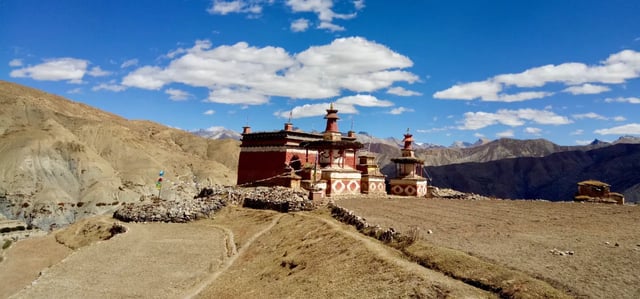
You greet them with “Namaste.” Then, the path narrows near forest edges and soon after, we cross a wooden bridge over a gushing stream. You get to refill your bottle at a natural spring, where locals wash vegetables nearby. You enter Ghanapokhara village by midday where stone houses cluster around a central square and prayer wheels line the entrance. You check into a guesthouse, rest for a bit, and explore the village. You visit a small monastery, featuring monks chanting softly.
You can photograph carved windows and slate rooftops and drink local honey tea. You feel the culture here, it's real and authentic. This is not just a walking day, it is a cultural immersion. The Ghalegaun Trek gives you mountains and moments.
On Day 5 of our Ghale Gaun Trek package, we begin from Ghanapokhara at 1470 meters after a hearty breakfast. You cross the Midim River over a sturdy suspension bridge to start the journey. We then climb steadily for three hours toward Khumre Danda, reaching 2000 meters with rewarding views of Annapurna and Manaslu peaks on clear days.
The trail winds through lush rhododendron forests and terraced rice fields, alive with bird calls and occasional waterfalls. Expect a mix of stone steps and dirt paths, covering about 12 kilometers total based on similar routes in the region. Gain 530 meters to the ridge before descending 405 meters to Baglungpani at 1595 meters, completing the hike in four hours.
We pause in Pasgaun to visit a serene Buddhist Gompa and interact with Gurung locals. You arrive early enough to relax in teahouses, join cultural dances, and savor dal bhat dinner.
You leave Baglungpani at 1,595 meters and descend sharply on stone steps worn smooth by boots and mules. You drop 295 meters over five to six hours, covering 10 to 11 kilometers. The trail cuts through dense forest of oak and rhododendron where using your trekking poles is recommended. Soon after, you pass a small waterfall at 1,400 meters; some water sprays your boots. You refill your bottle at a clean spring water stream and then cross a wooden bridge over a rocky stream.
Locals carry rice sacks uphill on the same route. The path narrows near Laxmi Bazar where terraced fields appear. There you might see women harvesting corn, children herding goats, if you are in the right season. You eventually enter Laxmi Bazar by early afternoon, a trading post with small shops that sell noodles, batteries, and trekking socks. We have you check into a basic lodge.
At the village, you can see porters unload kerosene drums. This day is a huge transition as we move from highland villages to a busier stop. The Ghalegaun Trek shows you layers of Nepal.
Early in the morning, you leave Laxmi Bazar at 1,300 meters above sea level. You walk for two to three hours to Begnas Lake. The trail is flat at first, following a dirt road through farmland. You pass banana tree farms and rice paddies where farmers still plow with oxen. After about one hour, you reach the edge of Begnas Lake, where the water stretches wide.
You get to see the Annapurna mountains rise behind it. You follow a stone path along the shore. At the lake, fishermen paddle wooden boats and herons stand in shallow water. You stop at a lakeside teahouse. This marks the end of the trekking days on the Ghalegaun Trek itinerary.
You can order a refreshing masala tea and wait for the ride, if it is not there. The driver meets you here with your transport, then you load your gear into the vehicle, and drive directly to Pokhara. The ride takes a little more than forty minutes.
Starting your day in Pokhara, you pack your gear as we arrange an early departure to Kathmandu. The drive takes six to seven hours. You travel 200 kilometers on the Prithvi Highway as the road winds through hills and river valleys. You pass small towns like Mugling, Dumre, and Naubise. Buses, trucks, and motorbikes fill the lanes and we stop a couple of times for tea, cold drinks, and refreshment.
You watch locals sell fruit by the roadside. The landscape shifts from lakeside green to urban sprawl as you near Kathmandu. You cross the Tribhuvan Bridge over the Bagmati River and enter the city at around 3 or 4 PM. After getting dropped off at your hotel, you can review photos from the past week. The Ghalegaun Trek ends where it began.
You return with stronger legs and clearer thoughts. You saw forests, villages, lakes, and culture, and experienced Nepal beyond the usual routes. We built this itinerary for depth and real connection. In the evening you will enjoy the farewell dinner at Nepali cultural restaurant with cultural dance program.
You start the last day of the Ghalegaun Trek in Kathmandu. We confirm your flight time, pack your bags, and have you check out of your hotel by 12 p. We arrange a private vehicle for your transfer.
The drive to Tribhuvan International Airport takes 30 to 45 minutes. Traffic can slow you down, so we will leave some extra time. Reflecting on the past eight days, you remember Ghalegaun’s stone steps and the morning fog over Begnas Lake.
You walked through culture, not scenery alone, experiencing seldom-visited villages of Nepal.
Fly into Tribhuvan International Airport in Kathmandu unless the itinerary uses another regional hub. Airport or hotel pickup can be arranged when you share arrival details ahead of travel.
Briefings cover road or domestic travel to the trailhead. Build buffer time before onward international flights in case mountain weather shifts the schedule.
Twin or double rooms in a comfortable Kathmandu hotel cover your first nights and your return from the trail, with breakfast on those city stays when included in the package. Briefings happen at the hotel, and airport collection from Tribhuvan is available when flight times are shared in advance.
Family-run teahouses or lodges line the route with twin beds and a shared dining room. Rooms get simpler and colder as you climb, with shared bathrooms common at higher villages. Hot water, Wi-Fi, and charging are paid at the lodge when offered.
Stable trekking weather most often falls in pre-monsoon spring and post-monsoon autumn. Monsoon cloud sits lower on the hills while winter brings ice on steps above village level.
If your dates sit in winter or monsoon, pack rain and cold layers and accept that flight or pass days may move by a day when safety requires it. Weather can shift daily plans, so your guide keeps a steady pace with regular breaks.
You should be comfortable walking several hours a day on uneven paths with a daypack, including steady uphill sections as you gain height. Hill training and longer weekend walks in the months before travel help your legs and lungs on uphill trail days.
Hill training, stair climbing, and longer weekend hikes in the months before travel help your legs and lungs, even when acclimatisation days are built into the route. Break in boots before you fly and carry a light daypack on practice walks.
Guided trekking with licensed leaders, lodge nights on the trail, meals as described for walking days, and permits for the regions crossed are included when they are part of this trip. Domestic flights, porters, and airport transfers apply only when they are part of this trip.
Domestic flights, road transfers, porter support, and airport transfers apply only when they are part of this trip. Permits for the regions you cross are arranged in Kathmandu or Pokhara when included.
International flights to Nepal, visa fees, compulsory travel insurance, personal trekking clothing, snacks and drinks outside included meals, and tips for crew are not covered. Hot showers, Wi-Fi, and battery charging in lodges are usually paid locally when offered.
Charges for hot showers, Wi-Fi, or battery charging in lodges are paid locally when offered unless your trip notes say otherwise. International flights, visa fees, and personal insurance stay outside the trek package.
Hotel meet in Thamel is typical; send flight numbers so pickup can meet you at the international terminal. Allow a little extra time after the trek before international flights home in case mountain roads or flights move.
Rest day buffer after the trek helps if Lukla or helicopter sectors slip by a day. Trail conditions are checked each morning before the group moves.
Guides set a steady pace and watch for headache, nausea, or dizziness as you gain height. Your crew would rather wait for a safe window than rush marginal weather.
Tell your guide early if symptoms appear so tomorrow's stage can shorten or descent can start before conditions worsen. Thamel hotels are the usual meet point; drivers need flight numbers to meet you at the international terminal.
Jeep or bus days to the remote trailhead are arranged when they are part of your package. Your guide confirms departure times at briefing.
Motion sickness medicine helps on winding mountain roads. Shoulder weeks need an honest weather call before high passes or dawn viewpoints.
National park or restricted-area permits apply depending on the valleys you cross. The team arranges paperwork in Kathmandu or Pokhara when you provide passport copies and trek dates.
Keep copies in your daypack for checkpoint stops. Your crew would rather wait for a safe window than rush marginal weather.
Families join when children can manage the daily hours and terrain on this specific route. Pace and daily hours can be adjusted on private departures, though that may extend the calendar.
Ask our Kathmandu team if you are planning with younger walkers. Private departures can shorten daily hours, though that may add a day or two to the calendar.
Comprehensive travel insurance that covers trekking to the highest altitude on your itinerary, medical evacuation, and helicopter rescue when applicable is essential. Many standard policies exclude high altitude by name.
Read the wording before you travel so you can adjust cover if trekking above 5,000 metres is not named. Many standard policies exclude high altitude by name, so read the wording before you fly.
We partner with Rewilding Britain to help protect our natural spaces for future adventures.
All centres are vetted for safety and quality. Your adventure is in good hands with adventuro.
About the centre
Kathmandu
You'll travel with a Kathmandu-based team that plans treks, peak climbs, helicopter flights, motorbike journeys, and cultural trips across Nepal, Tibet, and Bhutan. Routes range from classic teahouse walks and high passes to luxury lodge itineraries and longer expedition-style climbs, with departures shaped around how you want to pace the mountains.
Licensed guides and office staff train regularly on mountain safety and guest care. Porters are insured, fairly paid, and equipped for the trail, with sensible load limits on lodge routes. We work with remote communities through sustainable tourism, including support for education in village areas, so your booking helps local people as well as your own adventure.
Operated by Himalayan Adventure Treks & Tours, a partner of adventuro.