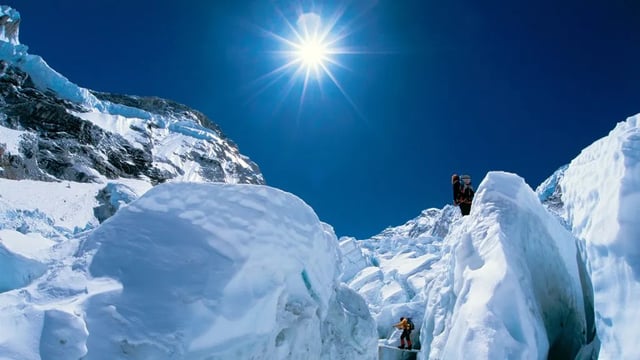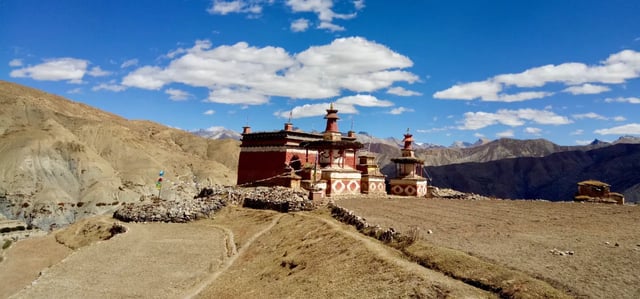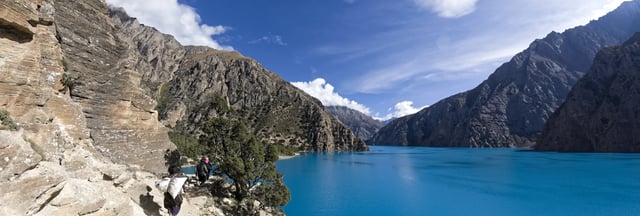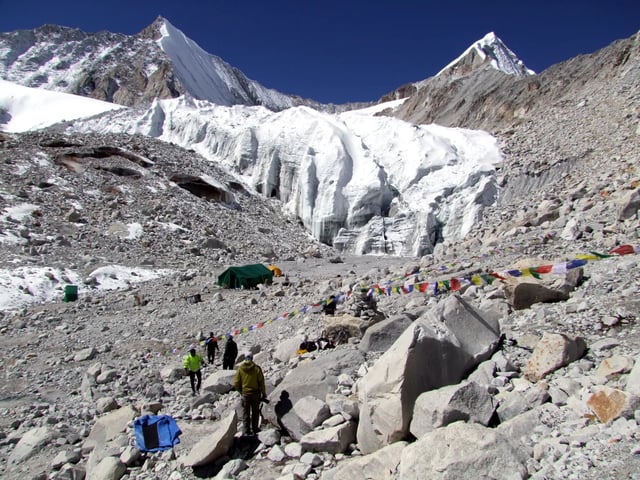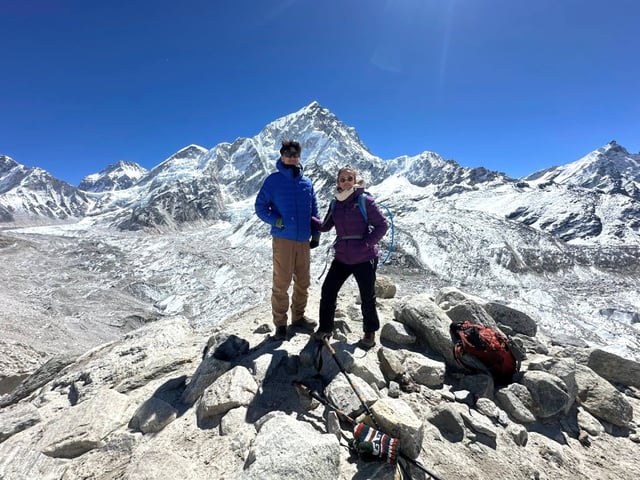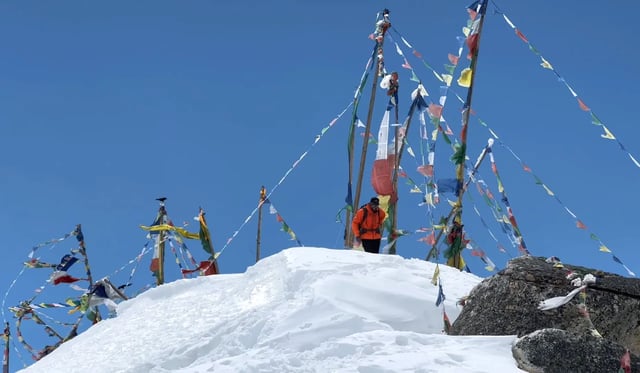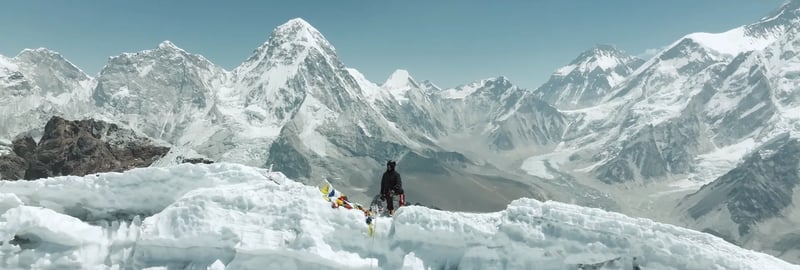
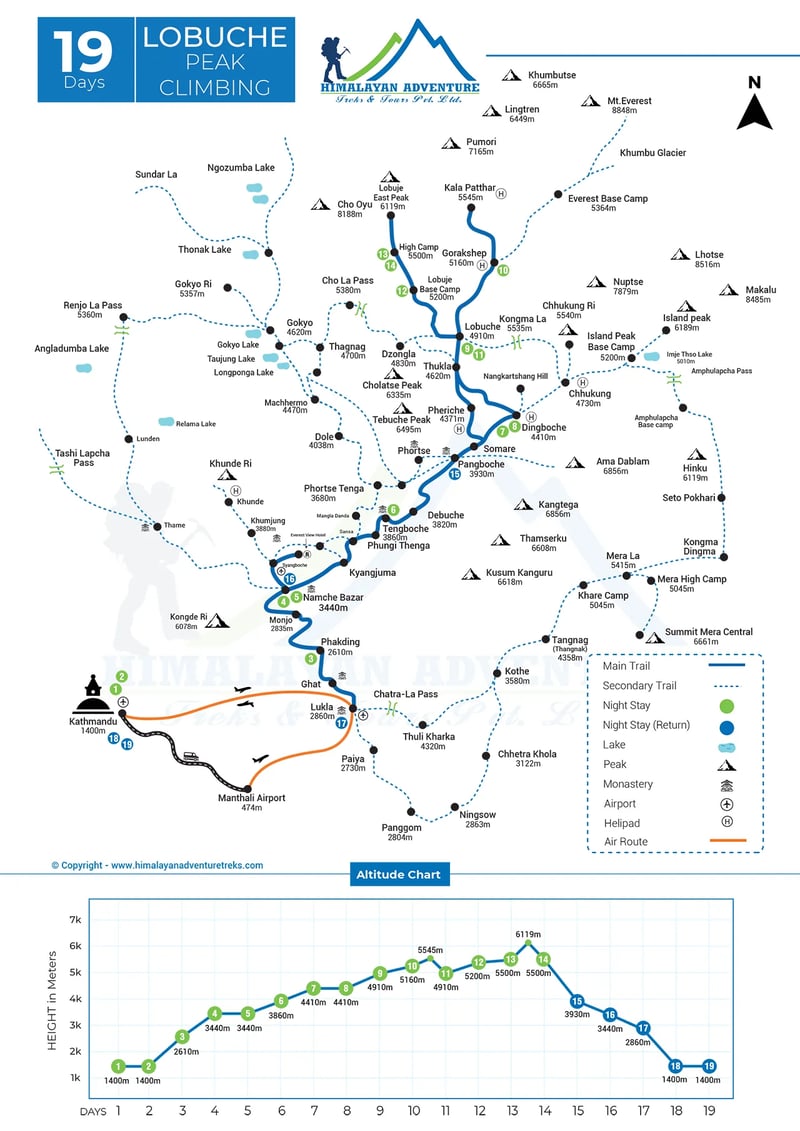
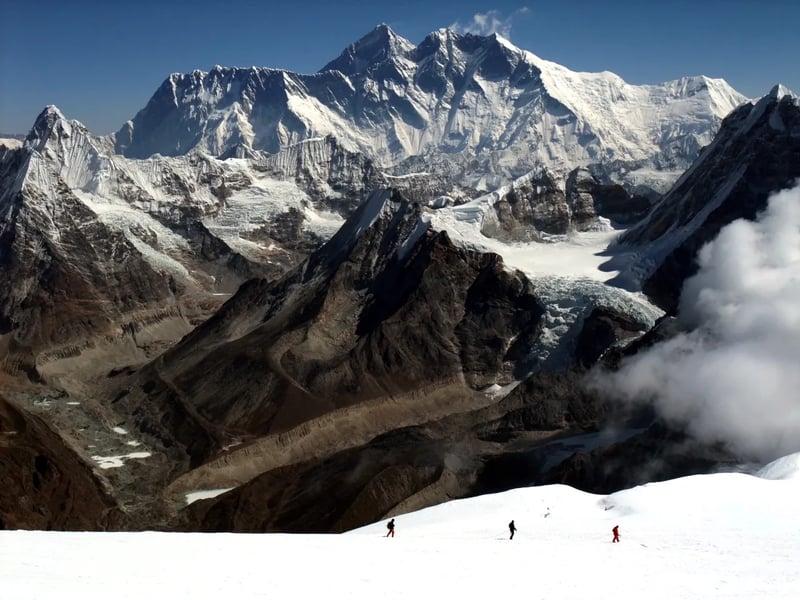
Lobuche East is approached through the Khumbu to Lobuche village, then high camp on the glacier and a rope climb to about 6,119 m. Everest, Nuptse, and Ama Dablam sit around the summit. Lobuche village, a glacier high camp, and a rope ridge to about 6,119 m put Everest and Nuptse around the summit.
You use the same teahouse trail as Base Camp walkers, then switch to tents and harnesses. Descent to the village and Lukla closes the expedition. The teahouse trail gets you there; tents and harnesses take over for the climb.
We belong to TAAN, the Nepal Mountaineering Association, KEEP, and the Village Tourism Promotion Forum, and that same desk books your NMA climbing permit, Sagarmatha paperwork, and Lukla seats. You'll walk Namche, Dingboche, Gorak Shep, and Kala Patthar on teahouse days, then leave the lodges for tents at Lobuche Base Camp and the 5,600 m high camp.
Climbing sirdars check harness and rope kits in Kathmandu, then time the 6,119 m East summit before midday wind. Summit morning uses fixed ropes on steep snow, and we turn back when wind or snowfall erodes the margin. Your guide shares the next camp plan each evening so a glacier hold can shift a day.
You will land in the city of temples, Kathmandu, and our company members will welcome you all to the airport. After all security checking and luggage screening, we’ll move to the hotel in a private vehicle. Upon arrival at the hotel, you will receive a welcome drink and refreshments.
This is the day to relax, chill, and prepare yourself for the adventurous Lobuche peak climbing. Meanwhile, in the evening, you can stroll in the local market and buy souvenirs and gifts for your family and friends.
Following breakfast, the team leaders will conduct an orientation program in the hotel's conference room. They will give you all the details and descriptions about the Lobuche Peak trek, which includes how to prepare, adapt to changing conditions, slowly walk on trails, work as a team work, and respond properly in emergency conditions.
After orientation, we’ll have lunch, and then you’ll have a sightseeing day. Today, we’ll learn about the history and culture of Nepal by exploring UNESCO sites like Pashupatinath (Lord Shiva Temple), Swayambhunath (Pilgrimage of Bouddha& Hindu), MahaBouddha, Kathmandu Durbar Square, and several other majestic places in Kathmandu.
Let’s begin our flawless journey of Lobuche. After having a morning breakfast, we all will drive away to the Tribhuvan Airport to domestic terminals. After boarding, we’ll sit and fly away to Lukla.
During the 35 minutes, you’ll see mesmerizing views of mountains and landscapes. After getting to Lukla airport, we all will forward our steps towards the beautiful settlement of Phakding. This place is the first part of our trekking.
During hiking, one will be able to admire elegant mountains, lush forests, and impeccable views of landscapes. After walking for 3-4 hours, we’ll finally reach Phakding, where we spend our night at a tea house.
This is day 4 of our trek. After taking an early meal, we’ll forward our steps to our ultimate destination today, Namche Bazaar. The trail is approximately 10 kilometers, and we have to walk approximately 6 to 7 hours.
After crossing and witnessing Mount Thamserku, you all will reach the checkpoint Monjo. It is the entrance to the Sagarmatha National Park. After taking the permit, we’ll forward our steps via the Bhotekoshi and Dudhkoshi Rivers till we reach the Namche Bazaar.
After reaching our destination, we’ll be able to witness the Giant Mountains of Nepal, which include Mount Everest (8848 m), Nuptse (7,861), and Lhotse (8516 m). Today, we’ll spend our night at a hotel or tea house, depending on the availability.
The 5th day of our tour is to acclimatize, rest, and admire the beauty of Namche and Khumjung. Namche, also known as the Gateway of the Everest, holds great significance. Additionally, it encompasses a variety of facilities such as cafés, restaurants, bakeries, ATM centers, among others. Although today is a rest day for us, we land our steps in the settlement of Khumjung.
It is an easy-going trail from Namche. After reaching the place, we’ll be able to explore impeccable mountain views, the monastery, and the hospitality of Sherpa. Meanwhile, after witnessing the Khumjung, we’ll move to the Hotel Everest view. This is the site where we have 360 views of Mount Everest, Lhotse, Nuptse, and several other peaks.
Furthermore, this hotel is fabulous for fine dining, restaurants, and accommodation. At the end of the day, we’ll return to our hotel where we’ll have a delicious meal.
After a mesmerizing day at Namche Bazaar, we’ll move forward to Tengboche. Today our hiking will be a bit strenuous. The trail is about 5 to 6 hours long, and we have to cover a maximum elevation of 3860 meters.
After leaving Namche bazaar, the trail will become narrower and less maintained. During the trek, we’ll be able to witness several mountains, lush green forests, and many more. Additionally, we’ll pass through the beautiful settlements of PhunkiThanga, and there will be many suspension bridges throughout the tour.
At the end of the day, we'll reach Tengboche and have an overnight stay at a tea house.
After a wonderful visit to Tengboche, we’ll forward our steps to Dingboche. The path goes through the alpine forest till we arrive at Deboche. We then cross the ImjaKhola via a suspension bridge.
You find yourself looking at a wall covered in etched stones. We will see Mount AmaDablam, which appears flawless from this location the same day. Then we will all continue the path of Imja Valley and climb towards the settlement of Pangboche.
Eventually, at the end of the day, we all will reach Dingboche, which has an elevation of 4360 meters. We’ll spend our night at the tea house.
By following the quote, “Rest is best,” today we will acclimatize at the Dingboche instead of following our steps for the trek. To enhance the effectiveness of the day, we will proceed to Nagarjun Hill (5000m). After breakfast, we will head for the trip to Nagarjuna Peak.
Initially, we will ascend steep slopes with rocks and stones, which makes the trek quite challenging. The entire concept of acclimatization is to walk higher and sleep lower. After a couple of hours of hiking, we’ll reach Nagarjun hill.
From this location, we have promising views of Makalu, Lhotse, AmaDablam, and several other mountains. Lately, at the end of evening, we’ll move down to Dingboche.
After a resting day at Dingboche, we will follow our 9th-day itinerary. Once again, the alarm sounded, and after a hearty breakfast, we embarked on our journey to today's destination. On the 9th day of our trip, we have to cover 4-5 hours of hiking over a distance of 8 kilometers.
Today our trail will be a bit tougher than the 7th day. We have to reach the maximum height of 4910 meters. Our trail starts with a gradual ascent.
After 2 to 3 hours of hiking, we’ll reach Thulka, a beautiful settlement in the lap of the Himalayas. We’ll have lunch there. After having a meal and resting for some time, we’ll move towards Thukla pass and finally, we reach Lobuche.
We are in the mid of trip. And today may be the longest day in our itinerary. After having an early breakfast, we’ll move forward our steps to Gorakshep to the last human settlement before the Mount Everest base camp. While hiking from Lobuche to Gorakshep, you’ll have steep rocky path and height/elevation is 250 meter, which covers approximately 6 km distance.
Today hike will not be prettier than yesterday. By gaining more elevation, you may feel low oxygen. Additionally, your steps need more energy to trek. After walking for sometimes, you’ll undergowith steep rocky path of the Khumbu Glacier.
Climbing down the steep and very frigid paths to Gorakshep and then Everest Base Camp comes next. It moves over the Khumbu Glacier's banks and, given its high altitude, requires a lot of energy even if the distance is somewhat modest. The splendor of Khumbu Icefall and other surrounding mountain peaks including Nuptse, Pumori, and Khumbustse will captivate you as you arrive at EBC. You will return to Gorakshep for a nighttime sleep after ideal quality time at Everest Base Camp.
Today, we’ll have the best day of our trip. On Day 11, we are going to hike to the popular point of view of Nepal, Kala Patthar, which has an elevation of 5545 meters. We depart early morning from our tea house. It is worth it to reach the top of the Kala Patthar.
On day 11, we may have undergone a strenuous route that includes steeps and moraines. However, you’ll get the fruit of patience after reaching the top of Kala Patthar. By reaching there, you witness the elegant views of Sagarmatha, Mt. Pumori, AmaDablam, Khumbu glacier, and Lhotse.
We’ll spend some time at this point and take photographs. Lately, we forwarded our steps down to the Lobuche settlement where we have a comfortable rest house and hygienic food for the night.
We are on day 12 of Lobuche Peak climbing. Today, we have to move our steps to Lobuche Base Camp, which has a height of 4900 meters. Once again, our alarm went off; following an early breakfast, we prepared to reach Lobuche Base Camp.
The 12th-day trail is going to be steeper and rougher. Therefore, we should slowly move our feet to reach the Lobuche Base Camp. After hiking for a couple of hours, we’ll reach base camp.
After resting forsome time, we will put the tents up and rest for today.
We are on the 13th day of the Lobuche Peak Climbing. The trail further continues gradually. After hiking for 2 to 3 hours, we’ll reach the high camp of Lobuche.
Tomorrow is going to be a bit tougher; we have to walk for more than 7 hours. Therefore, once we reach high camp, we will have lunch, install the tents, and then rest in preparation for the next day's trek.
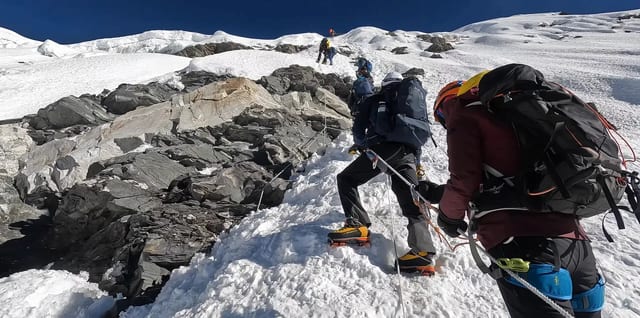
The 14th is going to be the tougher but more adventurous day for us. We’ll start our day before sunrise, as we have to cover 7-8 hours of hiking. Additionally, we have to reach the summit before 12 because the strong winds are going to create problems for us. Our climbing is going to be a bit technical today.
Today's path is going to be snowy, steep, and technical, and we have to conquer this day with fixed ropes. Tough terrains and 45-degree snow slopes will make our route challenging. Yes, it is the toughest day of our Lobuche trek. However, when you reach the top, you feel you are in heaven.
You’ll have impeccable and flawless views of Mt. Everest, Nuptse, Lhotse, Thamserku, AmaDablam, and Cholatse.
Once we have successfully reached the summit of Lobuche, it's time to make our way back. We will trek from Lobuche High Camp to Pangboche on day 15, covering a distance of approximately 10 kilometers. After waking up early in the morning, we’ll forward our steps to the Sherpa’s settlement, Pangboche.
Today walking is going to be easier than the previous day because we are declining our feet towards the lower altitude. After trekking for 7-8 hours, we’ll reach the beautiful village of Pangboche, where we’ll have mouthwatering food and a comfortable bed to stay in.
After waking up early in the morning, we have to return to Namche Bazar. By passing along the Imja River and seeing the lush green forest and flowering rhododendrons, we’ll reach Tengboche, where we’ll take some rest and have lunch.
After taking a rest, we’ll forward our steps and move to Sansa village. Later on, we’ll cross through the Dudhkoshi River after observing the pine forest.
This area is lovely with a variety of flora &fauna, different species of birds, and local animals. Eventually, we reach Namche Bazar after 5 to 6 hours of trekking.
Finally, we are on the last day of our trek. Hope you all enjoy the and adventurous Lobuche Peak Climbing. After an early wake-up and plentiful breakfast, we’ll drive our steps from Namche Bazar to Lukla.
Today we have to cover a distance of approximately 13 kilometers in 6-7 hours. Additionally, our feet traverse several settlements, suspension bridges, steep terrain, and stony trails to reach Lukla.
Your outstanding, remarkable, and impeccable trek will end after reaching Kathmandu by taking a flight from Lukla. Upon reaching here, our employee will receive you and drive you all to the hotel.
Today you can relax, chill, and have some refreshments by visiting local markets like Thamel and the New Road area of Kathmandu. At the end of the day, we’ll serve a mouthwatering farewell dinner of Thakali food, which includes rice, lentils, vegetables, mutton/chicken/fish, curd, and Nepali pickle.
By collecting all memories Lobuche Peak climb, our representative will drop you at the International terminal 3-4 hour prior your flight time.
You may also plan your another trip with us.
Most guests fly into Tribhuvan International Airport in Kathmandu. Share your arrival time ahead of travel so a Thamel hotel transfer can be arranged, or make your own way to the meeting hotel.
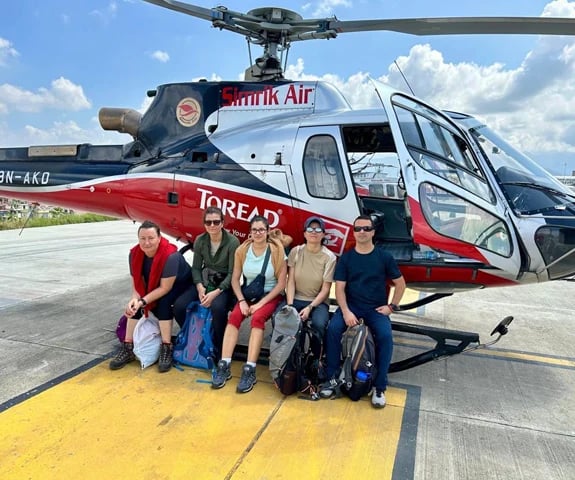
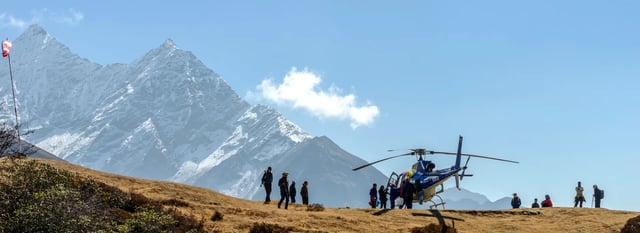
Pre-trek briefings usually take place in Kathmandu before the Lukla flight or helicopter sector. Allow extra days after the trek in case mountain flights are postponed by weather.
Twin or double rooms in a comfortable Kathmandu hotel cover your first nights and your return from the trail, with breakfast on those city stays when included in the package. Briefings happen at the hotel, and airport collection from Tribhuvan is available when flight times are shared in advance.
Family-run teahouses or lodges line the route with twin beds and a shared dining room. Rooms get simpler and colder as you climb, with shared bathrooms common at higher villages. Hot water, Wi-Fi, and charging are paid at the lodge when offered.
Spring from March to May and autumn from September to November usually bring the clearest views and stable walking conditions on this route. Winter is quieter but colder at altitude, while monsoon months bring cloud and wet trails at lower elevations.
Shoulder weeks need an honest weather call before high passes or dawn viewpoints. Monsoon cloud sits lower on the hills while winter brings ice on steps above village level.
You should be comfortable walking several hours a day on uneven paths with a daypack, including steady uphill sections as you gain height. Hill training and longer weekend walks in the months before travel help your legs and lungs on uphill trail days.
Hill training, stair climbing, and longer weekend hikes in the months before travel help your legs and lungs, even when acclimatisation days are built into the route. Break in boots before you fly and carry a light daypack on practice walks.
Guided trekking with licensed leaders, lodge nights on the trail, meals as described for walking days, and permits for the regions crossed are included when they are part of this trip. Domestic flights, porters, and airport transfers apply only when they are part of this trip.
Domestic flights, road transfers, porter support, and airport transfers apply only when they are part of this trip. Permits for the regions you cross are arranged in Kathmandu or Pokhara when included.
International flights to Nepal, visa fees, compulsory travel insurance, personal trekking clothing, snacks and drinks outside included meals, and tips for crew are not covered. Hot showers, Wi-Fi, and battery charging in lodges are usually paid locally when offered.
Charges for hot showers, Wi-Fi, or battery charging in lodges are paid locally when offered unless your trip notes say otherwise. International flights, visa fees, and personal insurance stay outside the trek package.
Pickup can be arranged from Tribhuvan International Airport or your hotel in Thamel when you share flight times ahead of travel. The pre-trek briefing is usually held at the hotel before the Lukla flight or helicopter sector.
Allow buffer days after the trek in case mountain flights move. Thamel hotels are the usual meet point; drivers need flight numbers to meet you at the international terminal.
The itinerary builds rest days and climb-high, sleep-low hikes where the route requires them. Your crew would rather wait for a safe window than rush marginal weather.
Tell your guide early if symptoms appear so tomorrow's stage can shorten or descent can start before conditions worsen. Trail conditions are checked each morning before the group moves.
Mountain weather can delay or postpone Lukla flights even in peak season, and Ramechhap diversions happen when the airstrip is congested. Weather can shift daily plans, so your guide keeps a steady pace with regular breaks.
Build buffer days after the trek for international connections, and follow crew advice if schedules change or flights shift to Ramechhap. Allow a little extra time after the trek before international flights home in case mountain roads or flights move.
Sagarmatha National Park and Khumbu municipality permits apply in the Everest region. The team arranges paperwork in Kathmandu or Pokhara when you provide passport copies and trek dates.
Keep copies in your daypack for checkpoint stops. Your crew would rather wait for a safe window than rush marginal weather.
Families join when children can manage the daily hours and terrain on this specific route. Pace and daily hours can be adjusted on private departures, though that may extend the calendar.
Ask our Kathmandu team if you are planning with younger walkers. Private departures can shorten daily hours, though that may add a day or two to the calendar.
Comprehensive travel insurance that covers trekking to the highest altitude on your itinerary, medical evacuation, and helicopter rescue when applicable is essential. Many standard policies exclude high altitude by name.
Read the wording before you travel so you can adjust cover if trekking above 5,000 metres is not named. Many standard policies exclude high altitude by name, so read the wording before you fly.
We partner with Rewilding Britain to help protect our natural spaces for future adventures.
All centres are vetted for safety and quality. Your adventure is in good hands with adventuro.
About the centre
Kathmandu
You'll travel with a Kathmandu-based team that plans treks, peak climbs, helicopter flights, motorbike journeys, and cultural trips across Nepal, Tibet, and Bhutan. Routes range from classic teahouse walks and high passes to luxury lodge itineraries and longer expedition-style climbs, with departures shaped around how you want to pace the mountains.
Licensed guides and office staff train regularly on mountain safety and guest care. Porters are insured, fairly paid, and equipped for the trail, with sensible load limits on lodge routes. We work with remote communities through sustainable tourism, including support for education in village areas, so your booking helps local people as well as your own adventure.
Operated by Himalayan Adventure Treks & Tours, a partner of adventuro.