We partner with Rewilding Britain to help protect our natural spaces for future adventures.
All centres are vetted for safety and quality. Your adventure is in good hands with adventuro.
Marangu is Kilimanjaro's oldest hut route: you sleep in bunks rather than tents, and you walk the same trail up and down. This six-day plan adds a rest day at Horombo Hut so you are not rushing straight from the forest to Kibo, which is the difference from a five-day Marangu dash. Huts also make this a practical choice in the March to June rains, when camping is less appealing.
Early days climb through rainforest to Mandara Hut, then moorland to Horombo, with a chance to walk up Maundi Crater on the way. After a rest day you cross the alpine saddle to Kibo Hut, then start for Gillman's Point and Uhuru Peak around 23:30. Hotel nights sit either side of the trek.
A cook prepares meals at the huts, so you are not eating in a tent each evening. Soft drinks and snacks are sold at the camps if you want them. Descent retraces the same path all the way to Marangu Gate. Full walking times are below.
Marangu Gate sits on the south-eastern side of the mountain, reached from Moshi. The trail is the only one that uses the same path for ascent and descent, with views towards both Kibo and Mawenzi.
Moshi is the usual hotel base, with kit hire for the nights either side of the trek. Kilimanjaro International Airport handles arrival and departure.
You should be comfortable walking for several hours on rough trails, including a steep, rocky summit night. Previous trekking is ideal, because consecutive days on the same path still add up.
The minimum age is 16. Get medical advice if you have heart, lung or blood-pressure conditions.
The extra Horombo night is the point of this itinerary compared with a five-day Marangu dash. Licensed guides, oxygen and AMREF cover travel with the group.
Hut beds, hotel nights either side, and airport transfers are included. You still walk; you just are not pitching a tent each afternoon.
A driver meets you at Kilimanjaro International Airport and takes you to the hotel. That evening your guide briefs the group, checks kit, and notes anything that still needs hiring before the drive to Marangu Gate.
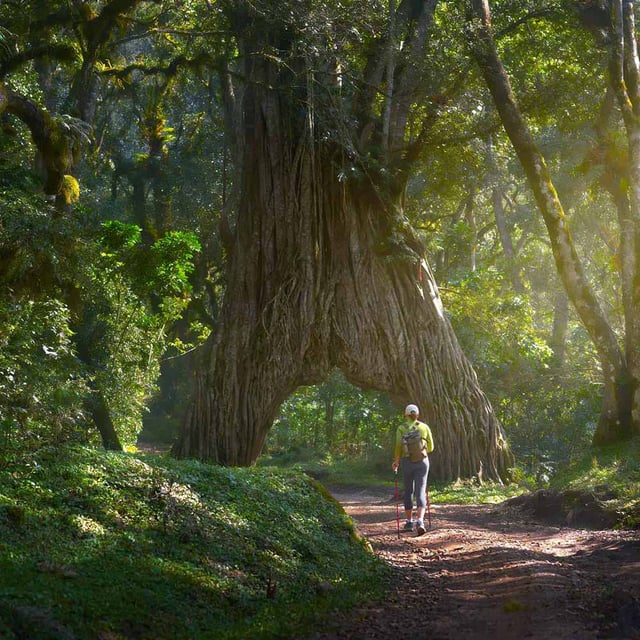
After breakfast you drive from Moshi to Marangu Gate at 1,980 metres, register, and start through rainforest that is often wet and muddy. Three to four hours and about 12 kilometres reach Mandara Hut at 2,700 metres. Rooms hold six to eight bunks, with solar lighting and flush toilets beside the central hut. Watch for colobus monkeys in the trees.
You leave the forest for heath and moorland, passing Maundi Crater, which you can climb for a view of Kibo. Giant lobelia and groundsel appear as you gain height. About six hours and 15 kilometres reach Horombo Hut at 3,720 metres, a larger hut on a small plateau that sleeps around 120 hikers. Nights here drop below freezing.
This is the extra acclimatisation day that makes the itinerary six days rather than five. You can rest at the hut or walk with your guide towards Mawenzi Hut at 4,600 metres and return to Horombo to sleep. Breakfast and dinner are at the hut; lunch is packed or at the hut depending on how you spend the day.
Two trails lead to Kibo Hut at 4,700 metres. The lower left-hand path is the more popular because it is about an hour shorter. You cross the saddle between Mawenzi and Kibo in alpine desert. There is no water at Kibo, though drinks can be bought at the camp office. Eat early and try to sleep by 19:00.
Woken around 23:30, you climb a rocky path past Hans Meyer Cave at 5,150 metres to Gillman's Point at 5,681 metres on the crater rim, then usually on snow to Uhuru Peak at 5,895 metres. After a short time on top you descend to Kibo for lunch and continue to Horombo Hut. About eight hours up and six hours down.
After a celebration at the hut you descend about six hours and 27 kilometres, all the way to Marangu Gate at 1,980 metres. You sign out and collect certificates: green for Gillman's Point, a Kilimanjaro certificate for Uhuru Peak. Then you transfer back to the hotel in Moshi.
After a night in a hotel bed, transfers to Kilimanjaro International Airport or the bus station are included if you are leaving Tanzania. There is no extra mountain walking on this day.
Safari or coast extensions are arranged separately if you want to stay on. Share your onward plans at the hotel briefing so pickup times can be set.
You are met at Kilimanjaro International Airport and driven to your hotel. The next morning the team collects you from Moshi for the drive to Marangu Gate at 1,980 metres.
Porters pack for the hike while you register with the park. You do not need to make your own way to the trailhead.
No technical climbing is required. Marangu is a walking route from gate to summit, approaching Uhuru Peak via Gillman's Point on the crater rim rather than Stella Point.
You still need moderate fitness, and previous trekking experience is ideal. You will walk consecutive days, including a long summit night from Kibo Hut, then a long descent on the same trail.
You sleep in shared mountain huts rather than tents. Mandara Hut has bunks in rooms of six to eight, solar lighting and flush toilets, with space for about 60 hikers. Horombo Hut sits on a small plateau and sleeps about 120.
Kibo Hut is on the saddle between Mawenzi and Kibo, with no water on site. Soft drinks and mineral water are sold at the camp office. A cook still prepares your meals; porters carry kit between huts.
The minimum age is 16. Speak to a doctor before booking if you have heart, lung or blood-pressure issues, because the summit is 5,895 metres.
Guides watch the group each day. Report headache, nausea or unusual tiredness early. The extra Horombo night is there to help, not to guarantee a summit.
Five-day Marangu skips the rest day at Horombo. This six-day plan spends that extra day at 3,720 metres, with an optional walk towards Mawenzi Hut at 4,600 metres if you want more height before Kibo.
Six days is recommended over five because the shorter plan gives less time to adjust. Success rates on Marangu are still lower than on other Kilimanjaro routes.
Airport transfers, park fees, hotel nights either side, hut fees, meals on the hill, guides, porters, cooks, oxygen, a medical kit, purified water and AMREF cover are included.
You still pay for international flights, a Tanzanian visa, insurance that covers trekking to 6,000 metres, personal clothing and boots, drinks bought at the huts, and tips for the crew.
You go up and down the same trail, so the scenery on the descent is familiar. Summit night climbs a steep, rocky path to Gillman's Point, then usually on snow to Uhuru Peak.
Green certificates are issued for Gillman's Point; climbers who reach Uhuru Peak receive a Kilimanjaro summit certificate. Both are collected when you sign out at Marangu Gate.
January, February and September are often the clearest months. June to October is the main dry season.
Marangu is also offered as a rainy-season option because you sleep in huts rather than tents. March through June can still mean mud and fog in the forest on the way to Mandara.
Yes. An equipment check at the hotel the evening before means missing layers can still be hired in Moshi.
You do not need a tent or camping stove. You do still need a warm sleeping bag, worn-in boots, and layers for a below-freezing night at Horombo and Kibo.
Marangu is a shorter hut-based option if you are short on time, and the bunks make wet months more practical than camping. It still has a lower success rate than other routes, because you go up and down the same trail with less time to adjust.
If you can spare more days on a camping trail, look at Lemosho or Machame. Use Marangu when hut nights and a single trail are the point.
After signing out at Marangu Gate you transfer to the hotel in Moshi for a shower and a night's sleep. Airport drop-off is included the next day if you are flying home.
Safari extensions are arranged separately, once you know how much spare time you have after the mountain.

About the centre
Moshi, Tanzania
Operated by Nihapa Tours, a partner of adventuro.