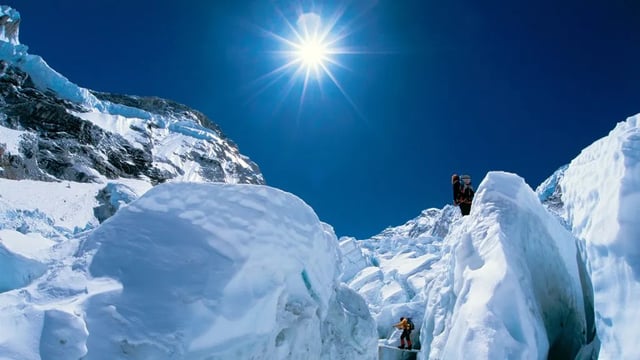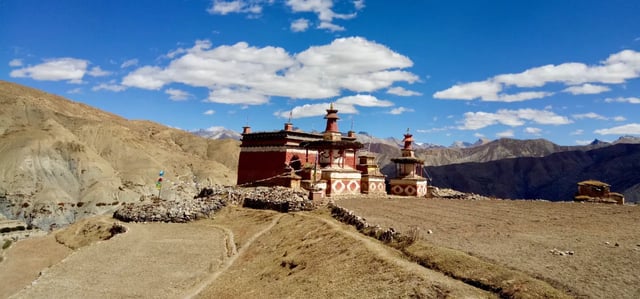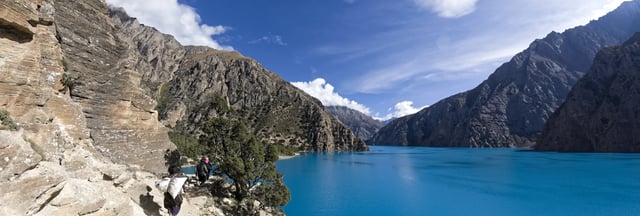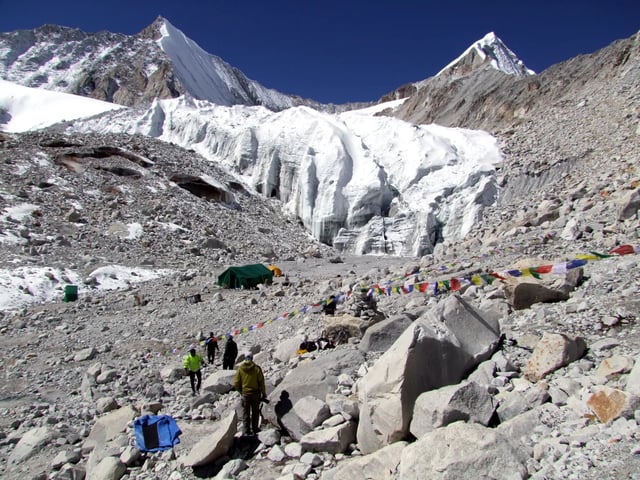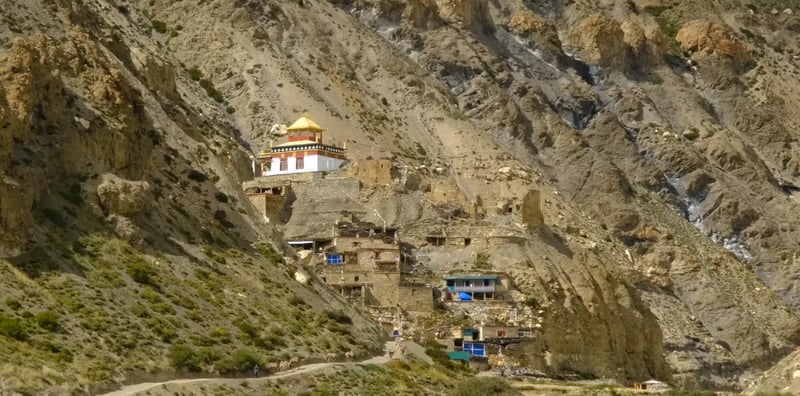
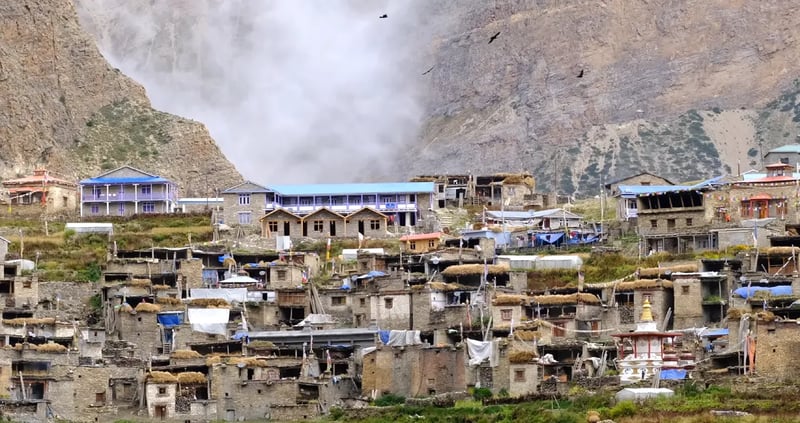
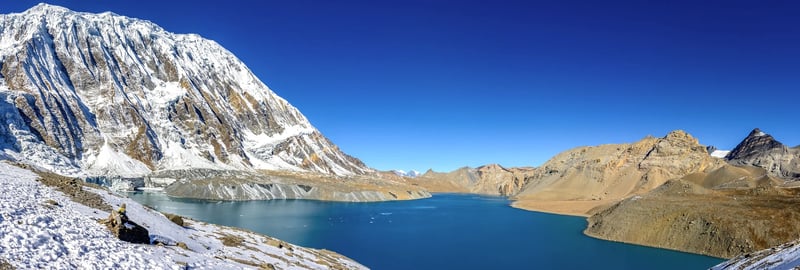
Restricted Nar and Phu valleys combine with a side trip to Tilicho Lake above Manang. You walk from Koto through Meta to Phu’s fortress village, then Nar, before rejoining the Marsyangdi and climbing toward Tilicho Base Camp. Phu’s fortress, Nar’s gompa, and Tilicho’s turquoise shore at about 4,900 m are the three landmarks.
Kang Guru, Pisang Peak, and the turquoise lake at about 4,900 m are the landmarks. Permits, river crossings, and cold lodge nights define the rhythm before you exit toward Manang or Thorong country. Koto, Meta, and a Marsyangdi exit keep the restricted days linked to the Annapurna road, not the Khumbu.
Restricted Nar-Phu permits and ACAP are filed in Kathmandu before the Besisahar jeep to Koto, with a licensed guide attached from the start. You'll walk Meta and Kyang to Phu's fortress village, then Nar, and we match a leader who already knows those gompas and the restricted-gate timing. Guides licensed through MOCTCA and NATHM document height gain so Kang La is not stacked on a tired day.
After Ngawal and Manang, the same crew paces Tilicho Base Camp and the lake morning, then Thorong La to Muktinath. Porters are insured, paid fairly, and carry about 25 to 30 kg, with one porter for two guests. Daily plans are shared so a hold in Phu or a windy Thorong morning can shift without a second briefing.
Welcome to the fascinating city of Kathmandu with a beautiful bouquet of unique sights and culture. AT TIA, you will be met by our representative who will drive you through the enchanting streets of Kathmandu to your hotel.
Please make yourself comfortable and go outside to see the vendors, bazaars, houses, and markets of the capital. Till then, all the participating members of our Nar Phu Trek will arrive.
Our tour guide will organize a small gathering and pre-trip meeting so you will get to know what lies ahead in the following days. Spend the evening as you desire for we have a whole day tomorrow to enjoy Kathmandu.
We will start our morning today with a drive to Pashupatinath Temple where you will breathe peace and see numerous gold-plated small temples and the cremation at Aryaghat. Then, a drive further will take you to Boudhanath to an extraordinarily beautiful white stupa surrounded by a multi-colored mandala.
From Boudhanath, we will drive to Swayambhunath Temple lying calmly atop a hill overlooking the entire Valley of Kathmandu. Then we will go to the old part of Kathmandu to Basantapur where there is a palace of the living goddess.
It is now time that we gear up for the Nar Phu and Tilicho Lake Trek. We will check equipment, and make sure everything is in place for our adventure.
Right after breakfast, we will engage in a long but beautiful drive out of Kathmandu through the Kalanki and Thankot Pass towards Trishuli. Then the long elongated road of Prithvi Highway will lead us to Dumre town.
From here starts the Besisahar Chame Highway which will take us toward the enigmatic town of Bandipur. The gigantic Annapurna is enchantingly visible from here.
Following the same Highway, we will proceed towards Besisahar which transfer us to the refreshing Marshyangdi Valley. This charming town of Lamjung district with a mix of Gurungs, Brahmins, Tamang, and other communities will be our shelter for the night.
From Besisahar, we will change to the local sharing jeep and drive north through the lower Marshyangdi Valley and arrive at Jagat which means we are now in the land of Manang Valley. The road gets steeper as we proceed towards Chamje (1400 m) crossing the impressive Marshyangdi River. The Highway will not stop rising eventually leading us to the Tal Village where we will see the first Mani Walls hinting we are entering Tibetan-Buddhist country.
The road of the valley gets steeper and more rugged as we keep on progressing to Karte and then to Dharapani (1900 m). We will now head west and keep on driving till we are at Bagarchhap town (2160 m).
The region of Annapurna will leave us now as we exit Koto on foot beginning our hiking adventure. After registering to enter Nar and Phu Valley, we will proceed north and cross a highly suspended bridge. A magically and steep canyon will show us our trail that runs high above the riverbed.
We will now make our ascent to 3230 m high Dharmasala where we may take the nourishing Dal Vat to gain the power for the next leg of the journey. Lamjung, the Annapurna II, and Pisang Peaks will give us their beautiful company as we advance further along the steeper section of the trail through the open terrain and scarce forest till we reach Meta.
We have planned an acclimatization walk today so we will be slowly ascending towards the higher altitude of Kyang. Taking off the beaten track and walking alongside the caravan of mules and yaks, we slowly enter residential areas with many abandoned villages.
We will cross a few ravines and pass through the last remnants of the birch forest till we arrive at the complete desert highland of Junam Goth (3690 m) from where we will pass by Chyako and then head to Kyang to take refuge for the night in one of its small tea houses.
We have one of the most gorgeous travel today as we will be entering the most attractive landscape of Nepal. After Kyang, we will take the path that hangs high above the river along the edges of the cliff. It may seem impassable but once we get going, it will become easier and more beautiful.
Eventually, we will arrive at the mouth of the Phu Valley. Now, the high gorges and the valley become easier but we will have to hike upward for about 20 minutes. Now, the series of Mani Walls start to appear and the trail turns straight out.
Our next 30-minute trek will be much simpler till we reach the Phu itself.
From Phu, we will head south and once again take the same exposed path that brought us to Phu. Navigating back through Kyang and Chyako, we will arrive at Junam Goth from where we will walk through the pastures for some time.
Then, we will descend along the rugged trail sharply making our way down to Mahendra Pul (Bridge). The gorge under the bridge seems deep but the bridge is safe to cross.
The route now becomes straight till we reach Nar Phedi where we will be taking refuge for the night. The village has beautiful Nar Phedi Gumba (Monastery) which sits restfully with the beautifully built guesthouse.
From the guesthouse of the monastery, we will take on the steepened path that will go on rising till we make it to our destination, the enchanting Nar Gaun (Village). As we keep on pushing, we will reach the suddenly expanded landscape that reveals the most charming series of Mani Walls with Kanguru sparkling in the background.
After a demanding journey of about 2 to 3 hours, we will finally make it to the grounds of Nar Village which is translated as the land of blue sheep. Comparatively, the village is slightly larger than its neighbor Phu but the Tibetan Buddhism influence is the same.
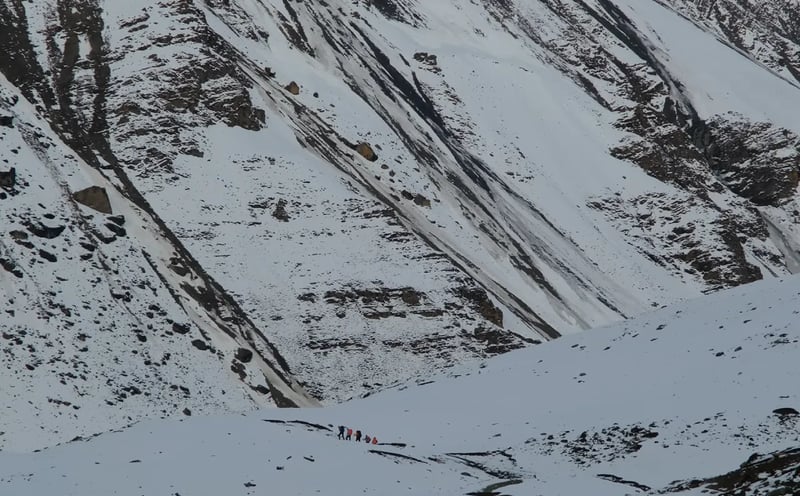
Today is the high mountain pass day as we have the massive Kang La Pass to cross. The pass crossing is not technically challenging but its altitude still passes over 5000 m elevation.
Taking things slowly, we will ascent the Temdenzon Khola mound and reach the simple stone huts of the Kanga La Phedi. Kanguru, Manaslu, and Ganesh fantastically shine in the distance as we commence our hardships climbing numerous ravines and cliffs.
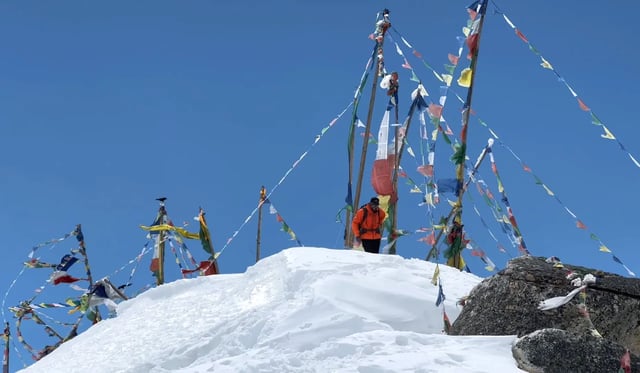
After a few hours, a small mountain lake can be seen but the Pass is still not visible to our naked eyes. Ending our hardships, we are finally at the narrowest tip of the Pass.
Leaving Ngawal, we will descend along the sharp steep trail which will direct us to the valley floor. Slowly, the landscape will begin to transition from the plant-scarce area to the enchanting forest with tall trees.
Shortly, we will be at Humde where we will take the trail back of the town and reach the large expansive grassy land. We are heading to Braga (3450 m) where the main wide road begins easier for our legs.
Walking along the motorable path, we will encounter many bikers who will also be going to Manang. We will have to deal with a small ascension to Mungli before we enter the welcoming gate of Manang.
Marshyangdi River will once again greet us as we progress on our trail toward Tilicho Lake. After Manang, we will take the trail that runs parallel to the gigantic river. A short while after, we will come across a suspended metal bridge that will take us across the river towards the path that slopes the mountain.
In about 2 hours, we will arrive at Khangshar, a small Tibetan settlement that provides the delicious spectacle of Tilicho Peak, Gangapurna, Pisang, and Annapurna. Now traversing a gentle slope, we will arrive at Sri Kharka where we will rest the night in the wild highland to get as well acclimatized as we can before reaching the Tilicho Lake.
After Sri Kharka, we will be involved in the sharp ascent for about 30 minutes after which we will meet the same old suspension bridge. The trail after the bridge will take us to the scree of Tilicho slope.
Khangsar Kang starts to become more and more prominent as we progress along the descent towards the Tilicho base Camp. The path will be full of loose rocks and stones so we have to be extra vigilant.
We will traverse the Tilicho scree for about 20 minutes till we make it to the Tilicho Base Camp. It has around three shelters and one of them will be our refuge for the night.
From the Tilicho base camp, we will take on the sharp ascent for about 1 to 2 hours. Mind you, there can be slippery snow on the trail but crampons will not be necessary for the crossing.
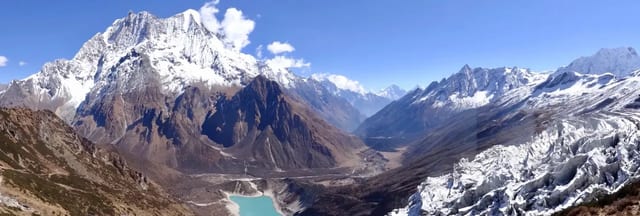
After this challenging climbing section, the trail will be on level terrain which will take an additional 30 minutes of crossing. Here we are at the beautiful Tilicho Lake, supposedly the highest-altitude Lake whose shoreline stands against the shiny mirror of the giant walls of ice and snow.
From Sri Kharka, we will take a left turn and reach the Viewpoint from where we can observe the beautiful Manang Valley. From the Pass, we will now sharply go down and be very vigilant as there can be slippery icy patches on the trail.
We will now meet the small rickety wooden bridge that will walk us over the Thorong Khola and take us to the main path marked the Yak Kharka. Justifying its name, we can truly see many yaks lazily grazing around the field, and among such herds is our tea house which will provide warm shelter for the night.
The trail after Yak Kharka will lead us to one more suspended bride this time spanning over the huge Marshyangdi River. The pathway now advances us to the small village of Ledar from where we will commence to sharply climb the slope. The landscape here resembles that of the moon but the views are awesome to take a frequent rest in between.
A strenuous hardship will ultimately lead us to the Thorong High Camp or Phedi where to much of our surprise, the enthralling mountain peaks await our arrival: Syagang, Khatungkan, Gundang, and Thorung Peaks. Truly, it is an incredibly beautiful place amidst the most beautiful mountains and the rugged rocky terrain.
Another mountain pass day has arrived when we have to cross one of the most famous passes of Nepal: the Thorong La. The Pass and the trail to the pas sis completely manageable although the steepness and the altitude will keep testing our resilience.
For about an hour, we will tackle the sharp incline, now the path becomes a bit easier and more beautiful. After we are above 5000 m, we will enter a small valley where we may find a tiny tea house.
We will come across numerous alpine streams as we progress to the tip of the Pass. We may get confused as there are numerous false summits in between but our guide will lead us to the true summit of the Pass.
We have almost a day's drive today from Muktnath to Pokhara via Jomsom, but it will be nothing but beautiful. The drive will be complemented by the views of Nilgiri, Annapurna, and Dhaulagiri with several other eye-catching peaks as we progress through the lower Mustang territory.
As the day approaches to end, we will be resting at the hotel in Pokhara.
After a big adventure in the Nar and Phu Valley, and the Tilicho Lake, we are now ending our journey with a tourist bus drive to Kathmandu. The same old Prithvi Highway will lead us back through Bandipur and Trishuli toward Kathmandu.
By the evening, we will probably be enjoying our final meal in Nepal with all our support team celebrating the success with a drink of champagne.
We will drive you to TIA so you can board a flight to land in your home country after the eventful Nar Phu trek.
Most guests fly into Tribhuvan International Airport in Kathmandu. Share your arrival time ahead of travel so a Thamel hotel transfer can be arranged, or make your own way to the meeting hotel.
Pre-trek briefings usually take place in Kathmandu before the Lukla flight or helicopter sector. Allow extra days after the trek in case mountain flights are postponed by weather.
Twin or double rooms in a comfortable Kathmandu hotel cover your first nights and your return from the trail, with breakfast on those city stays when included in the package. Briefings happen at the hotel, and airport collection from Tribhuvan is available when flight times are shared in advance.
Family-run teahouses or lodges line the route with twin beds and a shared dining room. Rooms get simpler and colder as you climb, with shared bathrooms common at higher villages. Hot water, Wi-Fi, and charging are paid at the lodge when offered.
March to May rhododendron bloom and October to November crisp air are peak windows for this itinerary. July and August mean leeches and cloud on lower slopes; December to February can ice steps above village level.
Your guide reads the forecast before long cols or sunrise hikes. Shoulder weeks need an honest weather call before high passes or dawn viewpoints.
You should be comfortable walking several hours a day on uneven paths with a daypack, including steady uphill sections as you gain height. Hill training and longer weekend walks in the months before travel help your legs and lungs on uphill trail days.
Hill training, stair climbing, and longer weekend hikes in the months before travel help your legs and lungs, even when acclimatisation days are built into the route. Break in boots before you fly and carry a light daypack on practice walks.
Guided trekking with licensed leaders, lodge nights on the trail, meals as described for walking days, and permits for the regions crossed are included when they are part of this trip. Domestic flights, porters, and airport transfers apply only when they are part of this trip.
Domestic flights, road transfers, porter support, and airport transfers apply only when they are part of this trip. Permits for the regions you cross are arranged in Kathmandu or Pokhara when included.
International flights to Nepal, visa fees, compulsory travel insurance, personal trekking clothing, snacks and drinks outside included meals, and tips for crew are not covered. Hot showers, Wi-Fi, and battery charging in lodges are usually paid locally when offered.
Charges for hot showers, Wi-Fi, or battery charging in lodges are paid locally when offered unless your trip notes say otherwise. International flights, visa fees, and personal insurance stay outside the trek package.
Share your Tribhuvan arrival time ahead of travel for a Thamel hotel transfer, or make your own way to the meeting hotel in the capital. Thamel hotels are the usual meet point; drivers need flight numbers to meet you at the international terminal.
Briefings cover Lukla bag weight, porter duffle limits, and what to wear on the mountain flight. Weather can shift daily plans, so your guide keeps a steady pace with regular breaks.
The itinerary builds rest days and climb-high, sleep-low hikes where the route requires them. Your crew would rather wait for a safe window than rush marginal weather.
Tell your guide early if symptoms appear so tomorrow's stage can shorten or descent can start before conditions worsen. Trail conditions are checked each morning before the group moves.
Mountain weather can delay or postpone Lukla flights even in peak season, and Ramechhap diversions happen when the airstrip is congested. Allow a little extra time after the trek before international flights home in case mountain roads or flights move.
Build buffer days after the trek for international connections, and follow crew advice if schedules change or flights shift to Ramechhap. Monsoon cloud sits lower on the hills while winter brings ice on steps above village level.
Sagarmatha National Park and Khumbu municipality permits apply in the Everest region. The team arranges paperwork in Kathmandu or Pokhara when you provide passport copies and trek dates.
Keep copies in your daypack for checkpoint stops. Your crew would rather wait for a safe window than rush marginal weather.
Families join when children can manage the daily hours and terrain on this specific route. Pace and daily hours can be adjusted on private departures, though that may extend the calendar.
Ask our Kathmandu team if you are planning with younger walkers. Private departures can shorten daily hours, though that may add a day or two to the calendar.
Comprehensive travel insurance that covers trekking to the highest altitude on your itinerary, medical evacuation, and helicopter rescue when applicable is essential. Many standard policies exclude high altitude by name.
Read the wording before you travel so you can adjust cover if trekking above 5,000 metres is not named. Many standard policies exclude high altitude by name, so read the wording before you fly.
We partner with Rewilding Britain to help protect our natural spaces for future adventures.
All centres are vetted for safety and quality. Your adventure is in good hands with adventuro.
About the centre
Kathmandu
You'll travel with a Kathmandu-based team that plans treks, peak climbs, helicopter flights, motorbike journeys, and cultural trips across Nepal, Tibet, and Bhutan. Routes range from classic teahouse walks and high passes to luxury lodge itineraries and longer expedition-style climbs, with departures shaped around how you want to pace the mountains.
Licensed guides and office staff train regularly on mountain safety and guest care. Porters are insured, fairly paid, and equipped for the trail, with sensible load limits on lodge routes. We work with remote communities through sustainable tourism, including support for education in village areas, so your booking helps local people as well as your own adventure.
Operated by Himalayan Adventure Treks & Tours, a partner of adventuro.