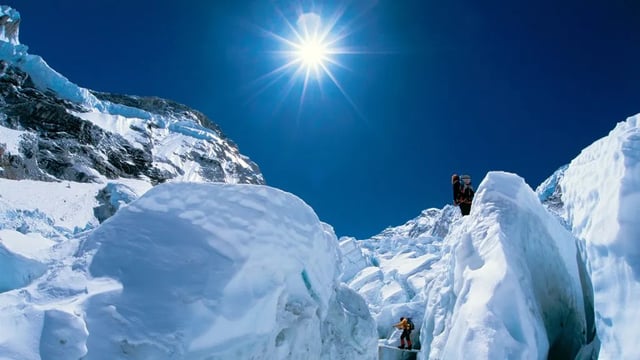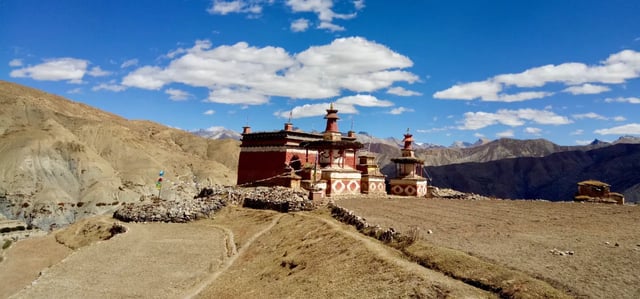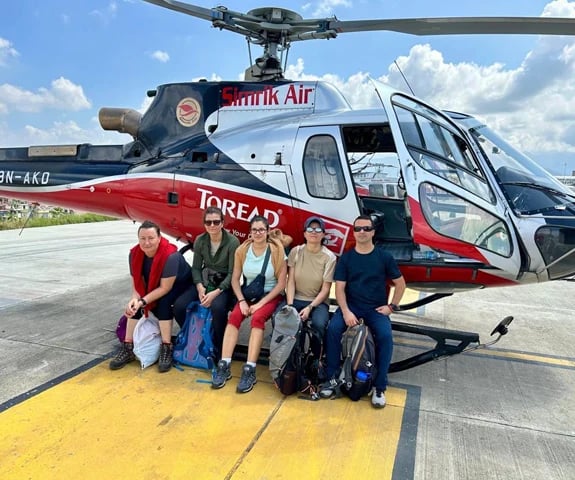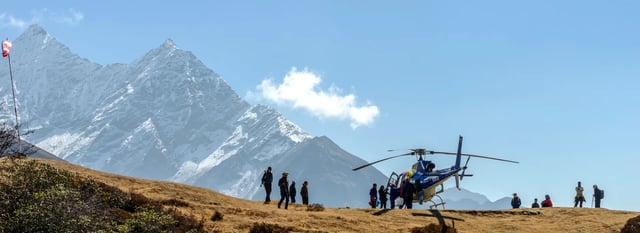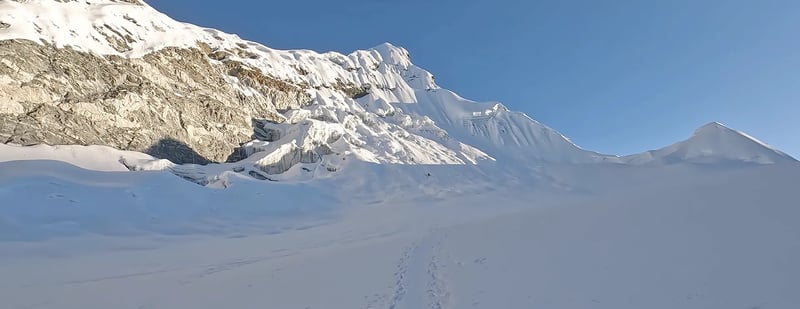
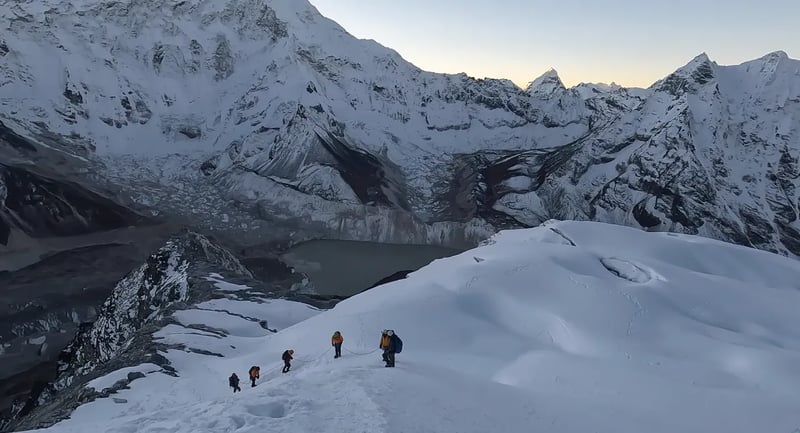
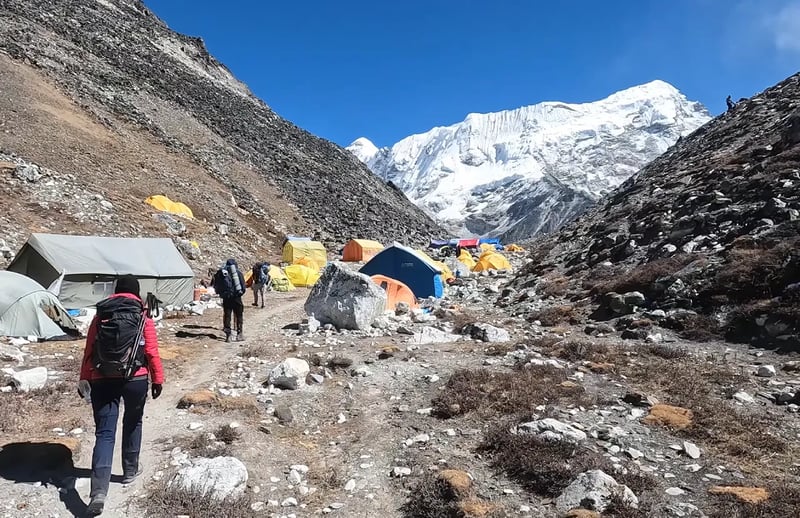
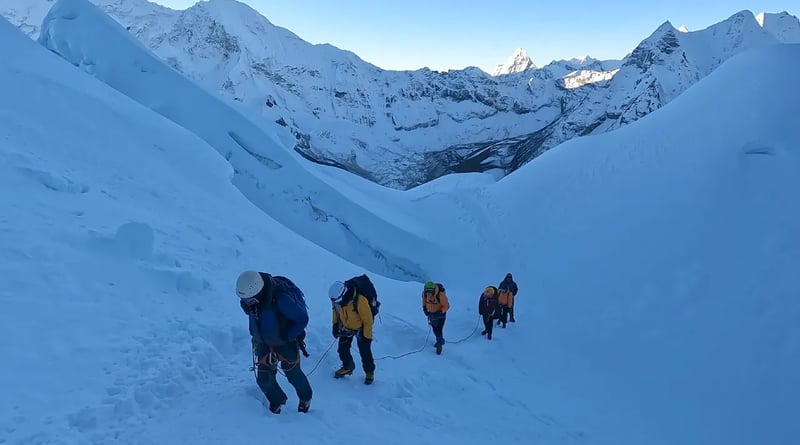
Island Peak (Imja Tse) pairs a Khumbu teahouse approach via Namche, Tengboche, and Chhukung with high camp and a pre-dawn summit on fixed lines. You look across Lhotse’s south wall from about 6,189 m. Chhukung, Island Peak high camp, and a jumar on the headwall put Lhotse’s south wall in your face at about 6,189 m.
Climbing guides teach crampon and jumar work before the alpine start. You walk out to Lukla after the summit window, with Everest Base Camp country on the same approach trail. You still walk Namche and Tengboche on the way in, so the climb sits inside a full Khumbu approach.
We are licensed by the Ministry of Culture, Tourism and Civil Aviation and the Nepal Tourism Board, so Sagarmatha and Island Peak permits sit on one Kathmandu desk. You'll fly to Lukla, or drive to Ramechhap when the city airstrip is busy, then walk Namche, Everest Base Camp, and Kala Patthar before turning into Chhukung. Climbing sirdars run a pre-climb day at 5,200 m base camp on harness, crampon, and jumar skills.
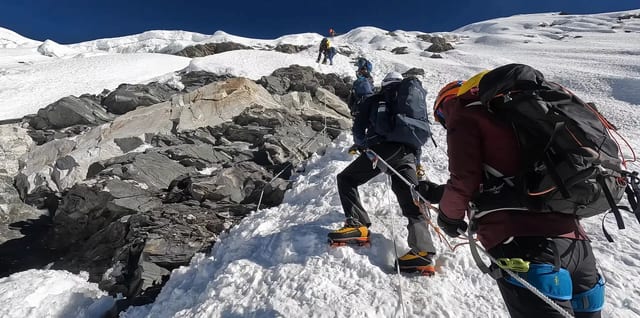
The midnight start aims at the 6,165 m summit on fixed ropes along the Imja ridge. We'll share the next day's plan each evening so a wind hold at base camp or a delayed mountain flight can move without losing the window. Your guide would rather wait a morning than chase a cloudy summit.
Tashi Delek, and a warm welcome! As soon as you get out of the TIA arrival Gate, you will see our dedicated member cordially welcoming you with open arms. He will then guide you to your first accommodation we have appointed for you in the peaceful surroundings of the capital.
Depending on the time, you can wander around and discover the local area today. Once all our climbers are in Kathmandu, you will all meet our guide at the hotel where he will go over the details of our upcoming Island Peak climbing with Everest trek expedition.
Early in the morning, our guide will take you to the pivotal Hindu shrine Pashupatinath Temple complex. The main temple will not allow us to enter but we will definitely visit the funeral ground of the temple at the edge of the Bagmati River. Then, we will take you to the enormous Tibetan Buddhist stupa Boudhanath where you can see devout Buddhists muttering mantras, circumnavigating the stupa, and lighting the butter lamps.
Then, we will head to Swayambhunath, famously known as the Monkey Temple, which is regarded as the oldest stupa in the world. Then, the remaining afternoon will be yours to prepare for the Island Peak climbing expedition.
In the early morning, you will go to the airport (TIA or Ramechhap) for the short flight to Lukla. This Sherpa city is the entrance portal to Everest and also the beginning spot of your trekking adventure. The brief flight will give you your first taste of the beauty of the Himalayas as you will see the prominent profiles of Kanchenjunga, Manaslu, and Everest literally passing under your feet.
Once in Lukla, you will meet the 6187 m Mount Kongde Ri and the smiling porters and crew. We will now set off for Phakding, our first Sherpa mountain village for an overnight stay.
Waking by Thamserku will be an amazing experience after which we will begin walking upstream along the coast of the Dudh Koshi River. Benkar will be the next town we will reach after which we will progress to Monjo, the landmark of Sagarmatha National Park begins from here.
We will now walk upstream to Jorsalle through the path parallel to the rich forest. Here we are the historic Suspension Bridge named in honor of Sir Edmund Hilary that spans across the Union point of Dudh Koshi and Bhote Koshi rivers.
Tarboche Peak (6495 m) will motivate us to walk across as we keep progressing upward to Top Danda (3140 m). Appreciate the enchanting contours of Everest, Nuptse, and Lhotse from the point.
To give our bodies the opportunity to get used to the Khumbu altitude, we will stay an extra day in Namche. We have a nice acclimatization walk planned towards Khumjung situated on a hill where we will have the incredible chance to visit the monastery that supposedly has the skull of the Yeti. We will have a cup of coffee at the world’s tallest elevated hotel to Everest View.
We will have beautiful views of the Pacchermo, Samdur, Thamserku, Cholatse, Everest, Ama Dablam, Nuptse, Taboche, Kangtega, Kongde Ri, Lhotse, and many more. We will then spend the rest of the day in Namche to get enough rest for the further travel ahead.
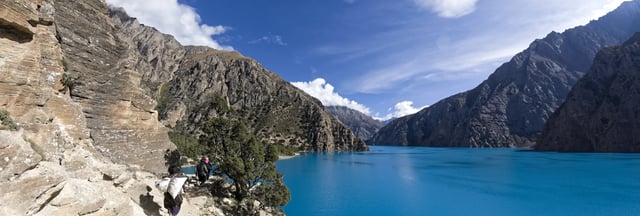
We are reaching very soon to the historical camp site of Everest Base Camp. First, we will be gentle as we walk along the edge of the ridge, and then we will approach the coast of the Imja River. A small hanging bridge will take us over this river and take us along the vertical forest trail to 3250 m Phungi Thanga.
Tengboche is now merely two hours away but the upstream hike will be challenging and tiring till we make it to the flat expansive monastic grounds of the monastery. If luck is on our side, we may also attend a prayer ceremony (puja) together with the monks. Ama Dablam, Nuptse, Everest, Thamserku, and Lhotse peaks will show their profiles here.
We will now walk our way to our accommodation in Tengboche.
From Tengboche, we will take a downward turn that will take us sharply through the rich luscious forest to the bridge over Imja Khola. Now, our path will vertically take us up but the trail will be quite easy to walk on along the stone slabs path.
After some time, we will be at Pangboche ground where again we will meet the monastery said to have the Yeti Skull. We are slowly entering into the open alpine area suitable for the yaks grazing.
Continuing on, we will walk down to another hanging metal bridge this time arching over the Lobuche Khola. Pheriche is just a few km afar, which is a really busy town after Namche with a Helipad, stone houses, and comfortable lodges.
The pathway from Pherche will take us on a steady walking for about 2 to 3 hours which will slowly start to rise up. Eventually, we will reach the path coming from Dingboche. At this point, the trail will now vertically incline taking us straight to Dughla town.
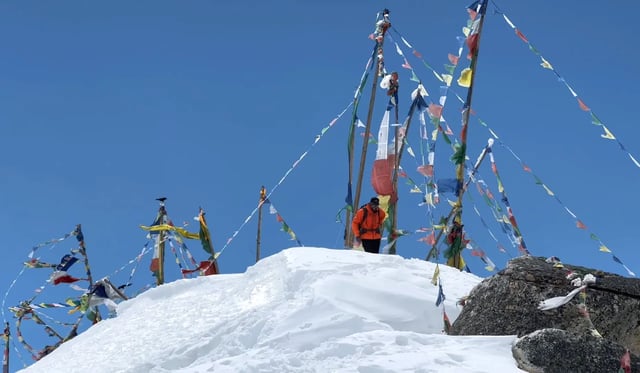
The track now twists and turns steeply to a ridge known as Dughla Pass rising to an elevation of 4830 m. This Pass can be regarded as the Everest Memorial where we can see offerings and a sea of prayer flags in the name of the souls who unfortunately disappeared in the Everest forever.
We are set to achieve the first milestone of our Island Peak climbing with EBC. Walking a little while over Khumbu Glacier, we will reach the Thangma Riju Pass more commonly known as Lobuche Pass.
The Pumori, Khumbutse, Nuptse, and Lobuche peaks seem to be extremely close form here. A steep climb will be followed next along the edge of the Changri Glacier where for the first time we will be able to see the enormous black walls of the infamous Kala Patthar.
In a short while, we will be at the empty land of Gosakshep, the last place where we will be able to eat and sleep in the Khumbu region. We will enjoy a brief moment of rest here after which we will continue our journey to the base camp of Everest.
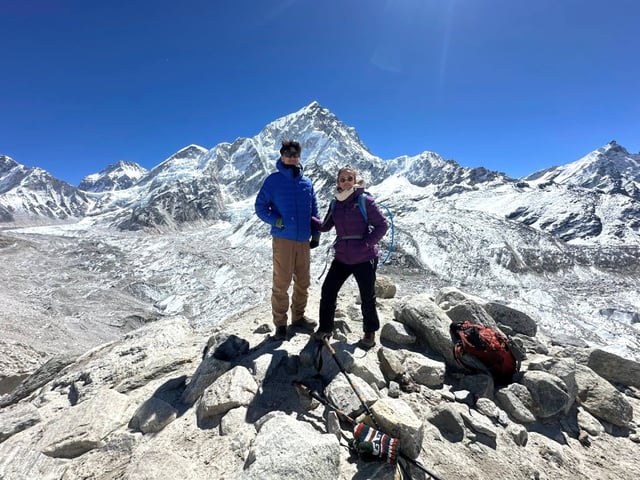
Early in the morning, we will set off for a 3-hour climb to the magnificent point of Kala Patthar. Making our way up the stony rugged slope, we will be finally at the summit. The view in front of us will make for everything: we will have sensational outlines of Everest of course along with Lhotse, Lobuche, Pumori, Nuptse, Changtse, Ama Dablam, Khumbutse, Lingtren, and Khumbu Icefall.
After this iconic climb, we will return to Gorak Shep after which we will follow the path down to Lobuche once again. From Lobuche, we will walk past the Dughla Pass and Dughla Pas once again before we make our way to Dingboche.
We are on the verge of achieving our next significant milestone in our island peak climbing in Nepal expedition, the summit itself. From Dingboche, we will turn east and start following the small refreshing stream. We will weave through the moraines of the Imja and Lhotse glaciers.
After about two hours, we will be at the humble settlement of Chhukung Village where the miraculous views of the Tawache, Cholatse, Kongde Ri, Karyolung, Numbur, and of course the grand Island Peak itself can be seen outstandingly. Once we have rested well, we can then venture to ascend the 5546 m high Chhukung Ri (optional).
The Island Peak is calling us! From Chhukung, we will walk comfortably for a while taking the southward direction.
Continuing for a while along the rugged landscape, we will shift to the east from where the track now follows the glacial icy track of the Imja and Lhotse Glaciers. After some time, we will arrive at the vast wide valley that lies beneath the Island Peak's southwest face.
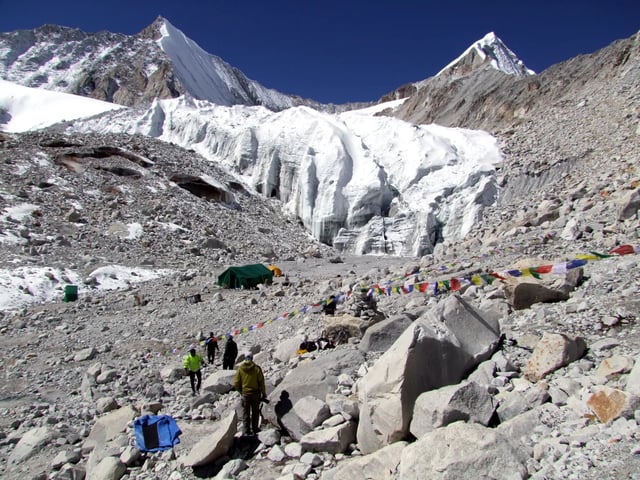
Here, our crew members will pitch the warm tents for us, after which we will rest facing the enormous walls of the Imja mountain itself. The rest is very essential here for adequate acclimatization before we push ourselves to the summit.
Today, our skilled Sherpa climbing guide will demonstrate the essential techniques for our ascent of Imja Tse. He will instruct us on the right use of climbing gear, such as crampons, harnesses, ice axes, ascender, jumar, etc. He will also show us the correct technique for using ropes to ascend and descend safely.
This training will help us further build our self-confidence and hone our climbing skills so there is a greater chance for all of us to succeed on the Island Peak. We can then choose to go to the High Camp of the Peak or just rest at its base camp preparing our gear and rucksacks.
We will commence our Island Peak attack at midnight. Waking up, we will quickly get dressed, and head to the food tent for a light breakfast and a warm drink.
Then putting on the headlamp, we will set out at around 1:30 and commence the gradual climb up the mountain. Following the bending trail, we will climb high sharply for around 800 m along the rough terrain.
After a short stretch over some uneven terrain, we will finally reach the High Camp of the Peak. The route now transitions into the mix of rocky and icy terrain which needs a sharp vigilance from us.
Exhaustion from the previous day weighs on us, yet we have to journey back to Imja Khola Valley once again. We will traverse once again through Chhukung, Orsho, and Shomare before we make it to Pangboche.
The once deserted rocky land of the Khumbu now gives way to scattered fir, pine, and birch trees. If we have energy left in us, we may also go to the Upper Pangboche to explore the monastery where supposedly the original Yeti Scalp has been stolen and has been replaced with its replica.
We will descend down further and cross the Imja River over the sturdy bridge. We will press on further towards Deboche along the mixed birch and rhododendron forest towards Tengboche.
Continuing on, we will ascend and descend along a beautiful path above the Dudh Koshi River now and make it through Top Danda, Jorsalle, and Benkar to finally reach Namche. Time to once again rejoice in a hot shower, delicious coffee, and cake.
Today is our last day of hiking in the Himalayas. We will walk from Namche back to the starting point of our Island Peak climbing via EBC journey.
We will descend and walk along the river for a while before crossing one after the suspension bridges. After 4 hours of walking, we will arrive in Monjo.
We will pass the villages of Benkar and Phakding and continue past Thadokoshi, Chaurikharka, and Chheplung. We will make one last short climb before we arrive in Lukla.
After a flight of about 30 to 35 minutes, we will arrive back in TIA where we will meet our transport with a driver which will take us to our hotel.
In the evening, we will assemble once again as a one strong cohesive team and enjoy a nice dinner in the friendly and lively Nepali restaurant.
Your island peak climbing in Nepal is unfortunately over.
Approximately 3.5 hours before departure of your flight, you will be picked up at your hotel and taken to the airport.
Fly into Tribhuvan International Airport in Kathmandu unless the itinerary uses another regional hub. Airport or hotel pickup can be arranged when you share arrival details ahead of travel.
Briefings cover road or domestic travel to the trailhead. Build buffer time before onward international flights in case mountain weather shifts the schedule.
Twin or double rooms in a comfortable Kathmandu hotel cover your first nights and your return from the trail, with breakfast on those city stays when included in the package. Briefings happen at the hotel, and airport collection from Tribhuvan is available when flight times are shared in advance.
Family-run teahouses or lodges line the route with twin beds and a shared dining room. Rooms get simpler and colder as you climb, with shared bathrooms common at higher villages. Hot water, Wi-Fi, and charging are paid at the lodge when offered.
Stable trekking weather most often falls in pre-monsoon spring and post-monsoon autumn. Monsoon cloud sits lower on the hills while winter brings ice on steps above village level.
If your dates sit in winter or monsoon, pack rain and cold layers and accept that flight or pass days may move by a day when safety requires it. Weather can shift daily plans, so your guide keeps a steady pace with regular breaks.
You should be comfortable walking several hours a day on uneven paths with a daypack, including steady uphill sections as you gain height. Hill training and longer weekend walks in the months before travel help your legs and lungs on uphill trail days.
Hill training, stair climbing, and longer weekend hikes in the months before travel help your legs and lungs, even when acclimatisation days are built into the route. Break in boots before you fly and carry a light daypack on practice walks.
Guided trekking with licensed leaders, lodge nights on the trail, meals as described for walking days, and permits for the regions crossed are included when they are part of this trip. Domestic flights, porters, and airport transfers apply only when they are part of this trip.
Domestic flights, road transfers, porter support, and airport transfers apply only when they are part of this trip. Permits for the regions you cross are arranged in Kathmandu or Pokhara when included.
International flights to Nepal, visa fees, compulsory travel insurance, personal trekking clothing, snacks and drinks outside included meals, and tips for crew are not covered. Hot showers, Wi-Fi, and battery charging in lodges are usually paid locally when offered.
Charges for hot showers, Wi-Fi, or battery charging in lodges are paid locally when offered unless your trip notes say otherwise. International flights, visa fees, and personal insurance stay outside the trek package.
Hotel meet in Thamel is typical; send flight numbers so pickup can meet you at the international terminal. Allow a little extra time after the trek before international flights home in case mountain roads or flights move.
Rest day buffer after the trek helps if Lukla or helicopter sectors slip by a day. Trail conditions are checked each morning before the group moves.
Guides set a steady pace and watch for headache, nausea, or dizziness as you gain height. Your crew would rather wait for a safe window than rush marginal weather.
Tell your guide early if symptoms appear so tomorrow's stage can shorten or descent can start before conditions worsen. Thamel hotels are the usual meet point; drivers need flight numbers to meet you at the international terminal.
Jeep or bus days to the remote trailhead are arranged when they are part of your package. Your guide confirms departure times at briefing.
Motion sickness medicine helps on winding mountain roads. Shoulder weeks need an honest weather call before high passes or dawn viewpoints.
National park or restricted-area permits apply depending on the valleys you cross. The team arranges paperwork in Kathmandu or Pokhara when you provide passport copies and trek dates.
Keep copies in your daypack for checkpoint stops. Your crew would rather wait for a safe window than rush marginal weather.
Families join when children can manage the daily hours and terrain on this specific route. Pace and daily hours can be adjusted on private departures, though that may extend the calendar.
Ask our Kathmandu team if you are planning with younger walkers. Private departures can shorten daily hours, though that may add a day or two to the calendar.
Comprehensive travel insurance that covers trekking to the highest altitude on your itinerary, medical evacuation, and helicopter rescue when applicable is essential. Many standard policies exclude high altitude by name.
Read the wording before you travel so you can adjust cover if trekking above 5,000 metres is not named. Many standard policies exclude high altitude by name, so read the wording before you fly.
We partner with Rewilding Britain to help protect our natural spaces for future adventures.
All centres are vetted for safety and quality. Your adventure is in good hands with adventuro.
About the centre
Kathmandu
You'll travel with a Kathmandu-based team that plans treks, peak climbs, helicopter flights, motorbike journeys, and cultural trips across Nepal, Tibet, and Bhutan. Routes range from classic teahouse walks and high passes to luxury lodge itineraries and longer expedition-style climbs, with departures shaped around how you want to pace the mountains.
Licensed guides and office staff train regularly on mountain safety and guest care. Porters are insured, fairly paid, and equipped for the trail, with sensible load limits on lodge routes. We work with remote communities through sustainable tourism, including support for education in village areas, so your booking helps local people as well as your own adventure.
Operated by Himalayan Adventure Treks & Tours, a partner of adventuro.