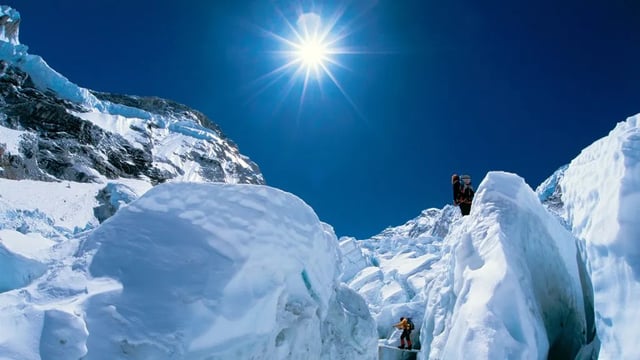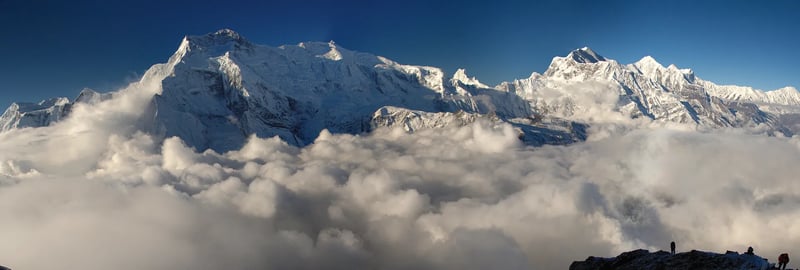
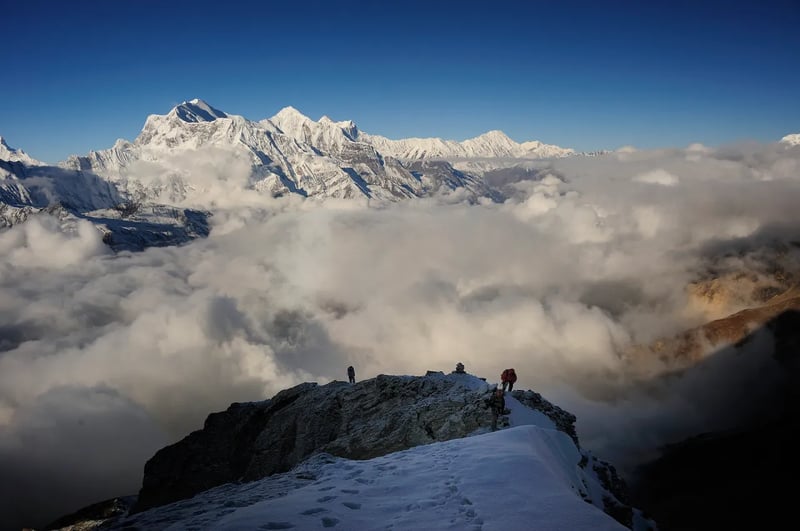
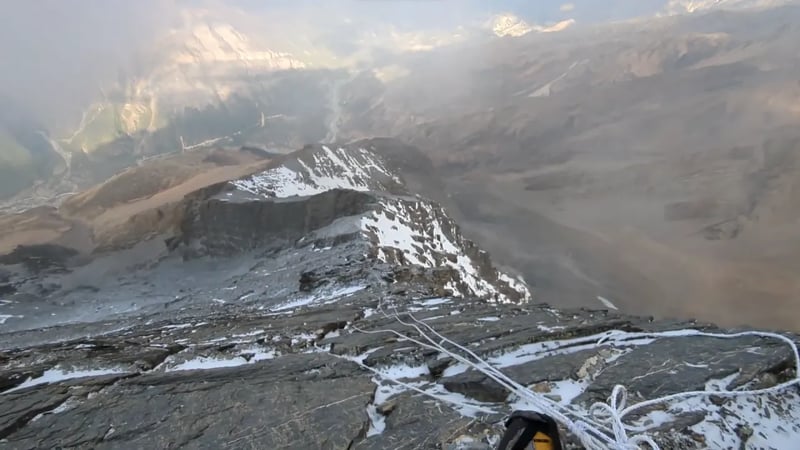
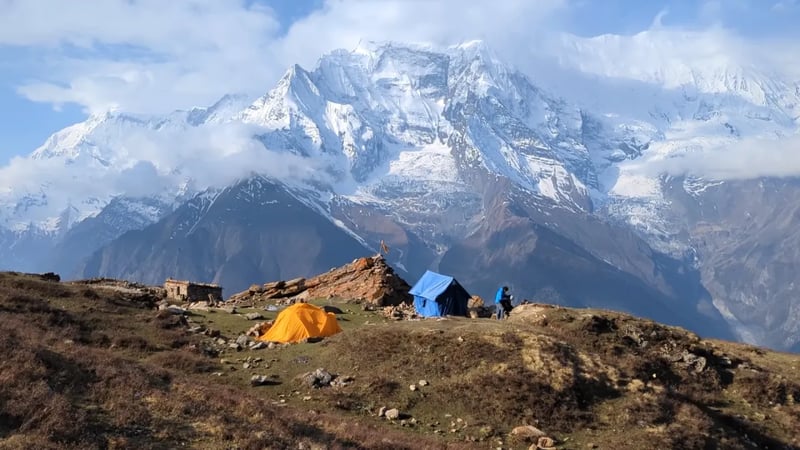
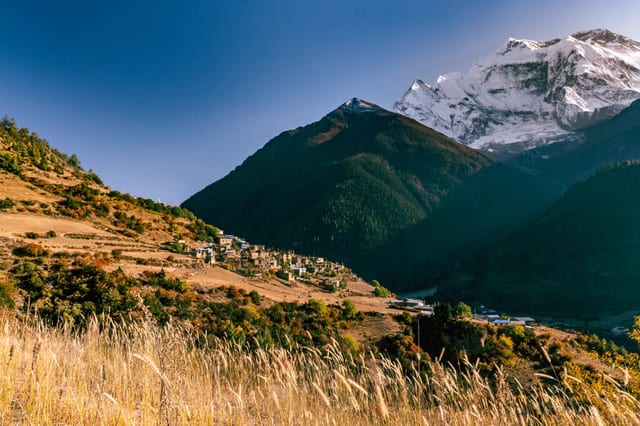
Pisang Peak rises above the Marsyangdi on the Annapurna Circuit approach. You walk through Chame and Lower or Upper Pisang, set a high camp, and climb a long snow ridge with Annapurna II and Gangapurna in view. Upper Pisang, a high camp, and a long snow ridge with Annapurna II in view are the climbing days.
The descent can continue toward Manang. Teahouse days plus a technical summit block are the shape of the trip. The Marsyangdi teahouses get you there; the summit block is why this itinerary exists.
We try to match a Manang-side guide licensed through MOCTCA and NATHM who knows the Marsyangdi from Chame to Upper Pisang. Our Kathmandu office files the Pisang Peak permit, ACAP, and TIMS before the Besisahar and Chame jeep days. You'll walk to the 4,380 m base camp and the 5,400 m high camp after a rest night in Upper Pisang.
Summit morning follows a marked snow ridge to about 6,091 m, then we continue through Manang and over Thorong La to Muktinath before the Pokhara drive. Your guide would rather add a night at Thorong Phedi than stack the peak and the 5,416 m pass without rest. We'll share the next stage each evening so a wind hold can move either morning.
Prepare to be embraced by the lovely Kathmandu, the gateway to your Pisang Peak climbing adventure. As you exit the TIA arrival gate, you will fond our local staff holding our agency name.
After you are being assisted with the luggage, he will take you to your Kathmandu lodging we have selected for your comfortable stay. If you have arrived early, you can spend the day resting or exploring the nearby attractions.
Once all our climbers are in Kathmandu, our guide will meet with the group and will explain about our Pisang peak climbing itinerary. We will have the whole day tomorrow for capital excursion and trip preparation so you will be at your leisure time today.
On the second day of your adventure, you will explore the mesmerizing city of Kathmandu. This important metropolis is deep in history and culture and is home to some of the most significant UNESCO protected landmarks such as Pashupatinath temple, the serene Boudhanath Stupa, the historic Kathmandu Durbar Square, and the iconic Swayambhunath.
Today, we will explore each of these remarkable landmarks, and once we are finished with our touring, we will then gear up for the exciting journey that lies ahead.
Early in the morning, we will take a tourist bus and get ready to leave Kathmandu. The busy traffic-laden Kathmandu road will lead us out through Kalanki and Thankot. Soon, we will be surrounded by the fresh air coming through the rolling green hills as we start to travel along the comfortable and beautiful Prithvi Highway.
The marvelous current of Trishuli River can be seen below while the Lamjung, Annapurna, and Langtang Peaks will grace the horizon. For a while we will be following the route to Pokhara, but once we pass by Dumre, we will diverge our route to north and see the wide crystal waters of Marshyangdi River guiding us to Besi Sahar, an administrative headquarter of Lamjung.
From Besi Sahar, we will enjoy a local jeep ride and travel onward through Bhulbhule and Ngadi. Our track will ascend for a while leading us to Bahundanda placed on the crest of the lovely green hill.
We will then descend to Syangje Village nestled beside the Marsyangdi River. The road will rise again towards Jagat from where the bending road will lead us to Chamje.
We will now drive through the location of the Manang region. The upcoming track can be a bit strenuous with some sharp and rocky segments but completely manageable by the jeep.
Finally, the trekking segment of our Pisang Peak climbing itinerary commences from today with a gentle and easy path leading us up to Upper Pisang Village. The route from Chame takes the north turn along the shore of the Marshyangdi River following the cool shade o the pine forest.
With mild elevation gain, we will continue on and arrive at the orchard village of Bhratang. From here, we will keep on proceeding along a moderately challenging trail to a bridge.
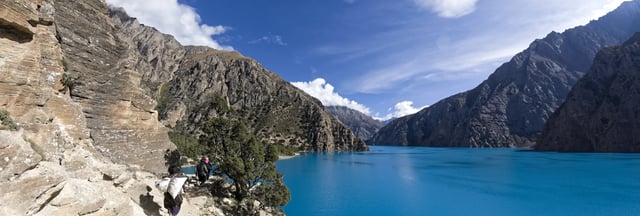
After the bridge crossing, the trail will take a steep turn taking us to the ridge of Dhukur Pokhari. Marveling at the picturesque view of Pisang Peak to the north and Chulu peak, we will take on a moderate one hour climb to lower Pisang.
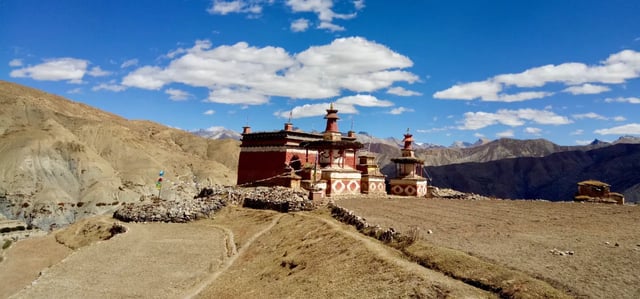
Today, we will take the opportunity to rest and acclimatize so our bodies are well-prepared before we attempt the summit climb. After breakfast, we will take a short visit to the nearby monastery of the village and admire the beautiful outlines of majestic Gangapurna, Annapurna and Tilicho Peaks.
Then, we will gear up ourselves and practice some climbing at nearby ridge which will prepare us for the ascension of the peak and also boost our confidence.
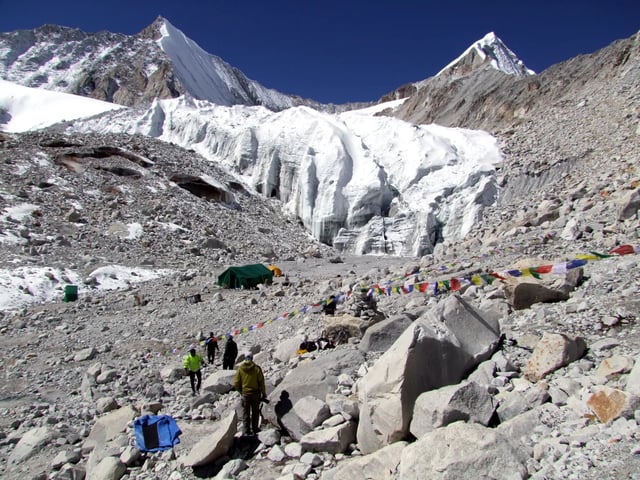
Today, we will be reaching the highly anticipated base camp of the Pisang Peak. After we leave Upper Pisang, our route will ascend through small forest and meadows leading us to an expansive pastureland known as Kharka elevated at 4380 m. It is an ideal location for establishing the base camp for the night.
This area is located along a well-established trail in a flat alpine zone. Here, we will pitch in our tents and our guide will then give us a brief introduction to technical climbing part of the peak.
After dismantling our tents at the base camp, we will now set forth to reach the High Camp of the Pisang Peak elevated at 5400 m. We will rise by around 1000 m by the end of the day so it is necessary that we proceed with caution and at slow pace. The trail leading up to the High Camp can be enveloped with snow and the route will be narrow, and steep along some rocky sections.
However, the Manaslu, Gangapurna, Annapurna, Chulu East, and Tilicho peaks will be shining brightly in the distance which will keep us encouraging to push forward. Once we are the High Camp, our crew will once again pitch in the camps for us and we will be for one last time practice some climbing session.
Finally, the moment has arrived, the biggest day of our Pisang peak climbing with Annapurna circuit. Its time that we assault the summit; so we will rise early even before dawn and set forth to tackle the clearly marked ridge. There is no such challenge of technical complexity but the inclination of the slope will be around 45 to 50 degrees steep.
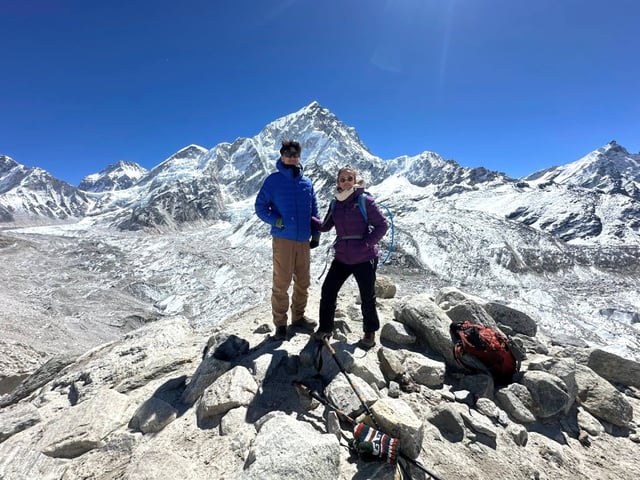
Therefore, our climbing guide will secure the ropes to facilitate our ascent. Once at the summit, Ganesh Himal, East Chulu, Manaslu, Tilicho Peak, Kuchubhro Peak, Gyaji Kang, Annapurna, and Kang Guru Peak will warmly embrace us with their profiles.
We will leave the base camp in the early morning hours and make our way back to Upper Pisang. Then, we will continue following the route running through the beautiful array of Mani Walls.
We will climb sharply for about an hour and reach the 3670 m high Ghyaru Village. The village is a seemingly a nice spot to enjoy the stunningly attractive features of Tilicho, Gangapurna, Lamjung, Annapurna II, III, and IV mountain Peaks.
Now walking along the relatively gentle flat terrain, we will reach 3657 m elevated Ngawal Village with massive Chulu range standing in front. Now, the trail will take the dramatic turn and take us downstream sharply to Bragha Village (3450 m).
Once we exit Manang, our journey will take place on the elevated path that will lead us to 3650 m high Tengi Manang. Our ascension will further intensify as we take on the vertical incline trail that will guide us to Ghunsang Village (3890 m).
We will now continue our journey north and keep climbing past several chortens and Mani Walls. Eventually, we will reach the extensive pastureland of Yak Kharka (4120 m).
From here, we will continue our journey to Upper Yak Kharka, and then walk across the highly suspended bridge to reach Chauri Letder. Now, a narrow track beside the calm waters of the Thorong River will guide us along the steep slope toward Thorogn Phedi.
Today, we will be reaching the penultimate point of our Pisang peak climbing with the Annapurna circuit trek: the prominent 5416 m Thorong La Pass. From Phedi, we will take on the demanding climb towards the High Camp of the Pass. Once we conquer that steep climb, the trail ahead will be comfortable enough for us to keep on going till we again encounter the sharp incline for about 2 to 3 hours.
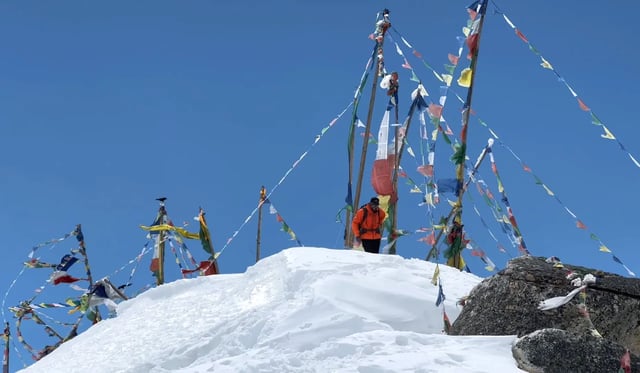
Eventually, the Pass decorated with the multifaceted prayer flags will arrive. Its top is not that narrow and here you can even find a small tea house where you can drink hot tea against the outstanding backdrop of Mukut Himal, Annapurna, Dhaulagiri, and the Kali Gandaki Gorge.
The days of trekking and climbing have finally come to an end, and now it's time to drive from Muktinath to Pokhara. Our bus will take us down along the twisting mountain road passing through the charming locales of Ranipauwa, Jharkot, Jhongg, and Kagbeni. The dramatic transformation of the landscape will no doubt captivate our senses while the striking outlines of Tukuche, Dhaulagiri, and Nilgiri seem to be even more magnificent.
As we approach Lupra, the road becomes smoother, guiding us toward Jomsom. Now, the nicely built tarmac road of the Beni-Jomsom Highway will carry us onward through Tukuche, Kowang, Lete, Dana, and Tatopani, eventually leading us to Beni.
From Pokhara, the countryside road of the Prithvi Highway will whisk us one more time through the Trishuli River. One more time, we will encounter the heavy road traffic of Thankot and Pokhara before we finally find ourselves in the comfortable setting of our capital accommodation.
A nice pleasant celebratory dinner will give a beautiful ending to our Pisang Peak climbing expedition.
You will journey back today to your home leaving Nepal and its Himalayas. Our staff will take you to the TIA departure Gate precisely 3 hours before your designated flight.
We hope we have given you some cherished moments of your life and we have played a part in making your journey enjoyable. Please have a very safe and pleasant journey back home.
Fly into Tribhuvan International Airport in Kathmandu unless the itinerary uses another regional hub. Airport or hotel pickup can be arranged when you share arrival details ahead of travel.
Briefings cover road or domestic travel to the trailhead. Build buffer time before onward international flights in case mountain weather shifts the schedule.
Twin or double rooms in a comfortable Kathmandu hotel cover your first nights and your return from the trail, with breakfast on those city stays when included in the package. Briefings happen at the hotel, and airport collection from Tribhuvan is available when flight times are shared in advance.
Family-run teahouses or lodges line the route with twin beds and a shared dining room. Rooms get simpler and colder as you climb, with shared bathrooms common at higher villages. Hot water, Wi-Fi, and charging are paid at the lodge when offered.
Spring from March to May and autumn from September to November usually bring the clearest views and stable walking conditions on this route. Winter is quieter but colder at altitude, while monsoon months bring cloud and wet trails at lower elevations.
Shoulder weeks need an honest weather call before high passes or dawn viewpoints. Monsoon cloud sits lower on the hills while winter brings ice on steps above village level.
You should be comfortable walking several hours a day on uneven paths with a daypack, including steady uphill sections as you gain height. Hill training and longer weekend walks in the months before travel help your legs and lungs on uphill trail days.
Hill training, stair climbing, and longer weekend hikes in the months before travel help your legs and lungs, even when acclimatisation days are built into the route. Break in boots before you fly and carry a light daypack on practice walks.
Guided trekking with licensed leaders, lodge nights on the trail, meals as described for walking days, and permits for the regions crossed are included when they are part of this trip. Domestic flights, porters, and airport transfers apply only when they are part of this trip.
Domestic flights, road transfers, porter support, and airport transfers apply only when they are part of this trip. Permits for the regions you cross are arranged in Kathmandu or Pokhara when included.
International flights to Nepal, visa fees, compulsory travel insurance, personal trekking clothing, snacks and drinks outside included meals, and tips for crew are not covered. Hot showers, Wi-Fi, and battery charging in lodges are usually paid locally when offered.
Charges for hot showers, Wi-Fi, or battery charging in lodges are paid locally when offered unless your trip notes say otherwise. International flights, visa fees, and personal insurance stay outside the trek package.
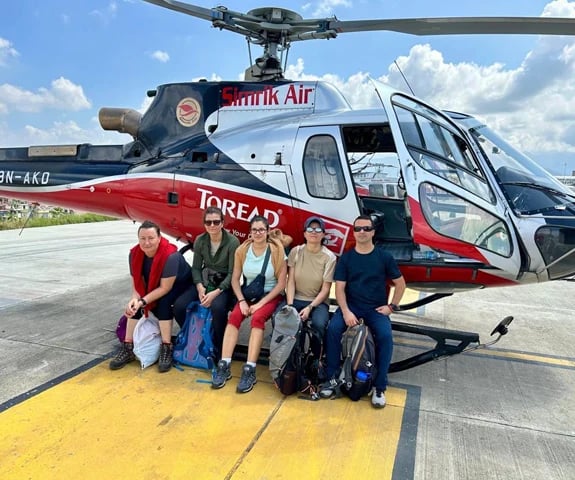
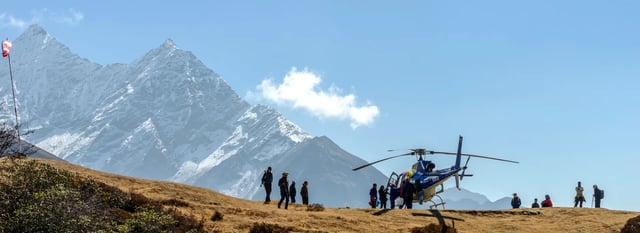
Pickup can be arranged from Tribhuvan International Airport or your hotel in Thamel when you share flight times ahead of travel. The pre-trek briefing is usually held at the hotel before the Lukla flight or helicopter sector.
Allow buffer days after the trek in case mountain flights move. Thamel hotels are the usual meet point; drivers need flight numbers to meet you at the international terminal.
Guides set a steady pace and watch for headache, nausea, or dizziness as you gain height. Weather can shift daily plans, so your guide keeps a steady pace with regular breaks.
Tell your guide early if symptoms appear so tomorrow's stage can shorten or descent can start before conditions worsen. Trail conditions are checked each morning before the group moves.
Jeep or bus days to the remote trailhead are arranged when they are part of your package. Your guide confirms departure times at briefing.
Motion sickness medicine helps on winding mountain roads. Your crew would rather wait for a safe window than rush marginal weather.
National park or restricted-area permits apply depending on the valleys you cross. The team arranges paperwork in Kathmandu or Pokhara when you provide passport copies and trek dates.
Keep copies in your daypack for checkpoint stops. Allow a little extra time after the trek before international flights home in case mountain roads or flights move.
Families join when children can manage the daily hours and terrain on this specific route. Pace and daily hours can be adjusted on private departures, though that may extend the calendar.
Ask our Kathmandu team if you are planning with younger walkers. Private departures can shorten daily hours, though that may add a day or two to the calendar.
Comprehensive travel insurance that covers trekking to the highest altitude on your itinerary, medical evacuation, and helicopter rescue when applicable is essential. Many standard policies exclude high altitude by name.
Read the wording before you travel so you can adjust cover if trekking above 5,000 metres is not named. Many standard policies exclude high altitude by name, so read the wording before you fly.
We partner with Rewilding Britain to help protect our natural spaces for future adventures.
All centres are vetted for safety and quality. Your adventure is in good hands with adventuro.
About the centre
Kathmandu
You'll travel with a Kathmandu-based team that plans treks, peak climbs, helicopter flights, motorbike journeys, and cultural trips across Nepal, Tibet, and Bhutan. Routes range from classic teahouse walks and high passes to luxury lodge itineraries and longer expedition-style climbs, with departures shaped around how you want to pace the mountains.
Licensed guides and office staff train regularly on mountain safety and guest care. Porters are insured, fairly paid, and equipped for the trail, with sensible load limits on lodge routes. We work with remote communities through sustainable tourism, including support for education in village areas, so your booking helps local people as well as your own adventure.
Operated by Himalayan Adventure Treks & Tours, a partner of adventuro.