Langtang and Helambu join across Gosainkunda and Laurebinayak, linking Kyanjin with Tarkeghyang and Sermathang. You start in Syabrubesi and finish on the Kathmandu rim via the lakes. Kyanjin, Gosainkunda, and Helambu’s apple villages sit on one crossing via Laurebinayak.
Two cultural regions with the sacred-lake ridge in the middle, and teahouse nights throughout. The last days drop toward Melamchi or the valley road. Melamchi or the valley road is the pickup after Tarkeghyang, not a Ganja La descent.
Porters on this lodge crossing are insured, paid fairly, and given kit we renew each year. You'll have one porter for two guests, or your own porter if you travel solo, with lodge loads kept around 25 to 30 kg from Syabrubesi through Kyanjin.
We cross into Helambu via Laurebinayak and Gosainkunda, not Ganja La. Your guide confirms Kutumsang and Chisapani rooms after the lake days so the Sundarijal finish stays booked. Daily plan updates keep Langtang and the Helambu ridges on one crew.
Welcome to the capital of heaven, the Himalayas, and adventure! Our Himalayan Adventure correspondent will be at the TIA arrival gate to accompany you in a private vehicle to your cozy accommodation. Take your time to settle in and get on with the exploration of the city as it waits to show you its colorful alleys, and rich history.
After all the participants of our Langtang Helambu Trek have arrived at the hotel, our guide will meet you all and give you a short explanation of the itinerary ahead. Later in the evening, you can celebrate the beginning of your new adventure with the first taste of Dal Vat or Momos.
Get ready early in the morning for an exciting road journey to your first mountain village of Syabrubesi in Rasuwa District nestled in the Langtang National Park. A private jeep or a bus will take us all out of Kathmandu through Kalanki and Thankot. The Trishuli Highway begins to guide us toward the bustling Trishuli Market.
After a brief refreshment, we will continue driving along the widely stretched Pasang Lhamu Highway. The route from here is truly spectacular, which starts to ascend along the ridges. The beautiful mountain hamlet of Rani Pauwa will be traversed before we reach Dhunche.
This small village serves as the administrative center of the entire Rasuwa district.
In the early morning, we will begin our adventure of walking. We will come across our first suspended steel bridge, then second both crossing the Bhote Koshi River.
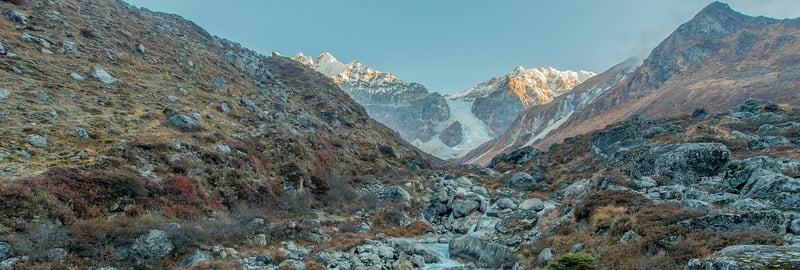
Parting our ways with the giant river, we will be met by the gorgeous Langtang Khola to show us our way to 1620 m Dhomen Village. The climbing trail will ascend through the jungle valley of huge rhododendrons and towering conifers till we arrive at Bamboo.
After some well-deserved refreshments, we will start to climb the long steep stone steps. After two hours of our effort, Rimche village will greet us from where Lama Hotel is just a stone's throw away.
Enjoying the company of the playful waters of Langtang Khola, we will begin ascending through the green landscape of Langtang forest. Shortly, we will be once again showing our permits to the officials of the Nepal Army Checkpost located at Ghumanchok.
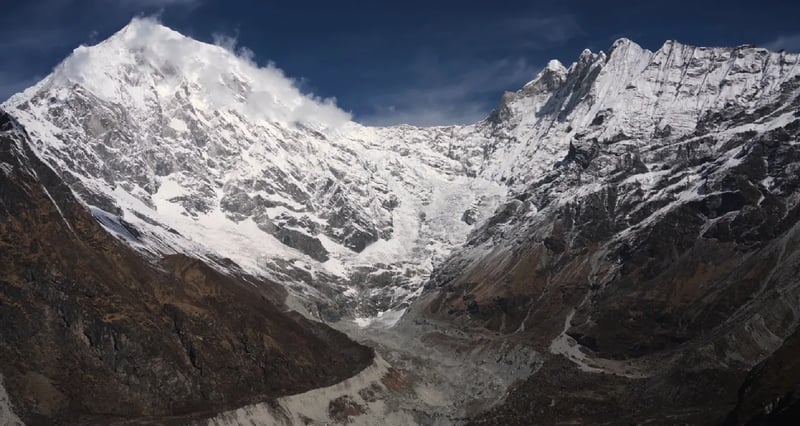
The gigantic crimson rhododendrons will decor our continuously climbing path till we reach Chunama. The magnificent 7225 m high summit of Langtang Lirung will make us pause our adventure for a while.
This rest will prepare us for the rapidly and sharply climbing trail that will take us to 3000 m elevation at Ghoratabela (Stable for Horses). The forward track now slowly goes down to Thangshyap, Ghumba, and Chyamki before we reach the new Langtang Valley.
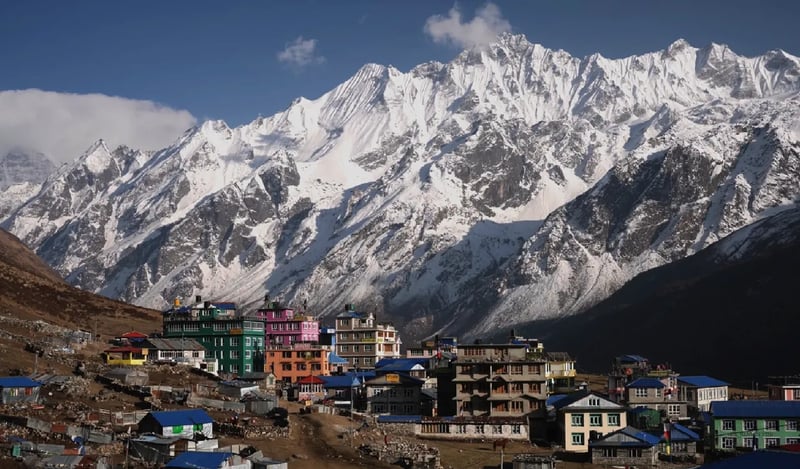
Our upward journey will continue today also as we travel to 3543 m high Mundu Village. It is now known as the new Langtang Village where most of the modern lodges are constructed.
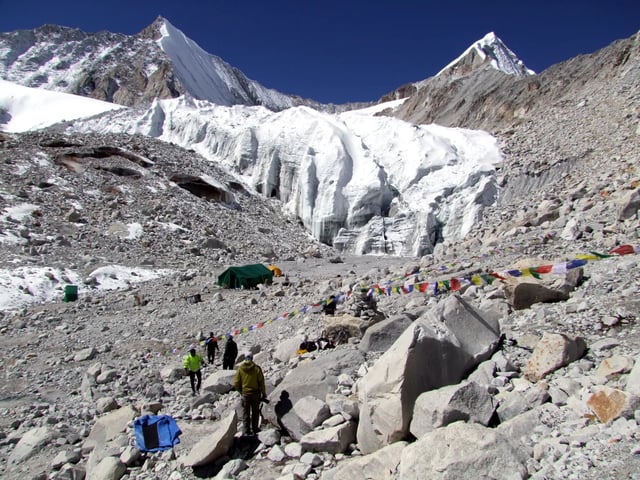
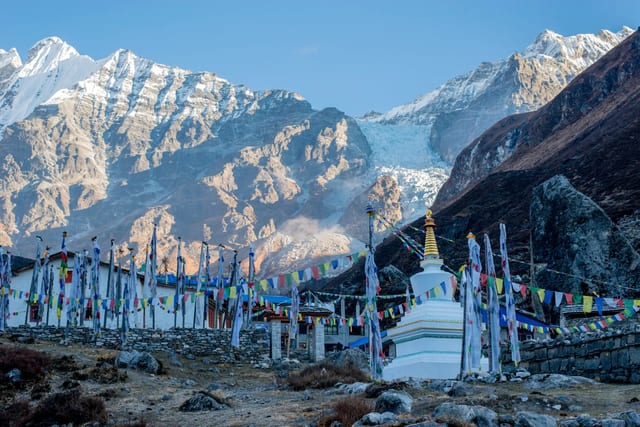
You can now feel the humid and green landscape has transitioned into the dry arid terrain of the Tibetan plateaus. Walking through the picturesque yak meadows of Singdun and Yemphu, we will soon reach Kyanjing Gumba.
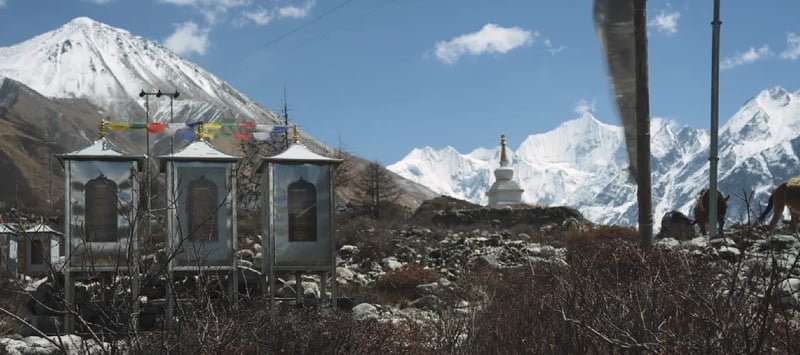
It is the final settlement in the Langtang Valley that provides access to several paths leading to various glaciers and summits. The area also hosts a beautiful Gumba (Monastery) and a government funded and operated yak cheese factory.
On this day, we will reach the highlight of our Langtang Helambu trek as we climb to the peak of Kyanjing Ri at 4773 m. Its ascent is not technical, no equipment is needed, all that is needed is your perseverance to climb the rugged stony trail for about an or two.
Being located in the strategic position in the heart of a mountainous landscape, its summit opens the unbelievable views of Langtang Yansa, Dshabu Ri, Dorje Lakpa, Langtang Lirung glacier, Kinshung, Tsergo Peak, Naya Kang, Changu, Langshisa Ri, Ganchenpo, Yurba, Yala Peak, and Langtang II. Filling our memory box with the precious spectacle and moment, we will now return with happy hearts to our lodge in Kyanjing Gumba.
From today, we will set on the beginning of a new journey towards Gosaikunda and Helambu.
The path today is predominately descending which will bring us closer to the already-known surroundings of Mundu, Ghumba, Thangshyap, Ghoratabela, and Ghumanchok before finally we reach at the welcoming lodge of Lama Hotel.
Once our loyal friend, the Langtang Khola will soon welcome us again and guide us down to Rimche from where we will walk down steadily to Bamboo. Get ready to climb sharply along the twisting track for a while, then we will head down to a canyon where a long and high (2000 m) suspended bridge will be waiting for us.
After carefully crossing the bridge, the track ahead will carry us above the small hill. With great delight, we will see the Ganesh Himal penetrating the cloudless sky.
Our trail will continue to climb as we aim to reach Sing Gompa today better known as Chandanbari. Our upward journey will soon lead us to the 2500 m high Dursagang, now our walking pathway eases as it transitions into a gradual rise surrounded by the tranquility of the forest. Next, we will push ourselves to the 3210 m height of the Foprong Danda.
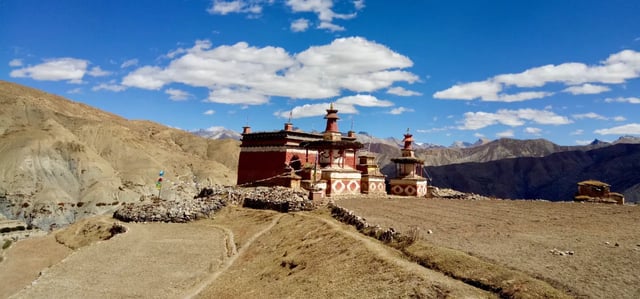
Ganesh Himal reveals its beauty from all its angles which is truly majestic. Now a forest trail of Dhimsa will lead us to Sing Gompa, the atmosphere here is simply filled with religious vibes emanating from the nearby Gompa.
After we depart from Sing Gompa, our ascent journey continues along a small ridge till we reach the flat terrain of 3380 m high Chalang Pati. Take a breather to witness the amazing contrast of the landscape, to the south, you can see the arid scrubland while to the north, the dense humid jungle will cool your eyes.
Next, we need to tackle the steepened trail again that rises hastily leading us to the 3930 m high Laurebinayak. This place is simply incredibly blessed by not only the massive peaks of Ganesh and Langtang but also by Annapurna and the double summit of Manaslu.
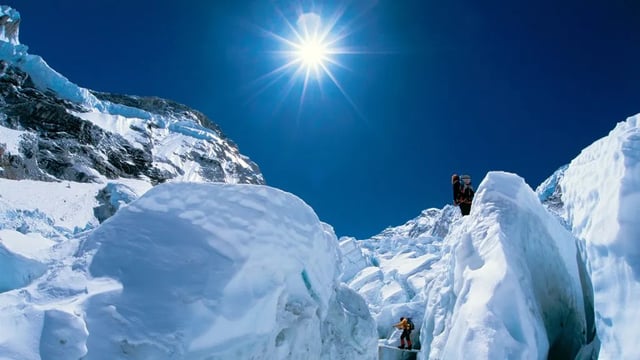
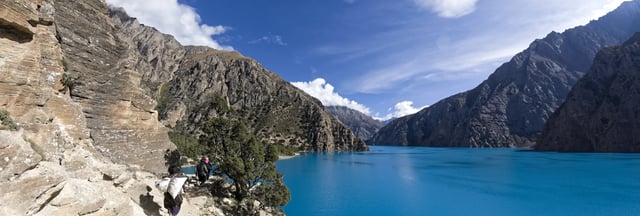
The trail keeps on rising more and more twisting and turning taking us to the enormous height of 4165 m at Gosaikunda Pass. The high altitude environment is visible now as we advance to the first of the Gosaikunda Lakes, the Saraswati Kunda at 4100 m.
We will devote our morning to discovering the beautiful terrain of the Gosaikunda. After that, we will walk along the inclined pathway that will soon direct us to the grassy meadow. We will now walk through the remaining four lakes of Gosaikunda: Dudh Kunda, Chandra Kunda, Ama Kunda, and Ragat Kunda.
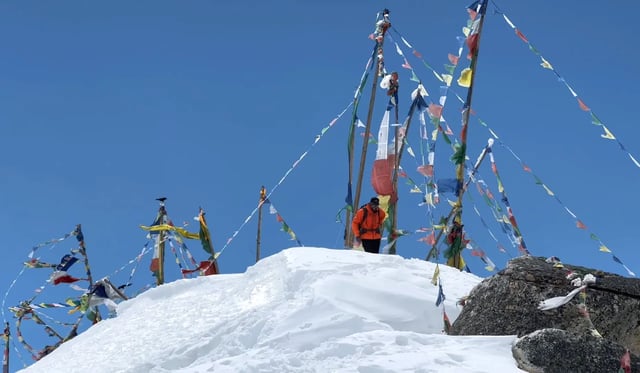
Their beauties will captivate our senses and in no time we will be at the top of the highest elevation of our Langtang trekking itinerary: the grand Laurebinayak at 4610 m. This Pass marks our entrance into the Helambu land. Now get ready for 900 m descent that will take us to the tail of this pass known as Phedi at 3741 m.
Now a series of ascents and descents follows till we settle ourselves at the lodge of Ghopte.
Early morning, we will exit Ghopte and indulge in a brief descent before we ascend the track passing through the rich pine and cypress forest. Now, a more challenging steep terrain will take us to the heights of 3690 m at Thadepati.
Dorje Lakpa and Gangchempo will be outstandingly standing tall in front of us. Now, we will go down slowly enjoying the cool breeze coming through the rhododendron and pine trees.
We will pass through 3265 m high Magin Goth from where we will have to climb a little to 3335 m Kuala Bhanjyang. The remaining trail is mainly downhill now till we make it to the village of Kutumsang located in the Shivapuri National Park.
From Kutumsang, we will trek up a hill and walk down to Gul Bhanjyang. A dusty road will take us to another ridge at 2500 m known as Thorong Danda.
After descending from this hill, we will arrive in Chipping village. We will then slowly make our way down to 1760 m Pati Bhanjyang from where Chisapani is just at a short distance.
Gazing on the magical Gaursishankar and Langtang Himals, we will eat our last mountain breakfast. Then, we will head along the picturesque trail winding through the lush forest of Shivapuri National Park.
Shortly, we will arrive at the army checkpoint from where we will exit the park and walk for a while to reach 1895 high Mulkharka. A stone steps will now guide us down to Sundarijal, keep your eyes open to see the dazzling Sundarijal waterfall and its hydropower station.
We will find our vehicle calmly waiting for us to take us back to the urbanization of Kathmandu. In the evening, we will celebrate the last night of your 15 days Langtang trekking journey with an authentic Nepali meal with our entire team.
It is now time to say farewell to the magnificent Himalayas and all the friends you have made during your stay. We hope every moment you have spent in this has formed for you a memory to treasure. Our car will come to transfer you to Kathmandu International Airport three hours before your flight for your home return.
Namaste! Until we meet again!
Fly into Tribhuvan International Airport in Kathmandu unless the itinerary uses another regional hub. Airport or hotel pickup can be arranged when you share arrival details ahead of travel.
Briefings cover road or domestic travel to the trailhead. Build buffer time before onward international flights in case mountain weather shifts the schedule.
Twin or double rooms in a comfortable Kathmandu hotel cover your first nights and your return from the trail, with breakfast on those city stays when included in the package. Briefings happen at the hotel, and airport collection from Tribhuvan is available when flight times are shared in advance.
Family-run teahouses or lodges line the route with twin beds and a shared dining room. Rooms get simpler and colder as you climb, with shared bathrooms common at higher villages. Hot water, Wi-Fi, and charging are paid at the lodge when offered.
Spring from March to May and autumn from September to November usually bring the clearest views and stable walking conditions on this route. Winter is quieter but colder at altitude, while monsoon months bring cloud and wet trails at lower elevations.
Shoulder weeks need an honest weather call before high passes or dawn viewpoints. Monsoon cloud sits lower on the hills while winter brings ice on steps above village level.
You should be comfortable walking several hours a day on uneven paths with a daypack, including steady uphill sections as you gain height. Hill training and longer weekend walks in the months before travel help your legs and lungs on uphill trail days.
Hill training, stair climbing, and longer weekend hikes in the months before travel help your legs and lungs, even when acclimatisation days are built into the route. Break in boots before you fly and carry a light daypack on practice walks.
Guided trekking with licensed leaders, lodge nights on the trail, meals as described for walking days, and permits for the regions crossed are included when they are part of this trip. Domestic flights, porters, and airport transfers apply only when they are part of this trip.
Domestic flights, road transfers, porter support, and airport transfers apply only when they are part of this trip. Permits for the regions you cross are arranged in Kathmandu or Pokhara when included.
International flights to Nepal, visa fees, compulsory travel insurance, personal trekking clothing, snacks and drinks outside included meals, and tips for crew are not covered. Hot showers, Wi-Fi, and battery charging in lodges are usually paid locally when offered.
Charges for hot showers, Wi-Fi, or battery charging in lodges are paid locally when offered unless your trip notes say otherwise. International flights, visa fees, and personal insurance stay outside the trek package.
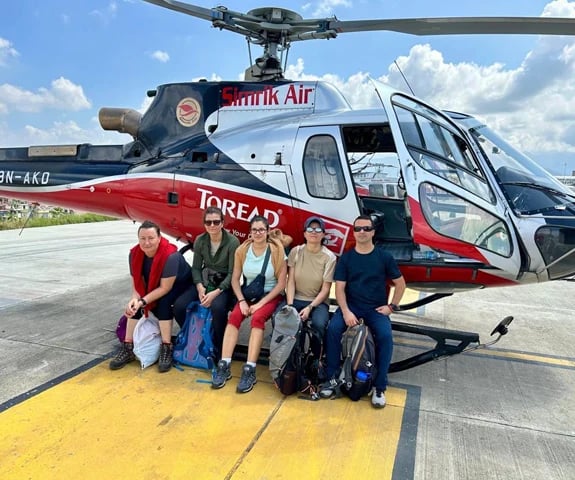
Pickup can be arranged from Tribhuvan International Airport or your hotel in Thamel when you share flight times ahead of travel. The pre-trek briefing is usually held at the hotel before the Lukla flight or helicopter sector.
Allow buffer days after the trek in case mountain flights move. Thamel hotels are the usual meet point; drivers need flight numbers to meet you at the international terminal.
Guides set a steady pace and watch for headache, nausea, or dizziness as you gain height. Weather can shift daily plans, so your guide keeps a steady pace with regular breaks.
Tell your guide early if symptoms appear so tomorrow's stage can shorten or descent can start before conditions worsen. Trail conditions are checked each morning before the group moves.
Jeep or bus days to the remote trailhead are arranged when they are part of your package. Your guide confirms departure times at briefing.
Motion sickness medicine helps on winding mountain roads. Your crew would rather wait for a safe window than rush marginal weather.
National park or restricted-area permits apply depending on the valleys you cross. The team arranges paperwork in Kathmandu or Pokhara when you provide passport copies and trek dates.
Keep copies in your daypack for checkpoint stops. Allow a little extra time after the trek before international flights home in case mountain roads or flights move.
Families join when children can manage the daily hours and terrain on this specific route. Pace and daily hours can be adjusted on private departures, though that may extend the calendar.
Ask our Kathmandu team if you are planning with younger walkers. Private departures can shorten daily hours, though that may add a day or two to the calendar.
Comprehensive travel insurance that covers trekking to the highest altitude on your itinerary, medical evacuation, and helicopter rescue when applicable is essential. Many standard policies exclude high altitude by name.
Read the wording before you travel so you can adjust cover if trekking above 5,000 metres is not named. Many standard policies exclude high altitude by name, so read the wording before you fly.
We partner with Rewilding Britain to help protect our natural spaces for future adventures.
All centres are vetted for safety and quality. Your adventure is in good hands with adventuro.
About the centre
Kathmandu
You'll travel with a Kathmandu-based team that plans treks, peak climbs, helicopter flights, motorbike journeys, and cultural trips across Nepal, Tibet, and Bhutan. Routes range from classic teahouse walks and high passes to luxury lodge itineraries and longer expedition-style climbs, with departures shaped around how you want to pace the mountains.
Licensed guides and office staff train regularly on mountain safety and guest care. Porters are insured, fairly paid, and equipped for the trail, with sensible load limits on lodge routes. We work with remote communities through sustainable tourism, including support for education in village areas, so your booking helps local people as well as your own adventure.
Operated by Himalayan Adventure Treks & Tours, a partner of adventuro.