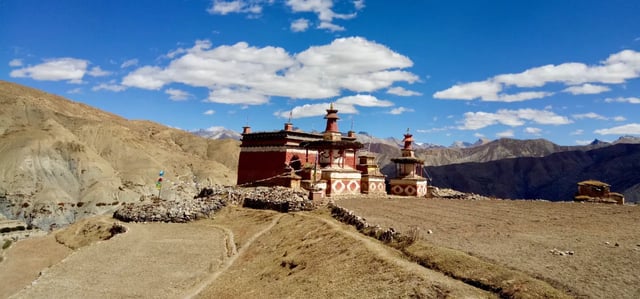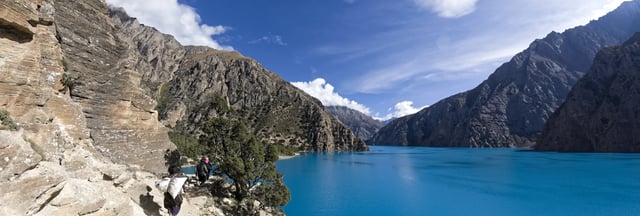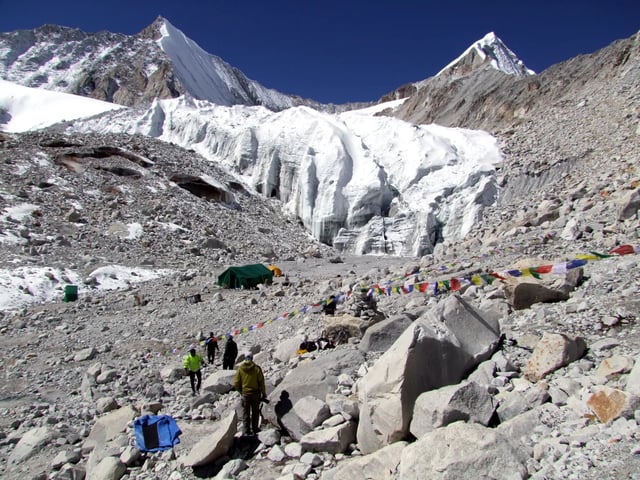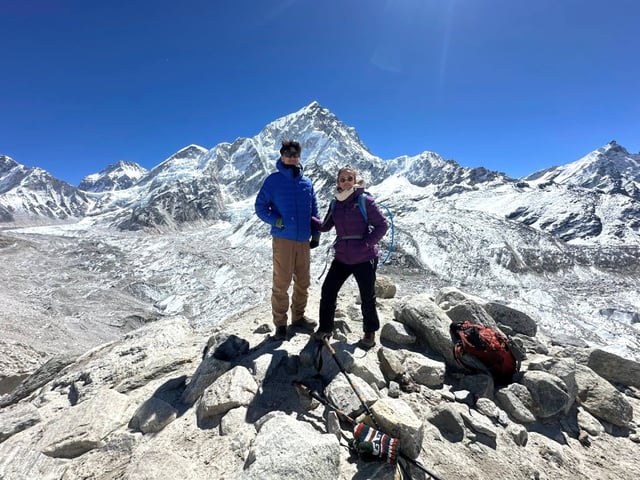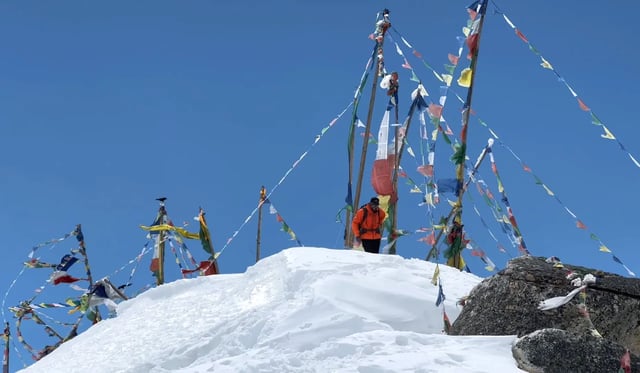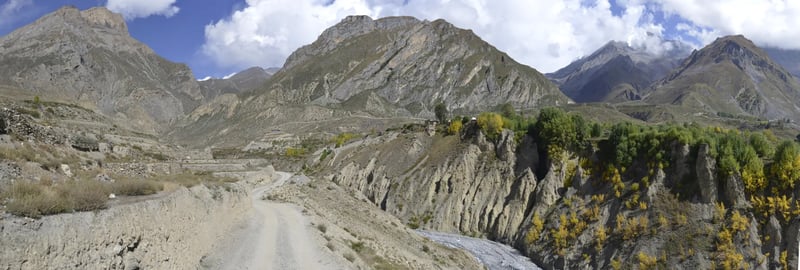
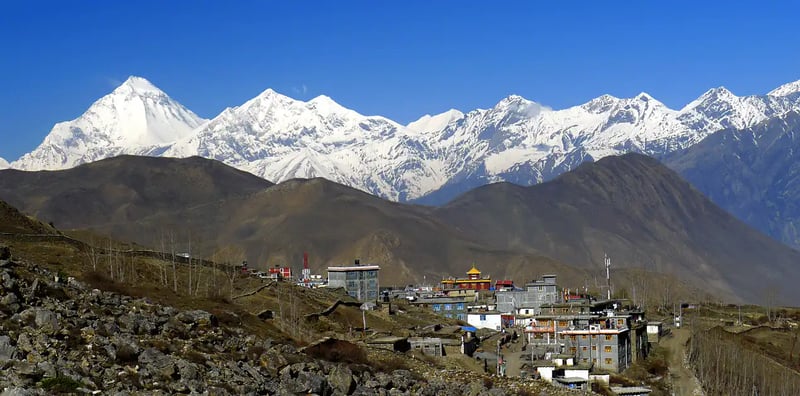
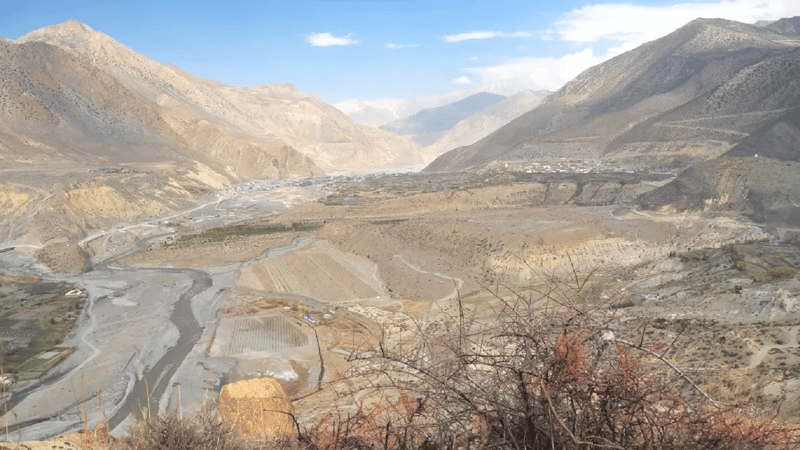
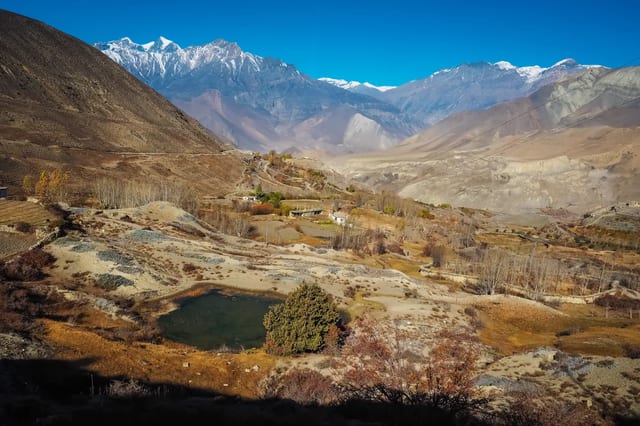
From Pokhara you fly or drive toward Jomsom in the Kali Gandaki, then walk the windy valley to Kagbeni and climb to Muktinath’s temples and 108 waterspouts. Nilgiri and Dhaulagiri frame the desert-side trail. Kagbeni’s desert lanes, Muktinath’s waterspouts, and Marpha’s white houses are the Kali Gandaki highlights.
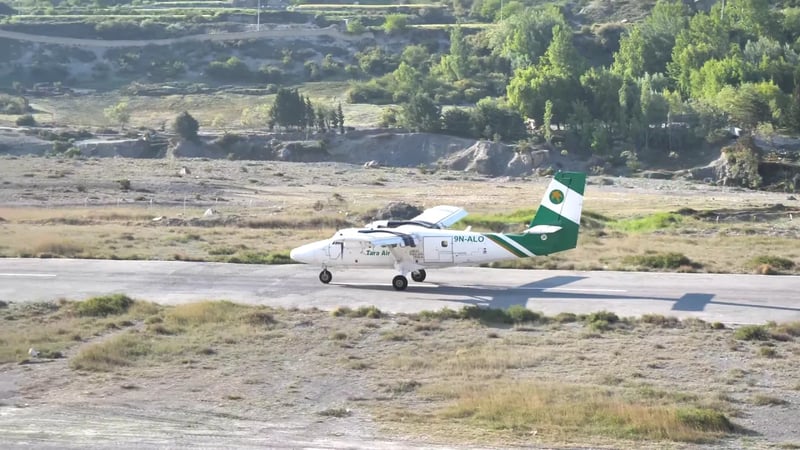
Marpha’s apple orchards and Thakali lodges break the walking days. You return via Jomsom’s airstrip or the road south when weather holds. Afternoon wind on the gravel and Thakali meals in Marpha set the rhythm between Jomsom and the temple.
We'll book the Pokhara to Jomsom flight and ACAP before you leave the lakeside, then walk you to Kagbeni and Muktinath's 108 waterspouts the next day. Your guide times the windy Kali Gandaki hours so you are not on the gravel at midday. Guides licensed through MOCTCA and NATHM are chosen for patience on this pilgrimage-and-foothill week.
After Tukuche and the Tatopani soak, the same crew climbs to Ghorepani for a Poon Hill dawn, then finishes through Ghandruk to Birethanti. Thakali lodge lists in Marpha country stay current, and porters carry insured loads of about 25 to 30 kg. Arrival briefings name the Jomsom weather hold so a delayed flight can shift without guesswork.
Namaste from Kathmandu! Once you complete the immigration procedures and retrieve your luggage, you will meet our representative, who will then drive you to your prearranged accommodation in Kathmandu.
In the early evening, you will have a brief meeting with our tour guide. Over dinner, you will get the preliminary details about our Jomsom Muktinath trek.
After your early organic breakfast in Kathmandu, our guide will collect you from your Kathmandu hotel. Together, we will leave Kathmandu through Kalanki and Thankot. The royal Prithvi Highway then commences to guide us beside the green velvety hills toward Trishuli.
Soon, the very vital central Muglin Market will begin to be seen, which will guide us onward to the decorative Newari Bandipur town. Watching the graceful form of Langtang, Fishtail, Manaslu, and Annapurna, we will soon be able to feel the refreshing Himalayan Air of Pokhara.
After you are picked up by our guide from your Pokhara hotel, you will be driven towards Pokhara Airport from where we will board a Jomsom flight traversing over the Dhaulagiri and Annapurna. Landing at Jomsom, we will get ready to engage in our first light hike towards Kagbeni. After Jomsom, we will move across the Kali Gandaki Valley through Pang Khola and move east, sometimes on the graveled road and sometimes off-road.
Ekle Bhatti, literally meaning lonely teahouse, will soon hail us where we may take a brief lunch break. Right across, we can see the beautiful feature of the Kagbeni town, which is only one or two hours farther.
Today, we will reach the prime attraction of our Jomsom Muktinath trek. The morning will begin with a sharp ascent towards the east. En route, we will walk through Ekle Bhatti and Khinga communities.
From up here, the visuals of Mustang to the north and Dhaulagiri to the south seem very. We will soon arrive at the Jharkot settlement from where we will proceed to the picturesque village of Purang. Jhong Khola with its marvelous current flows on the route.
A long air-hung suspension bridge will lead us across from where we will ascend to Jhong Village (3580 m).
Our Jomsom Muktinath trek is now elegantly approaching its end. From today, the journey will be predominantly downhill, beginning from Muktinath. The path ahead moves down through the dry Lower Mustang terrain of Kagbeni, after which we will meet Dagarzong and Jomsom yet again.
As we keep on descending, we will come across marvelous Marpha, the Apple town of the nation, where we will certainly take a moment to flavor the local apple wine and apple pie. From here, Tukuche village is just around the corner, our overnight location planned for tonight.
From Tukuche, our downhill trekking part of the Jomsom Muktinath trek will continue towards Ghasa. We will traverse the culturally rich village of Larjung, followed by Shyang and Kokhethanti.
We will then be at Lelep, placed further south, after which a popular spot and resting location of Annapurna, Kalopani, will be reached. Continuing on, we will walk through the Chhoya Village before arriving at Ghasa Village, known more for its astounding beauty and mountain scenery.
From Ghasa, we will navigate across a hung bridge, which will usher us along the nature trail towards Pairothapla. Then, we will traverse a few small communities where we will relax for a while, tasting the flavor of the natural honey.
The route will keep on moving down towards Kopchepani, and soon we will come face to face with the outstandingly gorgeous Rupse Chhaha/Waterfall of Dana Village. Tatopani is very nearby, where we will soon arrive and set forth to relax in the therapeutic natural waters of its hot springs.
After Tatopani, our route will lead us on a navigation across the vast river. After we are through this river, we will follow the right trail and walk serenely through the jungles of the Birauta and Ghara Villages. A short and tender ascending path ahead will carry us through Ghopte Kharka towards the beautiful locality of Shikha.
Our route from here will be dominated by the green and yellow cultivated lands of Phalante and Chitre villages. The crooked woodland will now guide us to the humid and pleasing environment of the Ghorepani Village, the village of the Magar community that literally translates as the site where horses hydrate.
Another momentous day of our Jomsom Muktinath trek is today, when we will be above one of the most indulging Lookout Point of Nepal, Poon Hill. With the soft melody of our alarm, we will set forth on foot towards the verdant slope of Poon Hill.
The final climb along the steel staircase will make us stand over the Viewpoint from where we can hug and feel the breathtakingly refreshing Himalayan air of Varaha Shikhar, Fishtail, Tukuche, Nilgiri, Manaslu, Dhaulagiri, and Annapurna range, including II, III, IV, and South.
Our Jomsom Muktinath trek itinerary trail today will progress towards Ghandruk, one of the largest and pretty developed villages resided by the Gurung tribe, a significant part of the British Gurkha regiment. From Tadapani, we will meander through the deep Nepali medieval forest and reach the open green space of Bhainsi Kharka (Pasture for the buffalo).
The trail here will branch off towards Ghandruk, which is also safeguarded by the imposing presence of the Fishtail, Gangapurna, Hiunchuli, and Annapurna South.
Our Jomsom Muktinath trek is culminating soon as we will today be at Pokhara by early afternoon. From Ghandruk, the stone stair will guide us downward towards Kimche village, from where we will tenderly climb the Kimrong Danda.
The path is now constantly downhill, navigating through Shyauli Bazaar to Birethanti. We will have the final stamp on our TIMS Card here as we depart from the boundary of the Annapurna Conservation Area.
Bringing an end to our trek now, we will get in our private 4WD vehicle to reach Pokhara. At first, the road will stretch along the dirt road, which soon turns into a black-topped, wide road following the town of Nayapul to Pokhara.
Our Jomsom Muktinath trek will conclude the same way as we began on its first day. A large, very comfortable AC tourist bus will yet again transfer us along the royal Prithvi Highway, Bandipur, Trishuli, and Thankot to Kathmandu.
You will be joined by our team later in the evening, who will host a very blissful evening dinner for you in the cultural Nepali restaurant.
With sweet memories of the Jomsom Muktinath trek, your journey from Nepal commences today.
Our team will offer you its private 4WD to take you to TIA.
Fly into Tribhuvan International Airport in Kathmandu unless the itinerary uses another regional hub. Airport or hotel pickup can be arranged when you share arrival details ahead of travel.
Briefings cover road or domestic travel to the trailhead. Build buffer time before onward international flights in case mountain weather shifts the schedule.
Twin or double rooms in a comfortable Kathmandu hotel cover your first nights and your return from the trail, with breakfast on those city stays when included in the package. Briefings happen at the hotel, and airport collection from Tribhuvan is available when flight times are shared in advance.
Family-run teahouses or lodges line the route with twin beds and a shared dining room. Rooms get simpler and colder as you climb, with shared bathrooms common at higher villages. Hot water, Wi-Fi, and charging are paid at the lodge when offered.
Spring from March to May and autumn from September to November usually bring the clearest views and stable walking conditions on this route. Winter is quieter but colder at altitude, while monsoon months bring cloud and wet trails at lower elevations.
Shoulder weeks need an honest weather call before high passes or dawn viewpoints. Monsoon cloud sits lower on the hills while winter brings ice on steps above village level.
You should be comfortable walking several hours a day on uneven paths with a daypack, including steady uphill sections as you gain height. Hill training and longer weekend walks in the months before travel help your legs and lungs on uphill trail days.
Hill training, stair climbing, and longer weekend hikes in the months before travel help your legs and lungs, even when acclimatisation days are built into the route. Break in boots before you fly and carry a light daypack on practice walks.
Guided trekking with licensed leaders, lodge nights on the trail, meals as described for walking days, and permits for the regions crossed are included when they are part of this trip. Domestic flights, porters, and airport transfers apply only when they are part of this trip.
Domestic flights, road transfers, porter support, and airport transfers apply only when they are part of this trip. Permits for the regions you cross are arranged in Kathmandu or Pokhara when included.
International flights to Nepal, visa fees, compulsory travel insurance, personal trekking clothing, snacks and drinks outside included meals, and tips for crew are not covered. Hot showers, Wi-Fi, and battery charging in lodges are usually paid locally when offered.
Charges for hot showers, Wi-Fi, or battery charging in lodges are paid locally when offered unless your trip notes say otherwise. International flights, visa fees, and personal insurance stay outside the trek package.
Pickup can be arranged from Tribhuvan International Airport or your hotel in Thamel when you share flight times ahead of travel. The pre-trek briefing is usually held at the hotel before the Lukla flight or helicopter sector.
Allow buffer days after the trek in case mountain flights move. Thamel hotels are the usual meet point; drivers need flight numbers to meet you at the international terminal.
Guides set a steady pace and watch for headache, nausea, or dizziness as you gain height. Weather can shift daily plans, so your guide keeps a steady pace with regular breaks.
Tell your guide early if symptoms appear so tomorrow's stage can shorten or descent can start before conditions worsen. Trail conditions are checked each morning before the group moves.
Jeep or bus days to the remote trailhead are arranged when they are part of your package. Your guide confirms departure times at briefing.
Motion sickness medicine helps on winding mountain roads. Your crew would rather wait for a safe window than rush marginal weather.
National park or restricted-area permits apply depending on the valleys you cross. The team arranges paperwork in Kathmandu or Pokhara when you provide passport copies and trek dates.
Keep copies in your daypack for checkpoint stops. Allow a little extra time after the trek before international flights home in case mountain roads or flights move.
Families join when children can manage the daily hours and terrain on this specific route. Pace and daily hours can be adjusted on private departures, though that may extend the calendar.
Ask our Kathmandu team if you are planning with younger walkers. Private departures can shorten daily hours, though that may add a day or two to the calendar.
Comprehensive travel insurance that covers trekking to the highest altitude on your itinerary, medical evacuation, and helicopter rescue when applicable is essential. Many standard policies exclude high altitude by name.
Read the wording before you travel so you can adjust cover if trekking above 5,000 metres is not named. Many standard policies exclude high altitude by name, so read the wording before you fly.
We partner with Rewilding Britain to help protect our natural spaces for future adventures.
All centres are vetted for safety and quality. Your adventure is in good hands with adventuro.
About the centre
Kathmandu
You'll travel with a Kathmandu-based team that plans treks, peak climbs, helicopter flights, motorbike journeys, and cultural trips across Nepal, Tibet, and Bhutan. Routes range from classic teahouse walks and high passes to luxury lodge itineraries and longer expedition-style climbs, with departures shaped around how you want to pace the mountains.
Licensed guides and office staff train regularly on mountain safety and guest care. Porters are insured, fairly paid, and equipped for the trail, with sensible load limits on lodge routes. We work with remote communities through sustainable tourism, including support for education in village areas, so your booking helps local people as well as your own adventure.
Operated by Himalayan Adventure Treks & Tours, a partner of adventuro.