
Ready to find a course or session?
APPI 1 Discover is where paragliding starts for most people who have never touched a wing before. APPI, the Association of Paragliding Pilots and Instructors, designed this rating for complete beginners who want structured coaching on the ground before anyone asks them to commit to height. You are not expected to arrive brave. You are expected to arrive curious and willing to listen.
Most of day one feels like kite flying with extra straps. You learn to inflate the wing, control it on the ground and read when the wind is helping versus when it is misbehaving. High flights may happen during the course but APPI does not require them for the rating. That matters if you are nervous. Your instructor builds confidence through ground handling first, then supervised flights with radio contact when you are ready.
APPI standards require at least three days with a certified instructor, including one full day of ground handling. You complete theory on weather, flight mechanics, air laws, equipment and emotional control, plus logbook tasks in the APPI 1 Discover section. Minimum age follows local rules. Leave a comment when you book if heights make you anxious or if you want a school known for patient beginner coaching.
APPI 1 is assessed continuously by your certified instructor rather than through a separate written exam day.
Quick answers about this qualification. For anything else, use live chat or browse bookable activities below.
Find activitiesIt is the entry-level APPI paragliding rating for complete beginners. You learn theory, ground handling and essential safety procedures, with high flights possible but not required for certification.
APPI 1 pilots may only fly under instructor supervision with radio communication. It is the first step toward APPI 2 Explore, not a licence to fly alone.
None. APPI 1 assumes you have never flown a paraglider. Light fitness for hill walking and ground handling helps.
If you have only watched videos and feel nervous, that is normal. Leave a comment when you book if you want a centre known for pacing beginners gently on the training slope.
APPI requires a minimum three-day course with a certified instructor, including at least one full ground-handling day. Some schools extend this if wind is uncooperative.
Intensive holiday formats and weekend blocks both work. Check the listing for how your chosen school structures the days.
No. APPI states high flights might be performed but are not necessary to obtain the rating. Many nervous beginners spend most of APPI 1 on the ground building wing control.
Your instructor introduces height only when you show safe ground handling and clear communication. There is no prize for rushing.
There is no separate high-stakes exam day. You complete the theoretical syllabus and logbook tasks described in the APPI 1 Discover section under instructor guidance.
Formal theoretical exams appear later in the pathway, notably at APPI 2 and above.
Sturdy trainers with ankle support, layers for changing hill weather, sun protection, gloves and water. Schools usually provide wing, harness, helmet and radio for training.
Leave a comment when you book about shoe sizing and whether the centre provides gloves or boots for your dates.
Many APPI 1 students feel the same. Ground handling lets you learn how the wing behaves without leaving the slope. High flights, if they happen, stay under instructor supervision with radio contact.
Leave a comment when you book if anxiety is a concern. Good schools match instructors to nervous beginners without making you feel singled out on the hill.
Minimum age follows local federation, civil aviation or army rules. Minors need parent or guardian authorisation.
Some schools set their own higher minimum for liability or insurance reasons. Ask the centre when you book if you are booking for a teenager.
APPI certifications are recognised among APPI schools and partner associations worldwide. In countries where the national authority delegates FAI IPPI issuance to APPI, an IPPI 1 stamp may appear on your licence automatically.
Legal flying rights depend on local law. Always check whether APPI is recognised by the authority managing free flight in the country where you fly.
Continue to APPI 2 Explore, where high flights and a theoretical exam build toward greater autonomy under supervision.
Some students take time for extra ground-handling days before moving on. That is a sensible path if the wing still feels unpredictable in your hands.
adventuro lists APPI schools on training hills and mountain sites in the UK and abroad. Compare whether transport, kit hire and accommodation are included before you pay.
Leave a comment when you book with your fitness level, height concerns and travel dates so the centre can advise on weather windows and pacing.

A 15-day camp in the spectacular setting of Iquique, Chile, designed for newcomers, offers a comprehensive introduction to paragliding under the guidance of world-class instructors
From € 3100
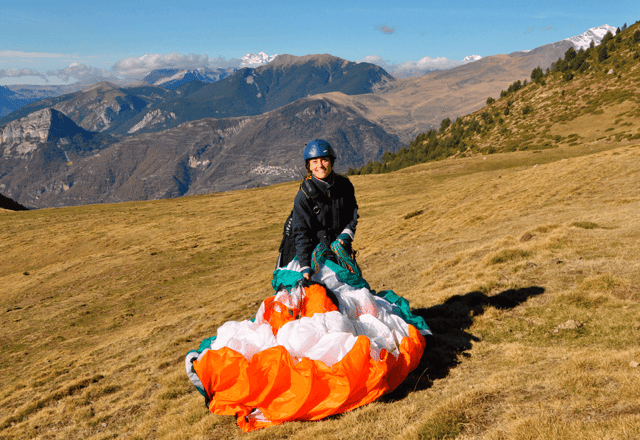
Beginner paragliding course in Spain with training flights, tandem session and APPI pathway near Zaragoza and Huesca. From 985 EUR.
From € 985