
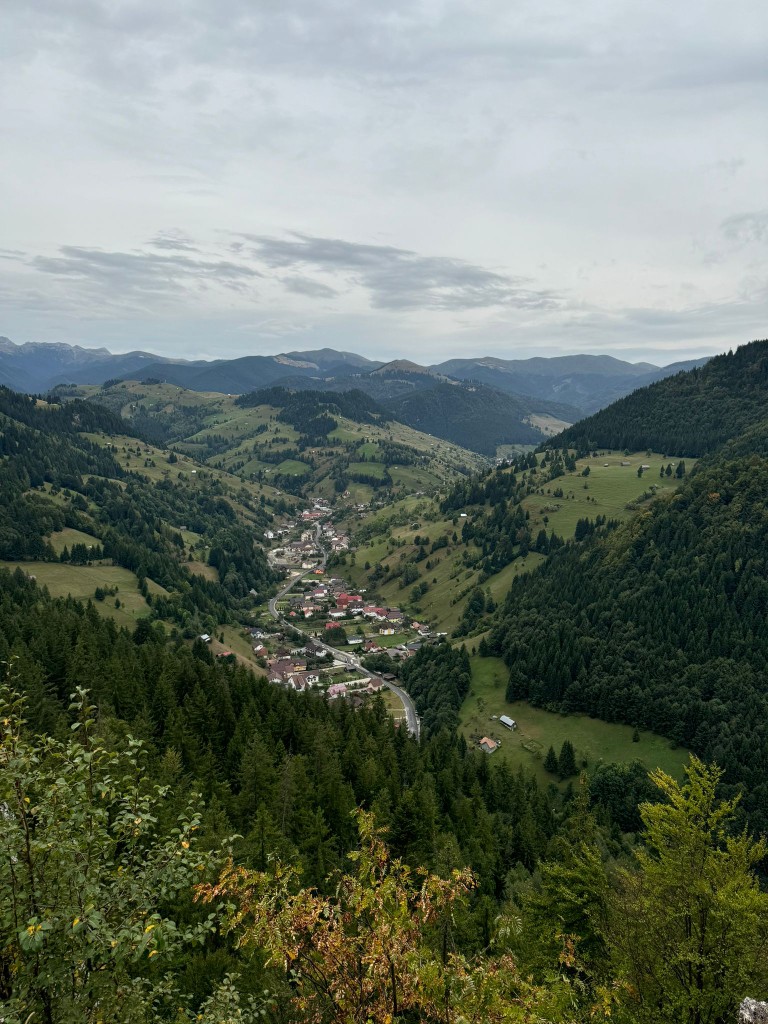
Hiking in Romania: bears, forests and what to expect
What is hiking in Romania like?
Romania gives you Alpine-scale mountains without Alpine prices or Alpine crowds. Trails are waymarked to a national standard, mountain huts serve hot food, and cable cars run to the high plateaus in the popular ranges. The difference from Austria or Switzerland is that the forests here are older and far less managed, so there is more wildlife in the landscape around you. On a normal walking day, that changes very little.
What it does change is a couple of habits: how you move through forest, and how you walk past a flock of sheep. Both take about a minute to learn. Here is the honest picture.
| What people assume | What it is like |
|---|---|
| Remote, no facilities | Waymarked trails, staffed mountain huts, cable cars in the popular ranges |
| You need technical skills | Fitness, navigation and weather sense matter more than ropework |
| Bears on every path | They live in the forest and are rarely seen. Simple habits keep it that way |
| Expensive, like the Alps | Comparable mountain days for a fraction of Alpine cost |
| Crowded all summer | Quiet outside a few honeypots, and quieter again in September |
How wild is Romania compared with the rest of Europe?
Wilder in the ways that matter, though not in the way people usually mean. Romania's forest cover is roughly 28 percent of the country, below the EU average of about 39 percent. What makes it exceptional is the age of what remains, and the fact that its mountain ecosystems were never fully cleared out.
The detail behind that:
- The PRIMOFARO inventory identified more than 525,000 hectares of potential primary and old-growth forest in Romania, around 8 percent of national forest cover.
- Romania contributes roughly 24,000 hectares to the UNESCO World Heritage site "Ancient and Primeval Beech Forests of the Carpathians and Other Regions of Europe", second only to Ukraine.
- The Carpathian arc is where this concentrates. Forest cover in Carpathian study areas runs to around 62 percent, against 28 percent nationally.
- European bison have been reintroduced to the Southern Carpathians by Foundation Conservation Carpathia, the first free-roaming herds there in around 200 years.
Practically, this means old beech and spruce, deep valleys, and forest that looks like forest rather than plantation. It is beautiful walking, and it is the real reason to come.

How many bears are in Romania?
The official 2026 estimate is around 11,500 brown bears, the largest population in the European Union. A 2025 Ministry of Environment study using DNA from hair and scat put the range at 10,419 to 12,770, and some environmental groups have contested the figures. A 2026 Council of the European Union paper notes that Romania and Slovakia together hold more than half of Europe's bears.
Those are big numbers, and they read alarmingly on a page. What they mean on a walking holiday is more mundane: bears live in the forest, keep away from people, and are rarely seen by hikers. A sighting is a story people tell for years precisely because it is uncommon.
The habits that keep it that way are easy, and they are the same ones guides use every day:
- Make some noise in dense forest and near loud streams. Talking normally is enough. Most encounters happen because a bear was surprised, and noise removes the surprise.
- Walk in a group of three or more where you can.
- Walk in daylight rather than at dawn or dusk in woodland.
- Keep food sealed and out of your tent if you are camping.
- Never stop for roadside bears. The ones that have learned to associate cars with food, notably along the Transfăgărășan, are the ones to avoid. Do not feed them, and do not stop to photograph them.
What do you do if you see a bear?
Do not run. Stand tall, speak in a normal firm voice so it works out you are human, and back away slowly while facing it. Nearly every encounter ends with the bear leaving of its own accord.
Bucegi Natural Park, the authority for the range above Bușteni, publishes a simple ladder. Worth reading once so it is in the back of your mind, then not worrying about.
| Situation | What to do |
|---|---|
| Bear at a distance, unaware of you | Stay calm, retreat slowly, increase the distance, do not approach for a photo |
| Bear aware of you | Speak firmly, move slowly, do not run, retreat while facing it |
| Bear standing on hind legs | It is having a look around, not preparing to attack |
| Bear approaching | Stand your ground, make noise, drop your pack as a distraction, use bear spray if you have it |
| Cubs visible | The mother is close by. Back away the way you came |
| Bear on the path | Give it a clear route past rather than standing in its way |
Guidance on the very rare case of physical contact differs between sources, so follow your guide's briefing on the day rather than anything you read online.
Sheep flocks and their dogs
This is the encounter you are far more likely to have, and it is worth knowing about mainly because it is unfamiliar. Through the summer, shepherds graze flocks across the open meadows and ridges of ranges like the Bucegi and Ciucaș, and each flock has large guard dogs that work alongside the shepherd.
Meeting them is a normal part of walking in the Carpathians. The dogs bark and circle to check you are not a threat to the sheep, and then lose interest. The etiquette is simple:
- Spot flocks early and walk a wide arc around them, above or below. Do not walk through the middle of a flock.
- Slow down rather than speeding up, and do not run.
- Wave to the shepherd. Most will call the dogs back and wave you through, which is the easiest end to the whole thing.
- Keep a trekking pole in hand and your pack on. Both work as a calm barrier if a dog comes close. No need to brandish anything.
- Skip the eye contact, and never offer food.
- Keep your own dog on a short lead and well away from the flock.
- Do not camp in a grazing pasture.
Salvamont, the Romanian mountain rescue service, asks walkers to give flocks plenty of room even if it means adding time to a route, and asks flock owners to supervise their dogs and sign their grazing areas. On a guided trip this is handled for you: your guide talks to the shepherd and picks the line.
What are the trails and mountains like?
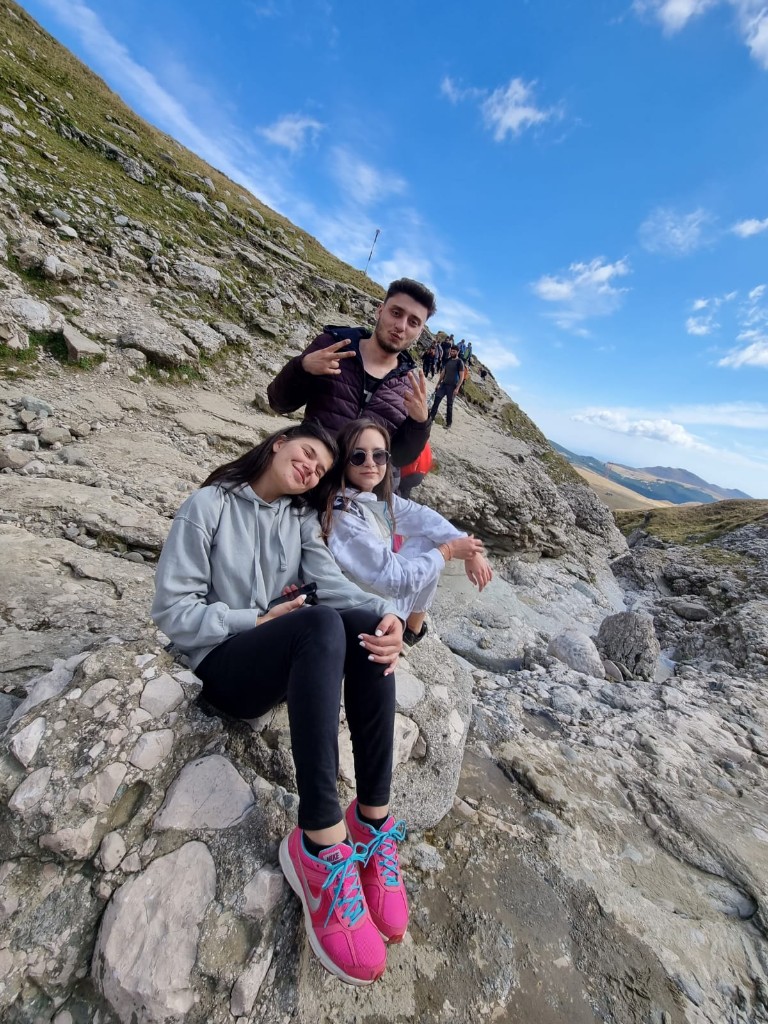
Better organised than you might expect. Romanian trails use a national waymarking system of coloured symbols painted onto rock and trees: a stripe, cross, dot or triangle in red, blue or yellow, with each combination marking one route. Mountain huts, known as cabanas, do food and beds, and the popular massifs have cable cars.
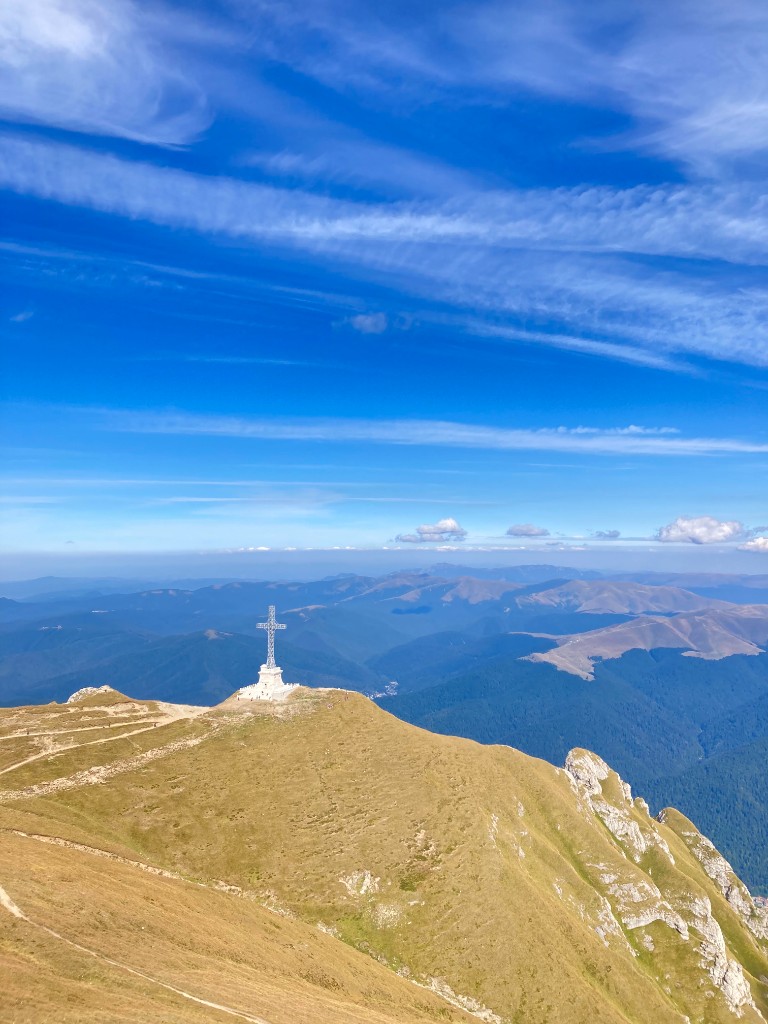
The Bucegi shows the range of it. You can ride a cable car from Bușteni up to the plateau at over 2,000 m, walk past the Sphinx and Babele rock formations, and reach the Caraiman Cross, a steel First World War memorial built between 1926 and 1928 at about 2,291 m. It stands roughly 39 m tall including its stone pedestal, is lit at night, is visible from the Prahova Valley below, and is recognised by Guinness World Records as the tallest summit cross at such an altitude.
The things that catch visitors out are practical:
- Weather turns fast. T-shirt to thunderstorm in two hours is normal on the plateaus, and wet limestone is slippery.
- Phone signal is patchy. Valleys are dead zones, so download offline maps before you start.
- The emergency number is 112. Ask for Salvamont for mountain rescue.
- Wild camping is not allowed inside national parks. Use designated spots, usually near a cabana. Outside the parks it is broadly tolerated.
- Distances take longer than the map suggests, thanks to forest sections, mule-track surfaces and altitude.
What is Via Transilvanica?
Via Transilvanica is Romania's long-distance trail, running about 1,600 km from Putna in the northeast to Drobeta-Turnu Severin on the Danube. According to the official trail project, it covers 85 stages and passes through around 400 communities, marked by carved kilometre stones.
It is built as a community project as much as a path: stays with local hosts, village food, monasteries and fortified churches. You do not need to thru-hike it. Most people walk a few stages, and the official guides and app are set up for that.
If Camino crowding is what put you off long-distance walking, this is the comparison to make. Similar structure, a fraction of the foot traffic.
When should you go?
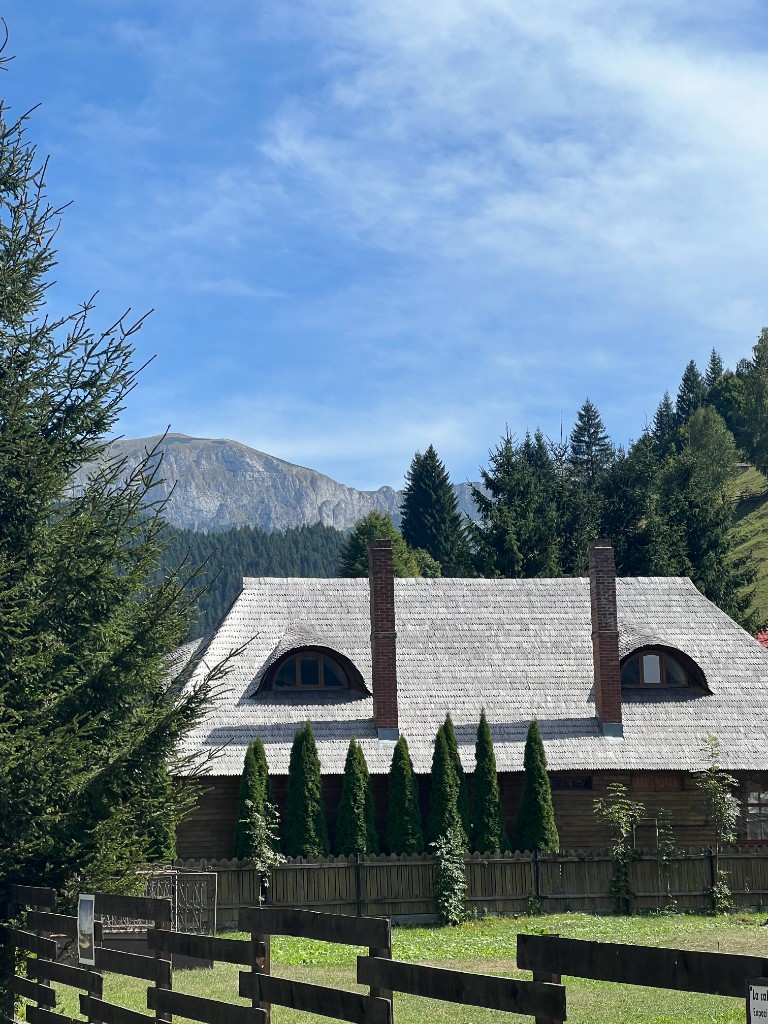
June to September is the core window, when huts are open, high routes are clear of snow and village guesthouses are running. Winter is a different discipline, and some upper routes near the Caraiman Cross close in dangerous conditions.
Sara on the adventuro team is Romanian and has walked these ranges for years. Her pick is September. Days are still long enough for full routes, nights cool down, cable car queues shorten, and once the school holidays end the meadows turn to dry grass and clear air.
If you want… do this
| If you want… | Do this |
|---|---|
| Mountains without the planning and the etiquette to learn | Book a guided multi-day trip |
| A high-altitude day with minimal commitment | Cable car to the Bucegi plateau, then the Caraiman Cross |
| Long-distance walking without crowds | Pick a few Via Transilvanica stages |
| Old forest rather than famous viewpoints | Head to the Southern Carpathians, away from the Prahova Valley |
| Quiet trails and settled weather | Go in September |
The guided option
A guide takes care of the parts that make a first trip feel like work: route choice, waymarking, weather calls, flocks and language. On adventuro, the multi-day option we feature links the Bucegi Mountains and Piatra Craiului National Park from Brașov, with three nights in the same village guesthouse.
4-Day Carpathian Hiking Tour: Bucegi Mountains & Piatra Craiului National Park
From €810 (checked 3 October 2026) · 4 days / 3 nights · Brașov hotel pick-up · Ages 6+ · Max group 8 · Eco-Romania certified · Guesthouse, breakfasts, packed lunches and dinners included
Keep reading
- Hiking in Morocco: what the High Atlas is really like
- UK access rights: where you can walk, camp and paddle
- Hidden gems for summer 2026: adventure destinations
- Browse hiking in Romania →
We partner with Rewilding Britain to protect wild places at home. The same courtesy applies abroad: stay on marked routes, pack out everything, give wildlife and livestock room, and leave no food behind.
FAQs
Is it safe to hike in Romania with so many bears?
Yes. Bears live in the forests but are rarely seen by hikers, and serious incidents are rare. The habits that prevent problems are straightforward: make normal noise in forest, walk in a group, walk in daylight, keep food sealed and out of your tent, and never stop for bears near roads.
Do I need bear spray in Romania?
Guides working the Carpathians carry it, and Bucegi Natural Park mentions it in official guidance, but most visitors on guided trips do not carry their own. If you do carry it, keep it in an accessible holster rather than inside your pack. Check current rules on buying and flying with it before you travel, since these change.
Can I wild camp in Romania?
Not inside national parks, where camping is restricted to designated spots, usually beside a cabana. Outside protected areas it is broadly tolerated. Wherever you pitch, avoid grazing pastures and keep food out of the tent.
Do I need a guide to hike in Romania?
No. Plenty of people walk the marked routes independently. A guide mainly saves you time and guesswork: reading the waymarking system, picking a line past flocks, judging fast weather. If you go alone, download offline maps, because phone signal fails in most valleys, and save 112 for emergencies.