
How to Stand Up on a Paddleboard: Tips and Techniques for Success
I still remember the first time I stepped onto a paddleboard—the slight (or not-so-slight) wobble beneath my feet and the sense of freedom as I found my balance. Paddleboarding quickly became a way to connect with nature, challenge myself physically, and find peace in a hectic world.
Stand-up paddleboarding (SUP) is a fantastic blend of surfing and kayaking, offering a unique perspective of the water. It’s rooted in ancient Polynesian culture but has evolved into a modern activity that’s accessible to almost everyone. Whether I’m exploring a tranquil lake, navigating a winding river, or catching small waves at the beach, paddleboarding never fails to bring joy and adventure into my life.
Benefits of Paddleboarding
Over the years, I’ve come to appreciate the incredible health benefits it offers. Physically, it’s a full-body workout. Balancing on the board engages my core muscles continuously, while paddling strengthens my arms, shoulders, and back. It’s low-impact, so it’s easy on the joints, and it’s adaptable to any fitness level.
But perhaps what I value most are the mental health benefits. There’s something profoundly calming about being out on the water, away from the noise and distractions of daily life. Paddleboarding allows me to practice mindfulness, focusing on the rhythm of my strokes and my surroundings.
Purpose of This Guide
Over time, many friends and fellow enthusiasts have asked me how to get started with paddleboarding. I’ve learned a lot through trial and error, and I’m excited to share that knowledge with you. This guide is meant to help you take your first steps onto a paddleboard with confidence.
II. Preparing to Stand Up
A. Choosing the Right Location
When I was learning to paddleboard, I quickly realized that the right location can make all the difference in your experience. I highly recommend starting out on calm, flat waters like lakes or sheltered bays giving your a good area, far from the banks and less things to crash into. These environments are forgiving and provide the stability you need when you’re getting the hang of balancing on the board.
Avoiding crowded areas is also important. Busy beaches or waterways with lots of boat traffic can be intimidating. Obstacles like swimmers, boats, and docks require quick maneuvering, which can be tricky when you’re just starting out. Find a quiet spot where you can focus on your technique without distractions.
B. Checking Weather and Water Conditions
Before I head out, I always make a point to check the weather forecast and water conditions. Wind is a significant factor in paddleboarding—it can either make your session delightful or turn it into a strenuous workout. Light winds are ideal for beginners because strong gusts can make balancing and steering the board much more challenging. Be very aware of offshore winds, especially on inflatable boards, blowing you out to sea. It is one of the top reasons for RNLI calls these days!
Understanding tides and currents is crucial if you’re paddling in coastal areas or rivers. I learned this the hard way when I once found myself struggling against an unexpected current—it was a tough paddle back to shore! There are plenty of apps and local resources that provide detailed information on tides and currents, which I find incredibly helpful for planning my outings.
C. Physical Preparation
Just like any physical activity, warming up before paddleboarding can make a significant difference in your performance and prevent injuries. I usually start with some light stretches focusing on my legs, back, and shoulders. Simple exercises like neck rolls, shoulder rotations, and hamstring stretches help loosen up tight muscles. Even a short walk or jog can get your blood flowing and prepare your body for the activity ahead.
Paddleboarding requires concentration and a positive mindset. I like to set realistic expectations for myself, especially when trying new techniques or venturing into unfamiliar waters. Remember, it’s perfectly normal to feel unsteady. Embrace the learning process, be patient with yourself, and don’t be afraid of falling—it happens to all of us!
IV. Step-by-Step Guide to Standing Up on a Paddleboard
A. Starting on Land (AKA Dry Run)
When I was first learning to paddleboard, I found it incredibly helpful to practice on land before hitting the water. This “dry run” allows you to get a feel for the proper stance and paddle grip without worrying about balance. Lay your board on a soft surface like grass or sand to avoid damaging it.
Stand beside your board and position your feet parallel and about hip-width apart—this will be your stance on the board. Hold your paddle with one hand on the top grip (the “T” grip) and the other hand about halfway down the shaft. The paddle blade should angle forward, away from you. Practice the paddling motion, simulating how you’ll stroke the water. This helps build muscle memory so that when you’re on the water, the movements feel more natural.
B. Entering the Water
When you’re ready to get started, carry your board safely to the water. I usually tuck it under one arm, holding the rail (the edge of the board), with the nose pointing forward. Be mindful of the fins underneath to avoid damaging them.
Before stepping into the water, attach the leash to your ankle—typically on your dominant leg. The leash keeps you connected to your board if you fall off, preventing it from drifting away. Make sure it’s secure but not too tight.
C. Mounting the Board
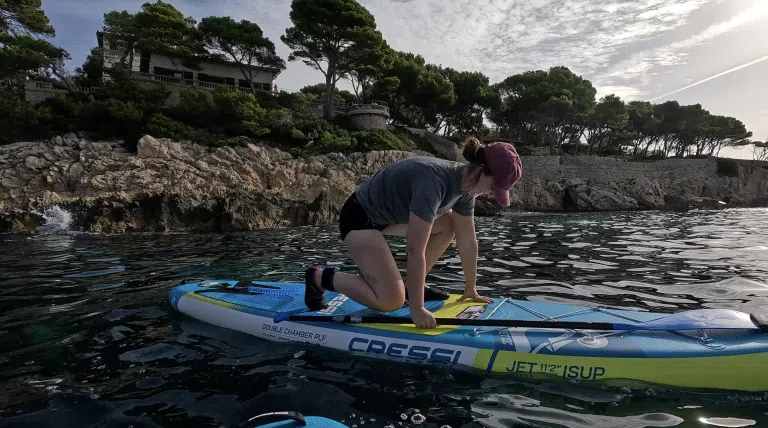
Find a shallow area where the water is about knee-deep. Place your board in the water, ensuring it’s floating freely without touching the bottom. Position yourself beside the board at the center point, which is usually marked by a handle.
Start by laying your paddle across the deck of the board, perpendicular to it. This helps stabilize the board as you get on. Climb onto the board by placing one knee on either side of the center line, so you’re kneeling over the handle. Take a moment here to get comfortable and feel how the board responds to your movements.
D. Establishing Balance
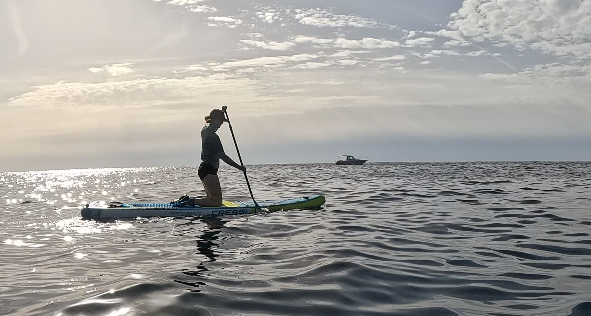
While in the kneeling position, keep your knees about shoulder-width apart to maintain stability. Focus your gaze on the horizon rather than looking down at your feet; this helps with balance and prevents dizziness. Hold the paddle with both hands in front of you and try a few gentle strokes on each side to get used to the sensation of paddling while kneeling.
E. Transitioning to Standing
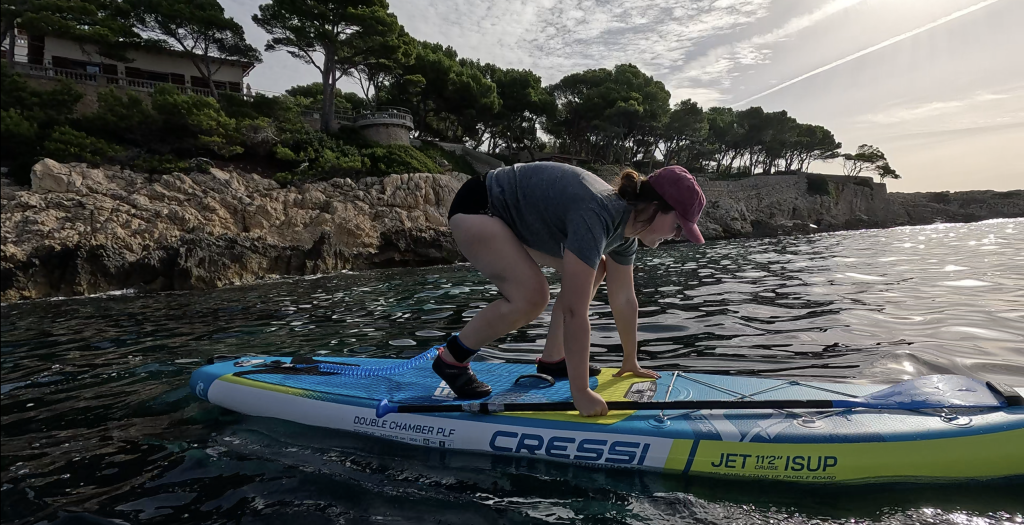
Once you feel stable kneeling on the board, you’re ready to stand up. Place your paddle across the board again for stability. Position your hands on the board in front of you to support your weight. One foot at a time, bring your feet forward to where your knees are, placing them parallel on either side of the center line.
Slowly begin to stand by lifting your chest and straightening your legs. Keep a slight bend in your knees to absorb any movement from the water. Take your time with this step; there’s no rush. The key is to move smoothly and maintain your balance as you rise.
F. Finding the Correct Stance
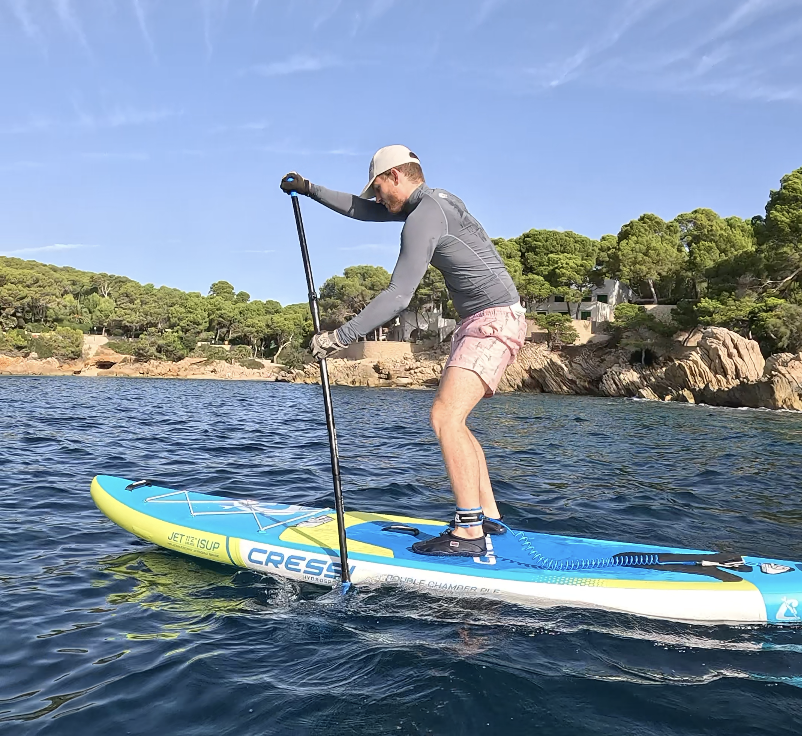
Now that you’re standing, ensure your feet are parallel and about hip-width apart, centered between the rails of the board. Keep a slight bend in your knees and engage your core muscles—this helps stabilize your body. Your back should be straight, and your shoulders relaxed. Remember to keep your gaze forward, not down at your feet, to help maintain balance.
G. Holding the Paddle Properly
With your stance set, it’s time to grip the paddle correctly. Place one hand on the top grip (this will be the hand opposite the side you’re paddling on) and your other hand on the shaft about shoulder-width down. The paddle blade should angle away from you; this might feel counterintuitive at first, but it’s designed to maximize efficiency and reduce strain.
H. Beginning to Paddle
Start paddling with smooth, even strokes. Insert the paddle into the water ahead of you, submerging the blade fully, and pull it back alongside the board. Engage your core and use your torso to rotate rather than relying solely on your arms. This not only provides more power but also helps prevent fatigue.
Alternate sides every few strokes to maintain a straight path. I typically switch sides every three to five strokes, but you’ll find a rhythm that feels comfortable for you. Keep your movements fluid and steady, and remember to breathe and relax. The more you can stay calm and centered, the easier it will be to balance and enjoy the ride.
III. Getting the Right Equipment
Choosing the Right Paddleboard
Selecting the right paddleboard can make all the difference in your experience. When I was starting out, I felt overwhelmed by the options—inflatable versus rigid, different sizes, shapes, and brands. Here’s what I’ve learned:
Inflatable Paddleboards: These have become my go-to choice for most situations. They’re made of durable PVC material and, when inflated properly, are surprisingly rigid and stable. The convenience is unbeatable—I can deflate and roll up the board into a backpack, making it easy to store and transport. If you have limited space or plan to travel with your board, an inflatable is a fantastic option.
Rigid (Hard) Paddleboards: These boards are typically made from fiberglass, epoxy, or carbon fiber. They offer excellent performance in terms of speed and maneuverability, which is great if you’re interested in surfing or racing. However, they can be more challenging to store and transport due to their size and susceptibility to dings and scratches. I’ve enjoyed using rigid boards in certain conditions but find them less practical for everyday use.
When choosing a board, size matters. For beginners, I recommend a board around 10’6″ in length and 32″ wide. The extra width provides added stability, which is crucial when you’re learning to balance. My first board was a bit narrower, and I remember those early wobbles all too well! A thicker board with more volume will also offer better buoyancy, supporting your weight and making balancing easier.
Selecting a Paddle
Your paddle is more than just a tool—it’s an extension of your body on the water. The right paddle enhances your efficiency and reduces fatigue. A good rule of thumb is to choose a paddle that’s about 6 to 8 inches taller than you. I like to stand the paddle upright next to me; if the handle reaches my wrist when I raise my arm above my head, it’s the right length.
Materials play a role in performance and comfort. Aluminum paddles are durable and budget-friendly but can be heavier. I’ve found that fiberglass or carbon fiber paddles, while more expensive, are lighter and less tiring over long distances. Adjustable paddles are great if you plan to share with friends or adjust for different activities like surfing versus cruising.
Essential Safety Gear
Safety is paramount whenever you’re on the water. I never head out without a personal flotation device (PFD). There are comfortable options designed specifically for paddleboarding that won’t restrict your movement. In many places, wearing a PFD is required by law, but more importantly, it can save your life in an emergency.
A leash is another essential piece of gear. It keeps you connected to your board if you fall off, preventing it from drifting away. I prefer a coiled leash, which doesn’t drag in the water or get tangled around my feet. Trust me, chasing after your board is no fun, especially if the wind picks up!
Wearing the right clothing enhances both safety and comfort. In warm weather, I opt for moisture-wicking fabrics, board shorts, and a rash guard to protect against sunburn. In cooler conditions, a wetsuit is invaluable—I learned that the hard way after an unexpectedly chilly dip! Water shoes or booties can protect your feet from sharp rocks or slippery surfaces when launching.
Optional Accessories
There are a few extras that I’ve found enhance my paddleboarding adventures:
- Sun Protection: A wide-brimmed hat and polarized sunglasses with a retainer strap are staples for me. They shield against glare and UV rays, making long sessions on the water more comfortable. Don’t forget waterproof sunscreen—I apply it generously before heading out.
- Dry Bag: I always bring a small dry bag to keep essentials like my phone (in a waterproof case), keys, snacks, and a bottle of water. Staying hydrated is crucial, especially on hot days.
- Safety Whistle and Light: Clipping a whistle to my PFD gives me peace of mind—it’s an easy way to signal for help if needed. If I plan to be out near dusk, I attach a small waterproof light to increase my visibility to others.
By investing in the right equipment, you’re setting yourself up for a safe and enjoyable experience on the water. Quality gear doesn’t have to break the bank, but it does make a difference in performance and comfort. Plus, taking the time to choose equipment that suits your needs adds to the excitement of embarking on your paddleboarding journey.
VIII. Progressing Your Skills
A. Advanced Paddle Techniques
As you become more comfortable on your paddleboard, you’ll likely want to expand your skill set beyond the basics. Learning advanced paddle techniques not only makes paddling more efficient but also adds a new layer of fun to your outings.
Turning Strokes
- Sweep Stroke: This is my go-to method for making smooth, wide turns. To perform a sweep stroke, plant your paddle in the water toward the front of the board and sweep it in a wide arc toward the tail, keeping the blade fully submerged. This motion will turn your board in the opposite direction of the side you’re paddling on. It’s especially useful when you need to change direction without losing momentum.
- Back Paddle: If you need to make a quick stop or a sharp turn, the back paddle is incredibly effective. Simply reverse the paddling motion by pushing the paddle blade toward the front of the board while it’s submerged near the tail. This action slows you down or moves you backward, allowing for precise maneuvering. I’ve found this technique invaluable when navigating around obstacles or in tight spaces.
Increasing Speed and Efficiency
To paddle faster and more efficiently, focus on refining your technique:
- Engage Your Core: Instead of relying solely on your arms, use your core muscles to drive each stroke. Rotate your torso with each paddle stroke, which adds power and reduces fatigue.
- Optimize Paddle Angle: Keep your paddle as vertical as possible during the stroke. A vertical paddle shaft improves tracking and maximizes the power of each stroke.
- Smooth Transitions: Practice switching the paddle from side to side smoothly without disrupting your balance. This becomes more intuitive with practice and greatly enhances your paddling rhythm.
B. Practicing in Varied Conditions
Once you’re comfortable on calm waters, gradually introducing new conditions can help improve your skills:
- Light Waves or Currents: Paddling in mild waves or gentle currents challenges your balance and requires you to adapt your stance and technique. I vividly recall the first time I paddled in small waves—it was both humbling and exhilarating!
- Windier Environments: Wind adds another layer of complexity. Start by paddling in light winds, learning how to adjust your body position and strokes to maintain control. Remember, always paddle into the wind at the start of your session so that you have an easier time returning.
By exposing yourself to different conditions, you’ll build confidence and be better prepared for various paddling environments.
C. Joining a Community
One of the joys of paddleboarding is the community that comes with it. Connecting with other paddleboarders has enriched my experience immensely.
- Group Paddles and Social Events: Many areas have local paddleboarding clubs or groups that organize outings. Joining these events is a fantastic way to meet like-minded people, explore new locations, and enjoy the social aspect of the sport.
- Learning from Experienced Paddleboarders: I’ve gained invaluable tips and insights from more seasoned paddlers. Whether it’s advice on technique, equipment recommendations, or local knowledge about the best spots to paddle, the community is an incredible resource.
D. Taking Professional Lessons
If you’re looking to accelerate your learning, consider taking professional lessons:
- Personalized Feedback: Instructors can provide immediate feedback on your technique, helping you correct any bad habits and improve more quickly. I took a few lessons early on, and the personalized attention made a significant difference.
- Accelerating the Learning Process: Lessons can introduce you to advanced skills in a structured way, ensuring that you’re progressing safely and effectively. Plus, instructors often share tips that you might not find in tutorials or online resources.
IX. Frequently Asked Questions
A. What Should I Wear for Paddleboarding?
Your clothing choices can greatly affect your comfort on the water:
- Warm Weather: In sunny conditions, wear breathable, quick-drying clothing like board shorts and a UV-protective rash guard. Don’t forget a hat, sunglasses with a retainer strap, and plenty of sunscreen.
- Cold Weather: For cooler temperatures, a wetsuit or drysuit is essential to prevent hypothermia. Layering with moisture-wicking materials helps keep you warm without restricting movement. Neoprene booties and gloves can also be beneficial.
B. Do I Need to Know How to Swim?
While you don’t have to be an Olympic swimmer, basic swimming ability is highly recommended:
- Safety Precaution: Knowing how to swim adds a crucial layer of safety in case you fall off your board and are separated from it.
- Confidence Booster: Being comfortable in the water allows you to focus on paddling rather than worrying about staying afloat.
Always wear a PFD, regardless of your swimming proficiency.
C. How Long Does It Take to Learn?
The learning curve for paddleboarding is relatively gentle:
- First Session: Many people can stand and paddle comfortably within their first hour or two on the board.
- Ongoing Improvement: Mastery of advanced techniques takes time and practice. The more you paddle, the more your balance, strength, and skills will improve.
Remember, everyone progresses at their own pace, so be patient and enjoy the journey.
D. Can I Paddleboard Anywhere?
While paddleboarding is versatile, there are considerations:
- Suitable Environments: You can paddle on oceans, lakes, rivers, and bays. Flat, calm waters are ideal for beginners.
- Legal Restrictions: Some areas have regulations regarding watercraft. Check local laws for any restrictions or required permits, especially in protected or private waters.
- Safety Concerns: Avoid areas with heavy boat traffic, strong currents, or hazardous wildlife until you’re experienced.
E. Is Paddleboarding a Good Workout?
Absolutely! Paddleboarding offers numerous physical benefits:
- Full-Body Engagement: It works your core, arms, shoulders, back, and legs. Balancing on the board engages stabilizer muscles that aren’t typically used in everyday activities.
- Cardiovascular Health: Paddling at a steady pace elevates your heart rate, improving cardiovascular fitness.
- Low-Impact Exercise: It’s gentle on the joints, making it suitable for a wide range of ages and fitness levels.