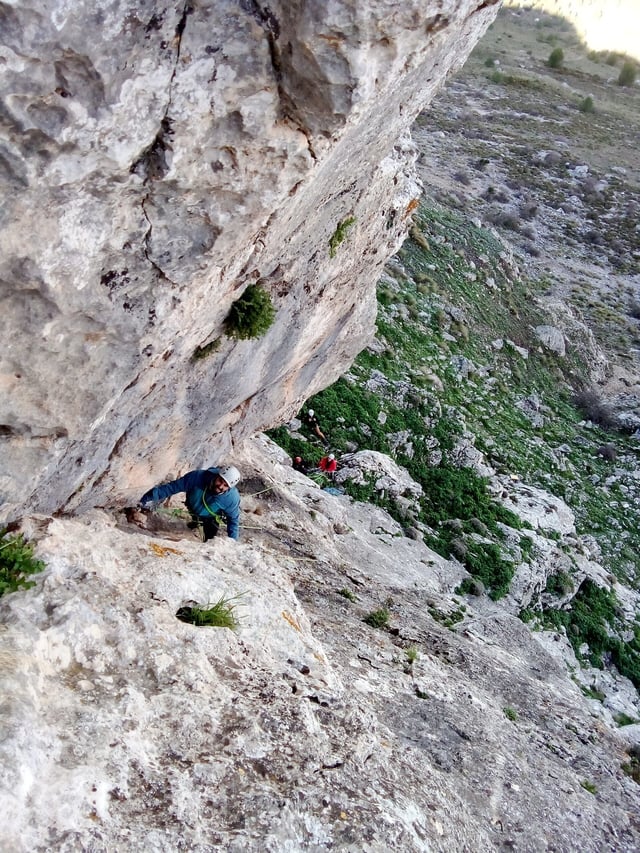
You will climb dolomitic limestone and calc-schist above the sea at El Embarcadero in Calahonda, on walls up to about fifteen metres, with crimps and jugs and a guide watching the landings. We work from double sea kayaks, so this is psicobloc over water rather than a crash-pad session on the beach.
We meet at the Calahonda fishing-port parking, walk to the kiosk and take double kayaks, a dry bag for each pair and a life jacket each. You paddle to the end of the boulder line, warm up on the easier blocks, then work back along the coast on higher and harder lines, learning how to approach the start, how to receive a fall and how to watch your partner from the kayak.
The session lasts about four hours, usually from half past ten until half past two or from three until six, in June, July and August. When the time is up we paddle back along the coast, return the kayaks and sort kit on the sand. We only run when the water and the cliff look right, and if the swell makes the landings poor we will message you early and look at another date.
Calahonda on the Costa Tropical has warm summer water and cliffs that drop into the sea, with Playa de Calahonda and Playa de la Conejita just along the shore. El Embarcadero is the usual sector, and access depends on the swell and the time of year.
We send the coastal pin once the plan is confirmed. Bring a small towel, sun cream, water, a snack and a plastic bag for wet kit, plus shoes you can get wet. We will show you where to leave dry bags in the kayak so phones and clothes stay out of the sea.
You must be a confident swimmer in open water. You do not need previous climbing experience, because we adapt the blocks to how you move, from easier warm-ups through to steeper lines around grade IV and V.
Minimum age is 14. Normal fitness and agility are enough, and we brief you on kayak handling before you leave the sand. This is a first psicobloc day for people who want to try climbing over water with someone watching every landing.
Climbing above the sea only works if someone is watching the water as carefully as the holds. We know this bit of the Costa Tropical in June, July and August, and we will not push a session if the swell or the landings look messy. Your guide is a mountain guide who specialises in rock climbing, and we work from double sea kayaks so there is a stable place to watch, rest and keep dry bags.
You will warm up on easier blocks first, then try a few chosen lines with time to swim back and catch your breath. We look after kayaks, life jackets, shoes and chalk, brief you on how to receive a fall and how to watch your partner, and keep the pace so you finish feeling like you climbed, not like you were rushed off the cliff. Digital photos and videos come with the session.
We meet at the fishing-port parking, walk to the kiosk and take double sea kayaks, a dry bag for each pair and a life jacket each. Bring a small towel, sun cream and shoes you can get wet, and we will show you where to leave dry kit in the boat.
You paddle to the end of the boulder line, warm up on the easier blocks, then work back along the coast on higher and harder lines up to about fifteen metres. Your guide coaches how to approach the start, how to receive a fall and how to watch your partner from the kayak, and we take digital photos where we can.
When the time is up we paddle back along the coast, return the kayaks and sort kit on the sand. The session is about four hours, and we stop earlier if the sea starts to look messy.
Flexible clothing, sun protection, water and snacks for the duration. Approach shoes with grip suit most venues; bring a light waterproof and extra layer for mountain or coastal wind.
You need to be at least 14. We welcome complete beginners, and we are just as happy if you have climbed indoors and want your first proper day on rock around Calahonda. The difficulty is adapted to how you move on the day.
Tell us a bit about your experience when you request a date. We will pick routes that fit you rather than guessing on the morning, and we will keep the briefing in English or Spanish as you prefer.
Most of our open dates are Saturdays and Sundays, which is how we usually run these days through the year. If one of those works, just request a place on that day and we will confirm the meet once it is accepted.
If you would rather go midweek, or only with your own friends, send us a date and how many of you there are. We will check a guide is free and get back to you by chat or email with the plan.
The activity itself is about 4 hours, plus a bit of time at the start for kit and the walk in to the sector. Lunch is a short stop with food you bring, except on indoor course days where we use the gym break.
Start times change with the season and the venue, because we chase shade in summer and sun in winter. Once your date is confirmed we will send the meet time, parking notes and what to bring.
You get a guide watching the water and the landings, plus the climbing kit you need for the session. We take digital photos and videos where we can, and we brief you beforehand on shoes and what to leave in a dry bag.
Meals, drinks, accommodation and getting yourself to the meeting point are down to you. Transport can sometimes be arranged separately if you ask ahead. Bring water and a snack that will last the session.
Wear clothes you can move in, with a layer for wind and a bit of sun cream. Trainers or approach shoes with grip are better than smooth soles, and we ask you not to come in flip-flops, sandals or clogs.
Pack at least a litre of water, a snack and a light waterproof. A 40 to 45 litre pack is useful on longer days. If you wear glasses, a strap stops them sliding when you look down, and a cap or sun hat helps on open limestone.
It depends on the exact sector near Calahonda and the weather that week. We decide the pin and the arrival time in the days before, so we can use the rock that is in the best condition.
Granada days often start from Plaza Alta in Monachil or a crag car park a few minutes away. Coastal and Alicante routes use a meet point closer to that cliff, and we send clear directions once the date is accepted.
We need dry rock and sensible wind. If it looks poor, we will message you as early as we can and either move venue or look at another day, because forcing a session on wet limestone is not useful for anyone.
High Sierra Nevada faces are the fussiest, and leftover snow or strong wind can close them even in summer. We would rather shift the date than stand around in poor conditions at that height.
If you are happy walking on rocky paths and standing in a harness for a few hours, you will cope with the day. We adapt the routes to how you move, so you do not need a specific indoor grade before you come.
We keep groups to 6 people per guide, so you still get time on the rock and someone watching how you move. That ratio is how we run these days through the year around Calahonda.
Yes. We issue a harness and helmet at the meet, plus climbing shoes or a ferrata lanyard if that is what the day needs. Tell us your shoe size if we ask for it.
You are welcome to use your own harness or helmet if it is CE marked. We will give it a quick check before we start.
Read the meet-time message and give yourself a few extra minutes for parking. A charged phone with the pin saved is enough.
When you book, tell us what you have climbed before. That helps us pick the right ropes and keep the day at a pace you will enjoy.
We partner with Rewilding Britain to help protect our natural spaces for future adventures.
All centres are vetted for safety and quality. Your adventure is in good hands with adventuro.
About the centre
Motril
We are a Granada-based outdoor climbing team offering guided rock routes, via ferratas, kit hire and multi-day trips across Andalusia and beyond. Sessions are led by qualified guides who focus on safety, clear communication and routes matched to your experience.
Whether you want a first day on the rock, a classic multi-pitch on local limestone, or ferrata kit for an independent adventure, we help you plan realistic days in the mountains with quality equipment and local knowledge of the Sierra Nevada and Costa Blanca crags.
Operated by Filoclimb, a partner of adventuro.

Comunitat Valenciana (Valencian Community), Spain
From €150


Comunitat Valenciana (Valencian Community), Spain
From €150