
How to Overcome Fear For Skydiving
If you’ve decided to take the plunge to try skydiving and are a bit scared now that the big day is approaching… don’t worry, that’s totally normal! In this post, we’re going to walk you through some strategies to help you overcome your fears and make the most of this awesome experience.
Understanding Your Fear
Before we dive into the strategies for overcoming fear, let’s take a moment to understand what’s actually going on in your body and mind when you’re afraid. Fear is a natural and important emotion. It’s your body’s way of protecting you from potential dangers. When you’re faced with a scary situation like jumping out of a perfectly good airplane, your body goes into “fight or flight” mode.
This response is an automatic, primal reaction that prepares your body to either confront the threat or escape it. When you’re afraid, your brain sends signals to release adrenaline and other stress hormones. These hormones cause a series of physical changes: your heart rate accelerates to pump more blood to vital organs, your muscles tense up to prepare for action, and your breathing rate increases to supply more oxygen.
These changes are meant to enhance your performance in critical situations, but they can also make you feel overwhelmed. Remember, all of these reactions are your body’s way of trying to protect you. The problem is, your body can’t always distinguish between real threats and perceived ones. So even though skydiving is actually very safe when done properly, your body might react as if you’re in serious danger.
Common Skydiving Fears
When it comes to skydiving, several common fears often arise, each with its own unique challenges. Understanding these fears can be a crucial first step in overcoming them. Here are some of the most frequently encountered concerns:
- Fear of Heights: Many people experience acrophobia, or fear of heights, which, as you can imagine, can be intensified when looking out from a plane
- Fear of the Unknown: The lack of control over the jump and not knowing exactly what to expect can trigger the fear of the unknown in some people
- Fear of Losing Control: The idea of being in a situation where you have limited control can be unsettling. With skydiving, you have to place your trust in the equipment and the instructors, which can be tough for those who have a strong need to be in control
- Fear of Equipment Failure: Concerns about the reliability of the parachute and other equipment are common. The thought of something going wrong with the gear, even though safety measures are put in place, can be a source of anxiety
- Fear of Physical Discomfort: The physical sensations of skydiving, such as the rush of wind, the pressure on your body, and the G-forces during freefall, can cause worry about experiencing discomfort or possible pain
- Fear of Motion Sickness: The rapid change in motion and the sensory overload during the jump can lead to feelings of nausea or motion sickness, especially for those who are sensitive to these sensations
Recognizing which of these fears resonate with you is an important step toward addressing them. By acknowledging your fears and understanding their origins, you can begin to take proactive steps to manage and overcome them, making your skydiving experience more enjoyable and rewarding.
Strategies for Overcoming Your Skydiving Fears
Now that we understand what we’re dealing with, let’s look at some practical strategies for managing your fears and anxiety about skydiving.
Remind Yourself You’re Safe
Modern skydiving equipment is incredibly advanced and reliable. There are various safety features in place and centres have to go through equipment and maintenance checks to make sure the gear is top notch. If you have a fear of the parachute not deploying properly, just know there are reserve parachutes and the automatic activation device will deploy the reserve parachute if needed!
Skydiving instructors go through a very thorough training process so they can ensure your safety. There’s a lot of dedication and practice that goes into becoming an instructor. For your first jump, you’ll likely be doing a tandem jump with a highly experienced instructor who has completed thousands of jumps before. Tandem skydiving with an instructor is the safest way to skydive. They know their stuff, so make sure you follow their lead and enjoy the ride!

Visualization Techniques
Visualization is a powerful tool you can use to conquer your nerves. Picture everything going smoothly, from gearing up to landing safely. The more vividly you can imagine a successful jump, the more confident you’ll feel when it’s time for the real thing.
To do this, you’ll first need to find a quiet place and get comfortable. Then, close your eyes and take some deep breaths. Imagine yourself going through the entire skydiving experience step by step. Focus on positive emotions like excitement and joy. Let’s break it down a little more:
The Plane Ride and Jump Preparation
You board a small plane, and as you go up higher into the sky, climbing to an altitude of around 10,000 to 14,000 feet, you take deep breaths, visualizing a calm, controlled jump. The engine’s drone fills your ears, and excitement builds as you approach the jump altitude. You’re suited up, harnesses checked, goggles on. The instructor gives you a nod; it’s almost time.
The Jump
Get ready, it’s almost time to jump! The door slides open, and a rush of cold air fills the cabin. The ground is far below, and the view is breathtaking. Your heart races. You step to the edge of the plane with your instructor, and you get ready to jump when they tell you to. The instructor counts down: 3, 2, 1… Jump!
You leap out of the plane, and for the first ten seconds, it feels like your stomach drops. You quickly start to accelerate towards terminal velocity, which is a constant speed that’s reached when you’re met with enough resistance to prevent further acceleration. Terminal velocity is around 120 mph (depending on your weight) meaning it’s the fastest speed you will reach on your skydive.
Free Falling
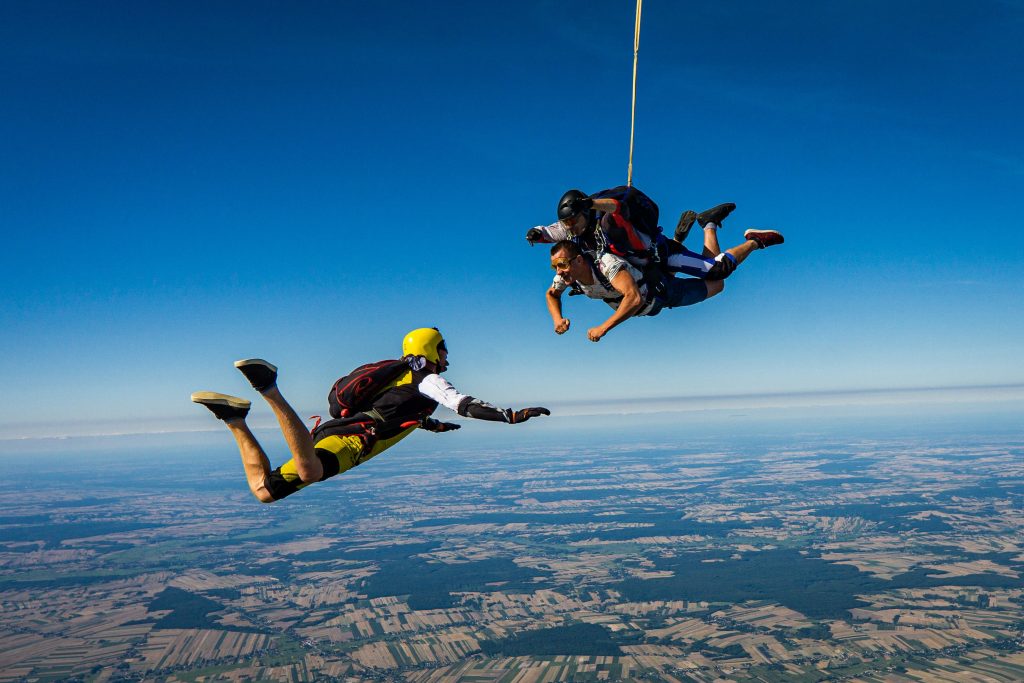
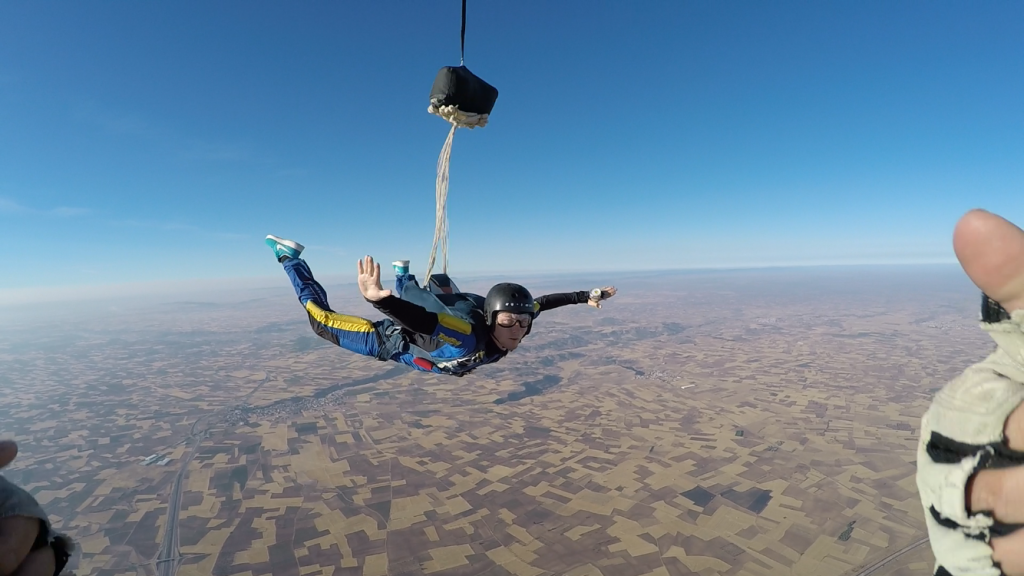
The wind roars past your ears, and your body stabilizes into a horizontal position. After the initial rush of adrenaline in the first 10 seconds, you start feeling like you’re suspended in mid-air, almost weightless. The wind pressure keeps you stable, and it feels like you’re floating on a cushion of air, albeit a very windly one. You can feel the wind on your face, see the sky around you, and the distant ground below. Everything feels incredibly vivid. Adrenaline surges through your body, heightening your senses. There’s a mix of exhilaration and awe as you take in the view – you’re now free falling!
Under the Canopy
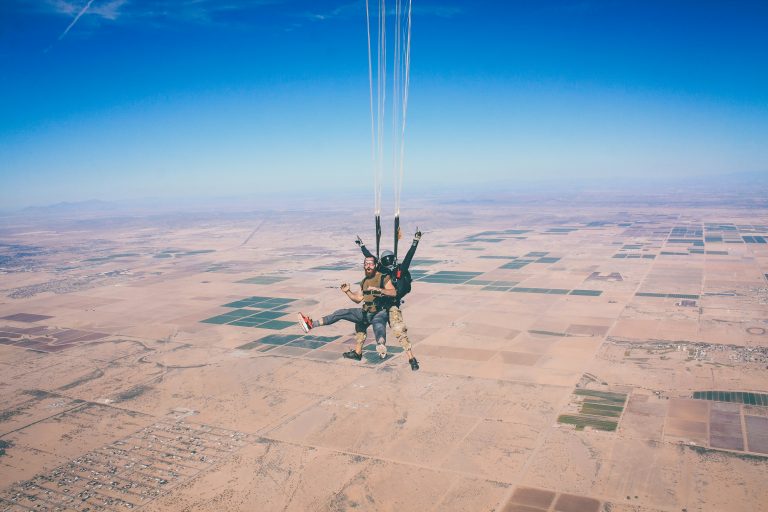
The free fall lasts about 60 seconds, and after the free fall, you deploy your parachute. The deceleration feels like a strong tug as the parachute opens gradually, and now you’re gently gliding. As you approach the ground, you know you’re going to have a smooth landing and that you’re safe. Your feet touch the ground, and a wave of triumph washes over you—you did it!

Progressive Exposure
Try to expose yourself to elements of skydiving before your big day. If you want to get some practice in to prepare yourself, you can try indoor skydiving and imagine yourself doing the real thing! If possible, you can find a local drop zone and watch skydivers land. Better yet, you could also watch skydiving videos to get yourself pumped up and have a better visualization of the jump. Each small step can help build your confidence and familiarity with the sport. Give it a try!
Physical Preparation
Besides being mentally prepared, you can prepare yourself physically to help you feel more confident and reduce anxiety. Get plenty of sleep in the days leading up to your jump and eat a light, nutritious meal before your jump. Before your jump, make sure to breathe properly too! When we’re anxious, we tend to take shallow, rapid breaths, which can increase feelings of panic. Try box breathing where you inhale for a count of 4, hold for a count of 4, exhale for a count of 4, hold for a count of 4, and repeat until you feel better! Practice this breathing technique and use it on the day of your jump to stay calm and centered.
Positive Self-Talk
The way we talk to ourselves has a huge impact on our emotions and performance. Replace negative self-talk with positive affirmations:
Instead of: “I’m too scared to do this.” Try: “I’m feeling nervous, but I’m also excited for this amazing experience.”
Instead of: “What if something goes wrong?” Try: “I trust the equipment and my instructor to keep me safe.”
Instead of: “I can’t handle this.” Try: “I am strong and capable of facing my fears.”
Connect with Your Instructor
Your tandem instructor is there to keep you safe, but they’re also an invaluable source of support and reassurance. Don’t be afraid to express your fears and concerns. Ask them questions about anything you’re unsure of and ask for additional explanation or demonstration if needed. If you’re feeling overwhelmed, it’s okay to let them know. Remember, they are there to keep you safe and they’ve jumped with countless first-timers before so they’ll know exactly how to help you feel more comfortable.
The Big Day: Managing Anxiety in the Moment
You’ve done your preparation, and now the big day has arrived. Here’s how to manage those last-minute jitters:
- Arrive Early: Give yourself plenty of time to get to the dropzone, complete any necessary paperwork, and get familiar with the surroundings. Rushing increases stress, so take it easy.
- Focus on the Present: Instead of worrying about the jump, focus on each step as it comes. Pay attention to your training, ask questions, and take in the experience moment by moment.
- Use Your Support System: If you’re jumping with friends or family, lean on them for support. If you’re solo, don’t be afraid to chat with other jumpers or staff. Sharing your feelings can help relieve anxiety.
- Remember Your “Why”: Remind yourself why you decided to try skydiving in the first place. Whether it’s for the thrill, to overcome a fear, or to tick off a bucket list item, connecting with your motivation can help push you through the fear.
- Trust the Process: You’ve chosen a reputable dropzone with experienced instructors and top-notch equipment. Trust in their expertise and the safety measures in place.
- Embrace the Fear: Instead of trying to eliminate fear entirely, try to reframe it as excitement. The physical sensations of fear and excitement are very similar – it’s our interpretation that differs.
The Jump: What to Expect
Knowing what’s coming can help reduce anxiety, so let’s recap the tandem skydive experience:
- Gearing Up: You’ll be fitted with a harness that attaches you to your instructor. This is also when you’ll receive your goggles and any other necessary equipment.
- The Climb: The plane ride up usually takes 15-20 minutes. Use this time to practice your breathing exercises and take in the view.
- The Door Opens: This is often the most nerve-wracking moment. Remember your breathing and positive self-talk.
- The Exit: Your instructor will guide you through the proper position. The actual exit happens quickly and before you know it, you’ll be free falling.
- Free fall: This typically lasts about 60 seconds. Many first-time jumpers report that this is when their fear disappears, replaced by pure exhilaration.
- Parachute Deployment: Your instructor will deploy the parachute at the appropriate altitude. You’ll feel a sudden deceleration, and then a peaceful canopy ride.
- Canopy Ride: This is your chance to catch your breath, take in the views, and maybe even steer the parachute if your instructor allows.
- Landing: Your instructor will guide you through the proper landing position so you can have a safe, soft landing.
You’ve Got This!
If you are interested in reading more about skydiving to better prepare yourself, check out our other article about learning to skydive. By educating yourself, preparing mentally and physically, and using the strategies we’ve discussed, you’re setting yourself up for an amazing skydiving experience. Trust in your training, your equipment, and your instructor, and allow yourself to enjoy this incredible adventure.