
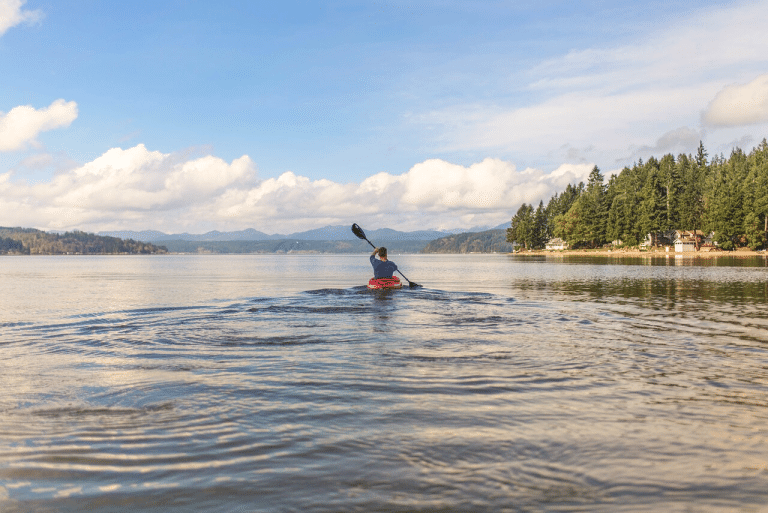
Most people see kayaking as a leisurely way to take in the sights. But let me let you in on a little secret: kayaking is also a fantastic workout for both your body and mind. As someone who’s paddled the warm waters of the tropics, the canals of London and the coasts of the mediterranean, I’ve found kayaking to be one of my most favourite forms of exercise.
The Science Behind Kayaking: What muscles does kayaking use?
Upper Body Engagement
Kayaking involves a comprehensive workout for the upper body, specifically targeting muscles like the biceps, triceps, and latissimus dorsi in the back. The action of paddling also involves various shoulder muscles to generate force during each stroke.
Core Strength and Stability
The core plays a critical role in kayaking. The core comprises not just the abdominal muscles but also includes the muscles in the lower back and the obliques, which are the muscles on the sides of your abdomen. These muscles work together to maintain stability in the boat, enabling precise control and steering.
Leg Involvement
Contrary to what some might think, the legs play an important role in kayaking. The quadriceps and hamstrings work to provide additional stability and balance. The inner and outer thigh muscles assist in the steering and stabilization of the kayak, especially in turbulent water conditions. Moreover, the gluteal muscles are engaged to counteract and balance the movements of the upper body, adding power and control to each stroke.
How many calories do you burn while kayaking?
You might be wondering just how many calories you can burn while kayaking. Well, hold onto your paddles, according to Harvard research kayaking can burn 300-400 calories an hour. This can increase up to 700-800 per hour for intense paddling or conditions. The calories burn can vary depending on several factors.
Intensity of Kayaking: A leisurely paddle will obviously burn fewer calories than when you’re racing against the tide or maneuvering through rapids. Adrenaline is your friend, and so is that extra resistance from the water. Recreational kayaking is likely in the 300-400 calories per hour mark with more intense whitewater or sea kayaking rising to the 600-700, with racing topping up to 800 calories per hour.
Bodyweight also plays a role—the heavier you are, the more calories you’ll burn, simply because you’re moving more mass through the water.
Conditions: if it is flat calm and you are cruising along with a lean slender sea kayak then you will likely burn less calories over the distance that rough water or a wider less streamlined kayak. Albeit, across the same time period you could burn the same but just not travel as far.
Mental Health Benefits of Kayaking
Stress reduction: Let’s not forget the mind in all of this. Being out on the water is a natural stress reliever. Studies have shown that being in a natural environment can lower levels of cortisol, the stress hormone. So, if your daily grind has you wound up, consider unwinding out on your nearest river.
Focus and Mindfulness: Kayaking isn’t just about physical prowess; it also demands mental clarity. With each stroke, you’re in the present moment—anything less, and you might find yourself floating in the wrong direction or, worse, capsizing. Think of it as an active form of meditation, where your paddle serves as a moving mantra.
Kayaking for Different Fitness Levels
Beginners
If you’re new to the world of fitness or perhaps a bit wary of water sports, fret not. Flatwater kayaking or lake kayaking are excellent starts. They offer the serenity of nature without the high-octane intensity of white-water rapids.
Intermediate
For those who have a bit of experience and are looking for more of a challenge, consider kayaking in rougher waters or even ocean kayaking. The stronger currents will make your muscles work harder, offering a more intense workout.
Advanced
And for the seasoned athletes out there, extreme kayaking in rapids or covering long distances is your adrenaline-filled playground. It’s not just about endurance but also about strategy and skill. Not for the faint of heart but certainly for the strong of spirit.
Proper Paddle Holding
The way you hold your paddle can make a significant difference in the effectiveness of your workout. Ensure that your hands are equidistant from each paddle blade, and maintain a relaxed grip to avoid hand fatigue. Your knuckles should be aligned with the blade, allowing for more efficient and powerful strokes.
The Importance of Torso Rotation
A common mistake among beginners is to paddle using just their arms. In fact, most of your power should come from your torso. By rotating your torso as you paddle, you engage your core, back, and shoulder muscles more effectively, resulting in a more efficient stroke.
Strokes and Turns
Mastering different strokes can not only help you navigate the water better but also engage different muscle groups for a balanced workout. A few to focus on:
- Forward Stroke: The most basic and frequently used stroke. Extend one arm fully forward and submerge the paddle blade, pulling it back while rotating your torso.
- Sweep Stroke: Great for turning your kayak. A wide, sweeping stroke from the bow to the stern on one side will spin your kayak in the opposite direction.
- Draw Stroke: Useful for moving your kayak sideways. Reach out to the side, pull water towards your kayak, and finish by slicing the paddle out of the water.
Is Kayaking Good for Losing Weight?
Absolutely. Kayaking can be an effective way to shed some pounds. You engage multiple muscle groups, getting your heart rate up, and burning calories. An hour of casual kayaking can burn anywhere between 300 to 500 calories depending on the intensity. It is a fantastic option for anyone looking to lose weight.
Do I Need to Be Fit to Kayak?
The beauty of kayaking is that it’s for everyone. You don’t have to be in prime shape to start. It helps to have some basic level of fitness for stamina and strength, but kayaking itself will help you build up these attributes over time. If you are nervous about starting, get a two person kayak with a friend to build it up gradually and have some help when you get tired. Start with calmer waters and shorter distances, and gradually work your way up as your fitness improves.
Can I Kayak if Overweight?
Kayaking is not exclusive to people who fit a certain body type. If you’re concerned about being overweight, rest assured that many kayaks are designed to accommodate a range of body sizes and weights. Sit-on-top kayaks are as they sound and may be preferrable if you are concerned about feeling restricted. Always check the weight capacity of the kayak to ensure it suits your needs.
Convinced? Check out our top kayaking experiecnes around the UK:
| Sea Kayak Tour in Cornwall – The Lizard |
| Experience sea kayaking in Cornwall from Mullion Harbour and Cadgwith Cove! |
| 1-1 Surf Kayak Coaching in St. Ives Bay |
| Learn to Surf Kayak from an expert instructor in St Ives Bay, Cornwall. |
| Sea Kayak Lesson & Tour in Newquay |
| Explore smugglers caves, inviting coves, imposing cliffs and epic landscapes. |
| SUP Sheltered Water Award |
| Designed to develop your understanding of how to plan and paddle a SUP |
| Introduction to White Water SUP |
| Learn your white water SUP skills with expert leaders in Cumbria |
| Early Intermediate White Water Kayaking |
| Master your early intermediate white water kayaking skills in Cumbria |
| Advanced White Water Kayaking |
| Work on your advanced white water kayak skills with experts in Cumbria. |
| Canoe Open Water Leader Assessment |
| Take your canoe open water assessment under expert guidance in Cumbria. |
| Canoe Open Water Leader Training |
| Train to be a canoe open water leader under expert teaching in Cumbria. |
| Canoe Performance Award |
| Prepare for your canoe performance award with expert teaching in Cumbria. |
| Canoe White Water Coach Training (Advanced Water) |
| Train to become a white water canoe coach with expert training in Cumbria. |
| Intermediate Canoe Skills |
| Develop your intermediate canoe skills under expert leadership in Cumbria. |
| Open Water Canoe Coach Training (Advanced Water) |
| Train as an open water canoe coach with expert instructors in Cumbria. |
| Paddlesport Instructor Course |
| Take your paddlesport instructor course with expert guidance in Cumbria. |
| Paddlesport Leader Assessment |
| Pass your paddlesport leadership award under expert guidance in Cumbria. |
| Paddlesport Leader Training |
| Train as a paddlesport leader under expert guidance in Cumbria. |
| Paddlesport Safety & Rescue Course |
| Take your Paddlesport Safety and Rescue course under expert guidance in Cumbria. |
| Paddlesport Touring Leader Assessment |
| Become a paddlesport touring leader with expert guidance in Cumbria. |
| Paddlesport Touring Leader Training |
| Train as a paddlesport touring leader under expert guidance in Cumbria. |
| SUP Inland Open Water Leader Assessment |
| Take your SUP Inland Open Water Leader Award with expert leaders in Cumbria. |
| SUP Inland Open Water Leader Training |
| Train as a SUP inland open water leader with experts in Cumbria. |
| White Water Kayak Leader Assessment |
| Take your white water kayak leader assessment under skilled guidance in Cumbria. |
| White Water Kayak Leader Training |
| Train as a white water kayak leader under expert guidance in Cumbria. |
| White Water Safety & Rescue Training |
| Train in white water safety and rescue with experts in Cumbria |