

Axe Throwing in Surrey, East and West Sussex
South Downs chalk ridge to wooded Weald. Known for long-distance hiking, South Coast kite-sports, gravel bikepacking and sandstone bouldering at the forest outcrops.
Overview
What Is Axe Throwing?
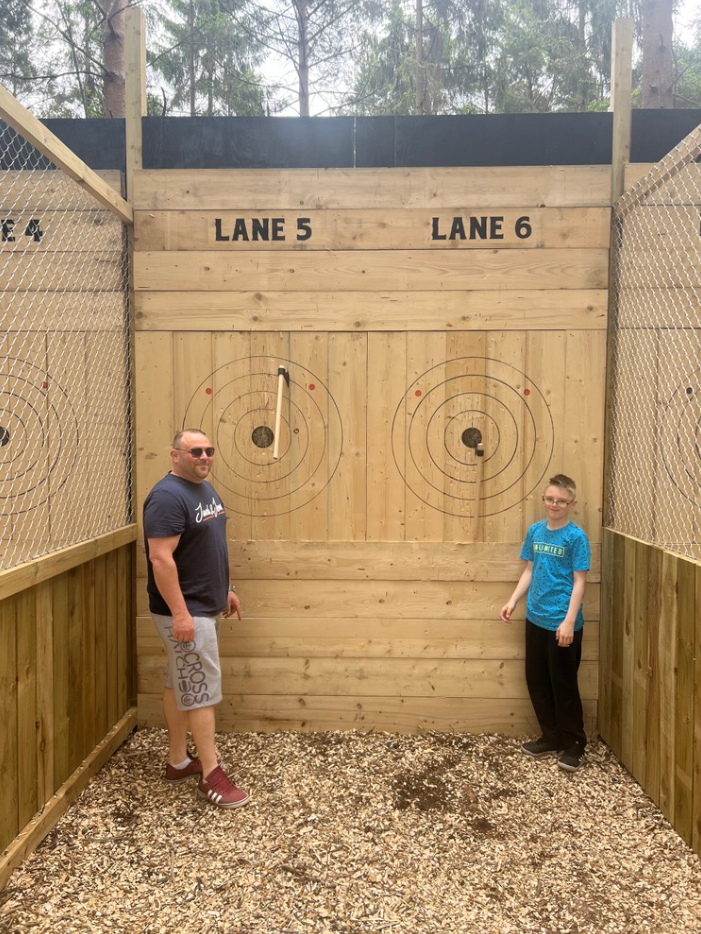
Axe throwing is a target sport that involves throwing a small axe at a wooden board from a set distance, aiming to hit marked scoring zones. The most common targets have concentric rings, similar to archery, with the highest points awarded for hitting the centre. The goal is to achieve a controlled throw that allows the axe to rotate once and stick into the target.
It’s typically played in individual lanes, where only one person throws at a time. The thrower stands behind a marked line and uses either a one-handed or two-handed technique. A standard throw relies on consistent grip, smooth motion, and correct distance, rather than force or speed. The sport rewards control and repetition, making the mechanics easy to learn but challenging to master.
Throwing styles may vary slightly depending on the axe, distance, or environment, but most share the same core principles: keeping the body aligned, focusing on follow-through, and letting the axe do the work. Targets are usually made from softwood to help the axe stick cleanly, and spacing between throwing and waiting areas is designed to allow safe movement throughout the space.
Although rooted in lumberjack traditions, modern axe throwing has been adapted into an accessible sport that focuses on technique, timing, and precision. It has grown in popularity through recreational venues and organised leagues, though the basic skills remain the same regardless of the setting.
Beginner Overview
For those unfamiliar with axe throwing, the fundamentals are easy to grasp. A successful throw involves getting the axe to rotate once and land blade-first into the target. The most common technique is an overhead two-handed throw, which provides balance and control. One-handed throws are also widely used, especially with smaller or lighter axes. Foot position, grip, and release timing all play a role in achieving a clean stick.
Beginners often start by focusing on distance and form, adjusting their stance to find the right number of rotations. If the axe hits the target handle-first or falls flat, it's usually a sign that a small change in position or release angle is needed. This trial-and-error process helps build coordination and makes the sport satisfying to learn.
Consistency is more important than strength. Throwing too hard can cause the axe to bounce, while a smoother, more controlled motion often leads to better results. Sessions typically involve repeated practice, allowing throwers to fine-tune their movements and develop their accuracy over time.
The structure of the sport supports both casual participation and skill development. Whether used as a group activity or individual challenge, axe throwing encourages focus, coordination, and repetition. The sport can be as relaxed or competitive as the environment allows, making it suitable for a range of settings—from dedicated venues to outdoor events.
At its core, axe throwing is about control and rhythm. It offers a simple, repeatable challenge that builds confidence through hands-on progression. With a focus on technique over force, it’s a sport that rewards attention to detail and controlled movement.