
Ready to find a course or session?
PSAI DPV Diving for the Open Water Environment teaches you to run a diver propulsion vehicle safely on sport dives. A scooter lets you cover ground without kicking yourself breathless, which matters on large reefs, long wall sections and wreck exteriors where the interesting bits sit farther from the entry than your fins alone want to go.
Most centres schedule one to two days with classroom theory and open water dives. You study how DPV systems are configured, what can go wrong at speed, and how to maintain the unit between dives. Then you practise controlled operation, buddy communication and emergency responses in open water. It is still recreational diving: you plan the dive, watch your gas and stay within your training limits even when the throttle tempts you to wander.
Prerequisites are modest compared with technical courses. You need open water certification and solid buoyancy. If you still fin hard on every descent, fix that before you add a scooter. DPV skills feel awkward for the first dive and boring by the third, which is the point.
PSAI DPV Diving is assessed through theory and in-water practical evaluation. Your instructor signs you off when you can operate a scooter safely on sport open water dives.
Quick answers about this qualification. For anything else, use live chat or browse bookable activities below.
Find activitiesIt is PSAI's specialty for safe diver propulsion vehicle use on sport open water dives. You learn configuration, operation, maintenance and the planning habits that keep scooter dives from turning into long swims home.
Many wreck and reef enthusiasts take it when they are tired of finning past the same entry reef to reach the interesting structure.
You must be a certified open water diver comfortable with buoyancy and navigation. The course assumes core scuba skills are already in place.
Leave a comment when you book with your certification details if you trained abroad or hold cards from another agency so the centre can confirm equivalence.
Typically one to two days with theory and open water dives. Some centres spread training across a weekend; others compress into a single intensive day if the group is ready.
Allow extra time if weather delays boat access or if you need another run-through on speed control and buddy spacing.
No. Most training centres provide scooters for the course. Models vary, so ask which unit you will use before you travel.
If you already own a DPV, many centres let you train on it provided it is serviceable and meets safety standards. Confirm hire and personal-unit policies when you book.
Any tool that moves you faster underwater adds risk if you stop paying attention. Runaway descent, buddy separation and outrunning your gas plan are the usual mistakes.
The course teaches conservative speeds, clear turnaround rules and emergency shutdown habits. Used properly, a scooter is a convenience, not a licence to ignore dive planning.
No. DPV training does not raise your depth certification. It changes how you travel horizontally on dives you are already qualified to make.
Depth limits still follow your existing recreational or technical cards and local rules. The scooter just gets you to the site with less finning.
Fix buoyancy before you add a throttle. A scooter magnifies small trim problems into large depth changes if you are overweighted or tense on the inflator.
Leave a comment when you book if you want a patient instructor or an extra shallow practice dive before the main training. That is normal, not a failure.
On sport open water dives within PSAI training limits and your existing depth qualifications. Wreck interiors, caves and overhead environments need additional training beyond this specialty.
Liveaboards and quarries sometimes rent scooters for certified guests. Check local rules and insurance before you assume scooters are allowed on every site.
There is no large separate exam. Theory is covered in classroom sessions and your instructor discusses weak areas in briefings.
Assessment is primarily practical: demonstrating safe DPV operation, maintenance habits and emergency responses on open water training dives.
Your usual open water kit: mask, fins, exposure suit, BCD and regulator as required by the centre. A dive computer is strongly recommended.
Centres provide the DPV for training in most cases. Bring warm layers for long surface intervals if you are training in UK water.
adventuro lists PSAI centres running DPV courses at quarries, coasts and holiday destinations where open water scooter training is practical. Compare whether boat fees, scooter hire and extra dives are included.
Pair DPV training with a wreck or reef site large enough to make the scooter worthwhile. Half a day of theory plus a weekend of fun dives at the same venue works well.
Experience the excitement of diver propulsion vehicles in Gosforth. Learn safe DPV use with 1 confined and 3 open water dives from £300pp.
From £ 300

This PSAI course offer divers like you an exciting opportunity to master the use of a Diver Propulsion Vehicle (DPV) in open water
From £ 275
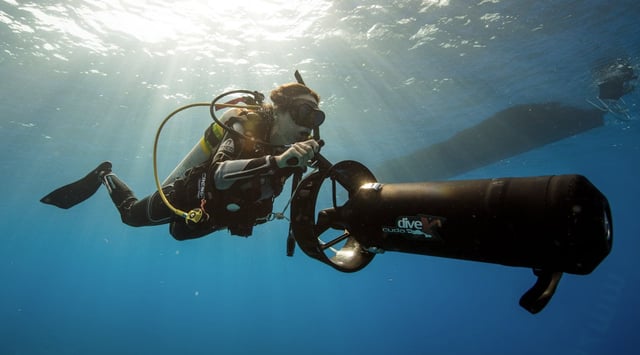
Learn to dive with an underwater scooter in Tenerife on the DPV Diver course. Includes practical training, ocean dives and internationally recognised certification from €320pp.
From € 320