
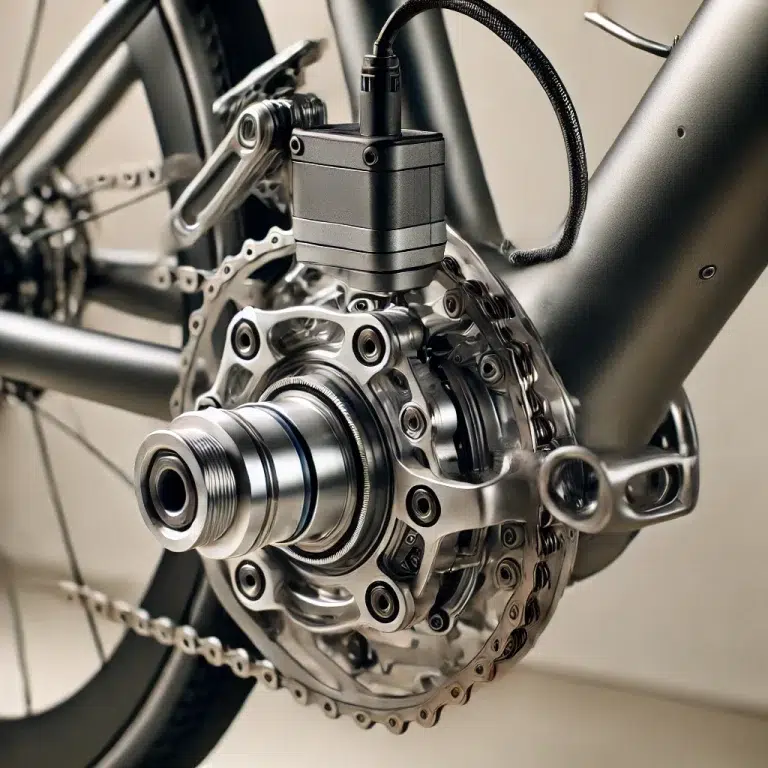
How Pedal-Assist eBikes Work and the Role of Torque Sensors
Electric bikes (eBikes) have revolutionized personal transportation and recreational cycling by combining human power with electric assistance. Pedal-assist eBikes provide motor support that amplifies the rider’s pedaling effort without the use of a throttle. This guide delves into the mechanics of pedal-assist eBikes, focusing on how they work, the critical role of torque sensors, and how these components integrate to create a seamless and efficient riding experience.
Check out our head to head comparison
1. Overview of Pedal-Assist eBike Systems
Pedal-assist eBikes are designed to complement the rider’s input, making cycling more accessible and enjoyable across various terrains and distances. The core components of a pedal-assist eBike include:
- Electric Motor
- Battery
- Sensors (Torque, Cadence, Speed)
- Controller
- Display/Control Unit
These components work in unison to provide assistance that feels natural and responsive, directly linked to the rider’s pedaling effort.
2. The Electric Motor: Heart of the eBike
Types of Motors
- Mid-Drive Motors
- Location: Mounted at the bike’s bottom bracket (central area where the crank arms attach).
- Advantages:
- Balanced Weight Distribution: Central placement lowers the center of gravity, enhancing stability and handling.
- Efficient Power Transfer: Drives the crankshaft directly, utilizing the bike’s gears for optimal performance across different speeds and terrains.
- Popular Brands: Bosch, Shimano STEPS, Brose, Yamaha.
- Hub Motors
- Location: Integrated into the front or rear wheel hub.
- Advantages:
- Simplicity: Fewer moving parts make for straightforward installation and maintenance.
- Cost-Effective: Generally less expensive than mid-drive systems.
- Disadvantages:
- Weight Distribution Issues: Can affect handling due to added weight at the wheel.
- Less Efficient on Hills: Does not leverage the bike’s gearing system.
Motor Functionality
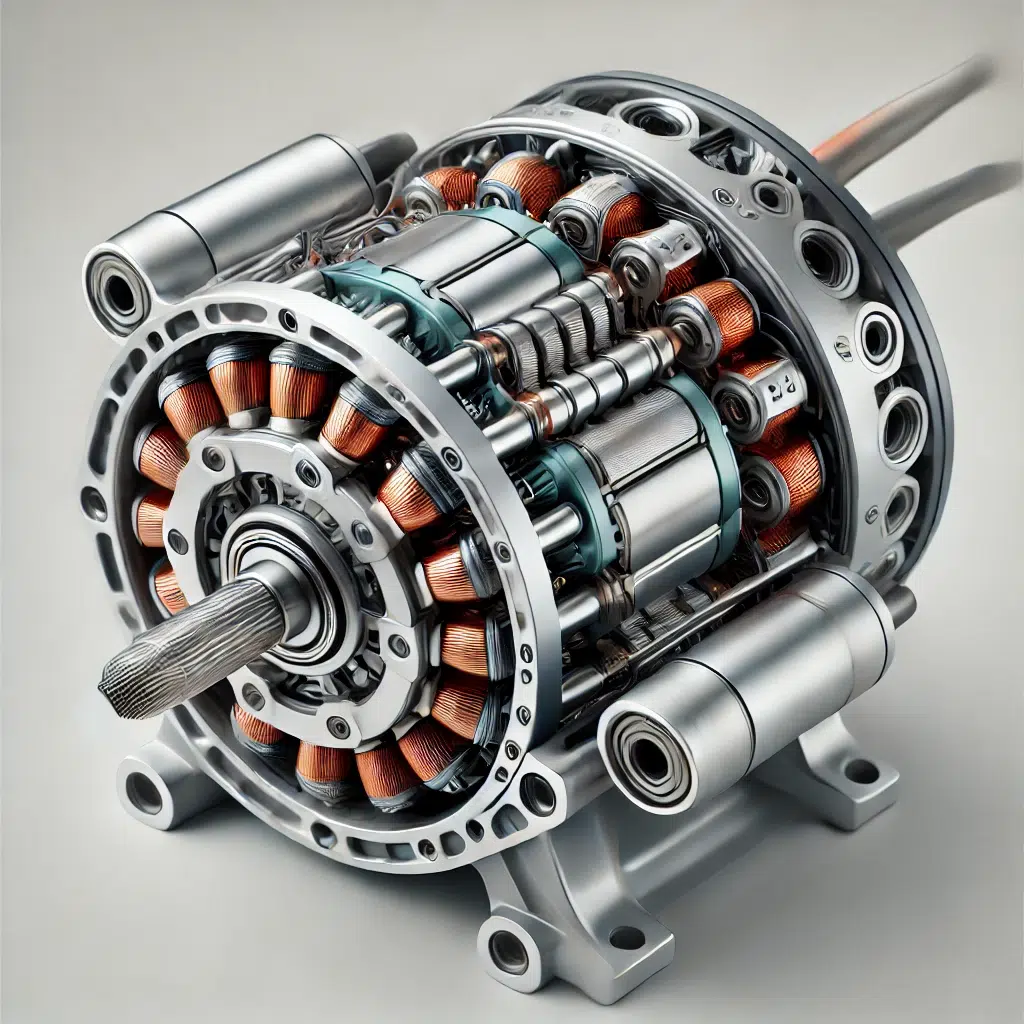
- Power Output: Measured in watts (W), common ratings range from 250W to 750W for pedal-assist eBikes.
- Torque Generation: Measured in newton-meters (Nm), torque determines the motor’s ability to assist during acceleration and climbing. Higher torque values indicate stronger assistance.
3. The Battery: Power Source of the System
Battery Types
- Lithium-Ion Batteries: Predominant in modern eBikes due to high energy density, lighter weight, and longevity.
Battery Specifications
- Voltage (V): Commonly 36V, 48V, or 52V systems.
- Capacity (Ah and Wh):
- Ampere-hours (Ah): Indicates the battery’s charge capacity.
- Watt-hours (Wh): Calculated by multiplying voltage by ampere-hours (V × Ah), represents the total energy stored.
- Example: A 36V battery with 14Ah capacity has 504Wh (36V × 14Ah).
Battery Management Systems (BMS)
The battery management systems protects the battery from overcharging, deep discharging, and overheating. It does this by cell balancing, ensuring uniform charge levels across all cells and monitoring the temperature.
4. Sensors: The Feedback Mechanism
Sensors are vital components in pedal-assist eBikes, acting as the system’s sensory network. Their primary purpose is to collect real-time data about the rider’s input and the bike’s operating conditions. This information allows the controller to determine the appropriate level of electric assistance, ensuring a smooth, intuitive, and efficient riding experience. The main sensors involved are:
- Torque Sensors
- Cadence Sensors
- Speed Sensors
Each sensor serves a specific function and operates through distinct mechanisms.
Torque Sensors
The torque sensor measures how hard you’re pedaling. Its main function is to detect the force you apply to the pedals. By sensing the pedaling force, it allows the eBike to provide motor assistance that is proportional to your effort. This ensures a natural and responsive riding experience.
How It Works:
- Mechanism:
- Strain Gauges: The torque sensor uses strain gauges, which are thin strips of conductive material that change electrical resistance when stretched or compressed.
- Placement: These strain gauges are attached to parts of the bike that slightly deform under pedaling force, such as the bottom bracket axle.
- Operation:
- When you pedal, the force causes a tiny deformation in the component with the strain gauges.
- This deformation alters the electrical resistance in the strain gauges.
- The change in resistance is proportional to the amount of force applied.
- Signal Processing:
- Amplification: The electrical signals from the strain gauges are very small and need to be amplified.
- Analog to Digital Conversion: The amplified analog signals are converted into digital data.
- Data Transmission: The digital data is sent to the controller, which adjusts the motor’s power output in real-time based on your pedaling force.
Types of Torque Sensors:
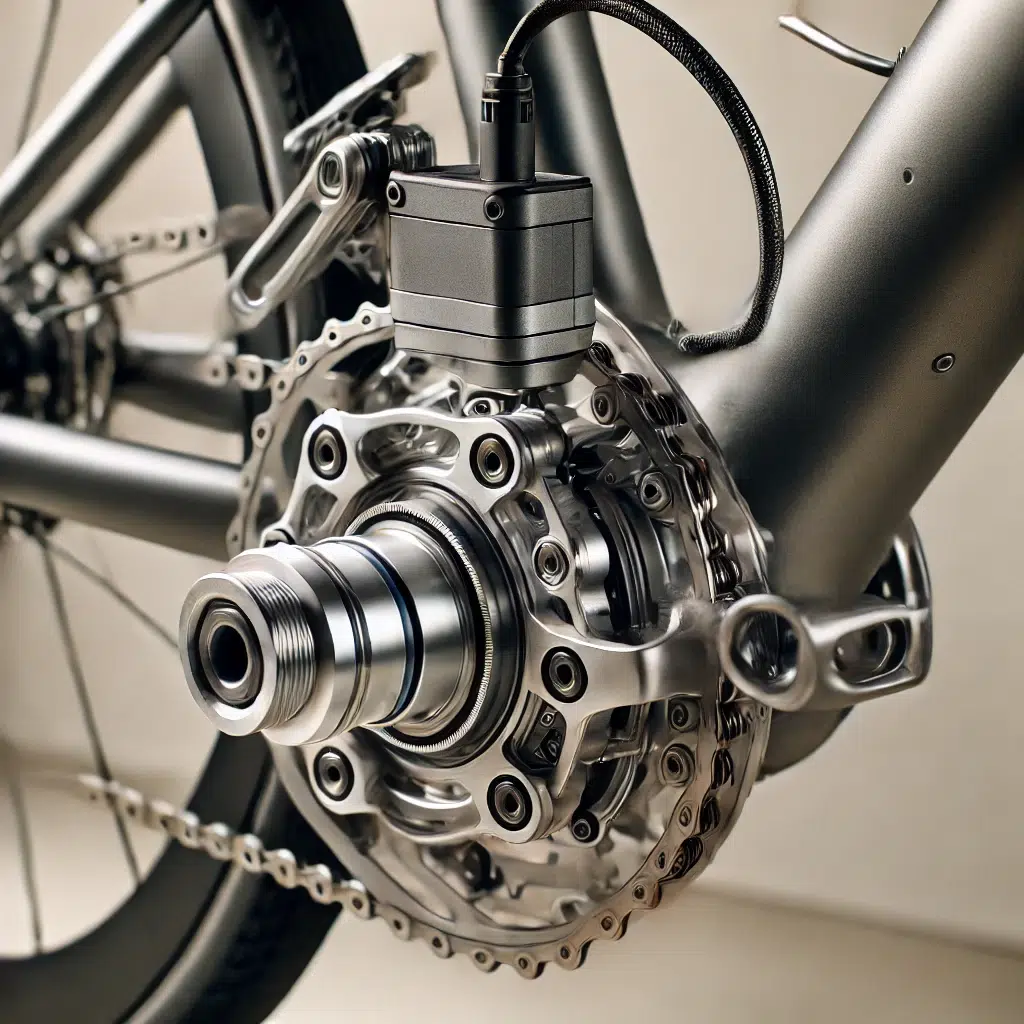
- Bottom Bracket Torque Sensors: Integrated within the bottom bracket area, where the crank arms rotate.
- Direct Measurement: Provides accurate readings by measuring force right where it’s applied.
- Quick Response: Immediate detection due to proximity to the pedals.
- Protected Environment: Enclosed within the frame, shielding it from dirt and moisture.
- Mechanism: Strain gauges detect deformation caused by pedaling force directly at the crankset.
- Rear Dropout Torque Sensors: Positioned near the rear wheel dropout, where the wheel connects to the frame
- Easy Installation: Can be added to existing bikes without major modifications.
- Cost-Effective: Generally less expensive than bottom bracket sensors.
- Mechanism:
- Measures torque based on chain tension as you pedal.
- Strain gauges detect changes in tension on the rear axle.
- Limitations:
- Less Accurate: Chain tension can be influenced by factors other than pedaling force, like gear changes.
- Exposed to Elements: More susceptible to damage from dirt and moisture.
Cadence Sensors
The cadence sensor detects whether you’re pedaling and how fast. It measures the rotational speed of the pedals (cadence), informing the controller to provide assistance only when you’re actively pedaling.
- Mechanism: It uses magnets attached to the crank and a sensor mounted on the frame. Magnets are evenly spaced around the crank arm. Positioned close to the path of the magnets. As you pedal, the magnets pass by the sensor with each rotation.
- Signal Processing:
- The controller counts these signals to calculate your pedaling rate (revolutions per minute).
- This data helps determine when to engage or disengage motor assistance.
Speed Sensors
The speed sensor monitors the bike’s actual speed and ensures that motor assistance is provided within legal speed limits and enhances safety by preventing excessive speeds.
- Mechanism: It is similar setup to cadence sensors but focused on wheel rotation with Magnetic Sensors. The controller calculates speed by counting these signals over time. Knowing the wheel’s circumference, it converts rotations into ground speed.
- Application:
- Speed Limitation: If you reach the maximum legal speed for assistance, the controller reduces or cuts off motor power.
- Information Display: Speed data can be shown on your eBike’s display for awareness.
Integration of Sensors
Combining data from all three sensors allows the controller to provide the right amount of assistance at the right time, making your ride efficient and enjoyable.
- Data Fusion:
- The controller receives input from torque, cadence, and speed sensors simultaneously.
- Processes this data to make real-time decisions about motor output.
- Assist Algorithms:
- The controller uses programmed algorithms to interpret sensor data.
- Determines how much assistance to provide based on your pedaling force, pedaling rate, and current speed.
Examples of Sensor Cooperation:
- Starting from a Stop:
- Torque Sensor: Detects initial force as you begin pedaling.
- Cadence Sensor: Confirms pedal rotation has started.
- Controller Action: Smoothly engages the motor to assist with acceleration.
- Climbing a Hill:
- Torque Sensor: Senses increased force due to the incline.
- Cadence Sensor: Notes any changes in pedaling speed.
- Controller Action: Increases motor assistance to help maintain speed and reduce effort.
- Approaching Maximum Speed:
- Speed Sensor: Monitors that you’re nearing the legal speed limit.
- Controller Action: Gradually reduces assistance to comply with regulations.
Benefits of Each Sensor
Torque sensors are integral to the superior performance of pedal-assist eBikes. By measuring the force you apply to the pedals in real time, torque sensors allow the motor to provide immediate and proportional assistance. This responsiveness makes the ride feel smooth and natural, closely mimicking the experience of traditional cycling but with an added boost. The precise power delivery is especially crucial in technical terrains, where navigating obstacles and varying gradients requires fine-tuned control.
From a technical perspective, high-quality torque sensors are designed to detect minute variations in pedaling force, enabling the system to adjust assistance seamlessly as your effort changes. However, torque sensors must be durable enough to withstand environmental factors like moisture, dust, and vibrations encountered during rides. Proper calibration is essential to maintain measurement accuracy over time.
Compared to systems that rely solely on cadence sensors—which provide assistance based only on pedal rotation speed—torque sensor systems offer significant advantages. Cadence-only sensors can result in less responsive assistance that may feel unnatural or lag behind your effort, as they don’t account for how hard you’re pedaling. This makes the support feel more intuitive and reduces the risk of unexpected acceleration.
Challenges and Considerations
- Calibration and Maintenance:
- Torque Sensors: May require precise calibration to maintain accuracy.
- Environmental Protection: Sensors need to be safeguarded against moisture, dust, and vibrations.
- System Complexity:
- Increased Components: More sensors can mean more potential points of failure.
- Cost Factors: Advanced sensors, especially torque sensors, can increase the eBike’s cost.
- Accuracy vs. Simplicity:
- Torque vs. Cadence Sensors: Torque sensors offer precise, effort-based assistance but are more complex. Cadence sensors are simpler but provide less nuanced support.
Advancements in Sensor Technology
- Improved Materials:
- Enhanced Strain Gauges: More sensitive and durable materials improve torque sensor performance.
- Miniaturization: Smaller sensors integrate better into the bike’s design.
- Wireless Technology:
- Reduced Wiring: Wireless sensors simplify the system and enhance reliability.
- Better Communication: Enables sophisticated data exchange between sensors and the controller.
- Smart Sensors with AI:
- Adaptive Assistance: Machine learning algorithms adjust assistance based on your riding patterns.
- Self-Diagnostics: Sensors that can self-calibrate and diagnose issues reduce maintenance needs.

5. The Controller: Brain of the eBike
Serving as the eBike’s central command center, the controller brings the system to life by processing continuous inputs from sensors—torque, cadence, and speed—as well as your selections on the display unit. It adjusts the motor’s power output in real time, ensuring your ride is smooth, responsive, and intuitive. Safety features like overcurrent protection and temperature monitoring are built-in to protect the motor and battery.
The controller’s smart assist algorithms determine how motor assistance scales with your pedaling input, providing just the right boost when needed. You can customize your experience by choosing modes like Eco for efficiency, Trail for balanced performance, or Turbo for maximum power, adapting the bike’s behavior to different terrains and preferences. Plus, with the ability to receive firmware updates from manufacturers, the controller allows your eBike to stay updated with the latest technological advancements.
6. Display and Control Unit
Modern eBike displays prominently show essential information to keep you updated throughout your ride:
- Assist Level: Shows the current motor assistance mode (e.g., Eco, Trail, Turbo), so you know how much support you’re receiving.
- Battery Status: Indicates remaining battery life, often displaying both percentage and estimated range to prevent unexpected depletion.
- Speed: Displays your current speed, and sometimes includes average and maximum speeds achieved during the ride.
- Odometer and Trip Distance: Tracks total distance ridden and individual trip distances, useful for monitoring progress and scheduling maintenance.
The control unit allows you to customize your riding experience:
- Mode Selection: Quickly switch between assist levels to adapt to changing terrains or conserve battery life. For example, Shimano’s STEPS system enables seamless transitions between modes with ergonomic handlebar switches.
- Settings Access: Adjust preferences such as screen brightness, units of measurement, or language. Access diagnostic tools to check system health and receive alerts.
Bluetooth integration has opened up a new realm of possibilities:
Smartphone Integration: Connect your eBike to apps like Bosch eBike Connect or Specialized’s Mission Control for enhanced features. This enables you to review detailed statistics on power output, cadence, and route mapping after your ride.
Syncing your eBike with wearable devices elevates your fitness regime:
- Heart Rate Monitoring: Pair with devices like Garmin or Apple Watch to display heart rate data in real-time, helping you stay within target zones.
- Customized Training Programs: Use data from wearables to tailor assist levels for interval training or endurance rides.
- Activity Sharing: Automatically upload ride data to platforms like Strava or MyFitnessPal to track progress and share with friends.
The latest eBike models feature cutting-edge technologies in their display and control units:
- High-Resolution Color Displays: Brands like Yamaha with their PW-X3 system offer vibrant screens that are easy to read in various lighting conditions.
- Touchscreen Interfaces: Allow for more intuitive interaction, similar to smartphones, with swipe and tap gestures.
- Voice Control: Emerging technology enables hands-free operation, so you can adjust settings or get information without taking your hands off the handlebars.
- Anti-Theft Features: Some systems include PIN code locks or GPS tracking, adding a layer of security to your eBike.
- Modular Designs: Removable displays like the Bosch Kiox can be taken with you when parking the bike, deterring theft and protecting the unit.
Several eBike models exemplify these advancements:
- Bosch Nyon Display: An all-in-one onboard computer with a color touchscreen, GPS navigation, fitness tracking, and the ability to customize ride modes.
- Giant RideControl EVO: Features a sleek design with an integrated light system, USB charging port for devices, and compatibility with the Giant E-bike App for ride data and diagnostics.
- Specialized Turbo Connect Display (TCD): Offers a clean interface showing key metrics and connects seamlessly with the Mission Control app for advanced tuning and ride planning.
Enhanced Connectivity and Ecosystems
Manufacturers are developing integrated ecosystems where the eBike, smartphone app, and online services work together:
- Over-the-Air Updates: Receive the latest software enhancements without visiting a dealer.
- Community Features: Share routes, compete in challenges, and connect with other riders through integrated platforms.
7. How the System Works Together
Pedaling and Assistance
- Initiation of Pedaling
- The rider begins pedaling, applying force to the pedals.
- Sensor Detection
- Torque Sensor: Measures the pedaling force.
- Cadence Sensor: Detects pedal rotation speed.
- Speed Sensor: Monitors the bike’s speed.
- Data Transmission
- Sensors send real-time data to the controller.
- Controller Processing
- The controller analyzes the data, considering:
- Pedaling Effort: From the torque sensor.
- Pedal Cadence: From the cadence sensor.
- Current Speed: From the speed sensor.
- Selected Assist Level: From the rider’s input via the display unit.
- The controller analyzes the data, considering:
- Motor Output Adjustment
- The controller calculates the appropriate motor power output.
- Sends signals to the motor to deliver the calculated assistance.
- Motor Assistance
- The motor provides torque to the drivetrain (in mid-drive systems) or directly to the wheel (in hub motors).
- Assistance is proportional to the rider’s effort, enhancing the pedaling force.
- Feedback Loop
- Continuous data flow allows the system to adjust assistance in real-time as riding conditions change.
9. Legal and Safety Considerations
Many regions impose speed limits on eBike assistance to classify them as bicycles rather than motor vehicles. In the European Union, eBikes are limited to providing motor assistance up to 25 km/h (15.5 mph) with a maximum continuous motor output of 250 watts, as specified in the EU directive EN 15194. In the United States, Class 1 and Class 2 eBikes are generally restricted to 20 mph (32 km/h), while Class 3 eBikes can assist up to 28 mph (45 km/h) but may face additional restrictions.
These speed limits are enforced by the eBike’s controller, which uses data from the speed sensor to cut off motor assistance once the legal limit is reached. This ensures compliance with regional laws and maintains safety standards on public trails and roads. For advanced riders pushing the boundaries of speed and performance, awareness of these regulations is crucial to avoid legal issues and to advocate responsibly for the eMTB community.
Manufacturers must adhere to specific electrical and mechanical safety regulations, such as EN 15194 in Europe or UL 2849 in the United States. These standards cover electromagnetic compatibility, battery safety, and mechanical integrity. Certification involves rigorous testing to ensure that eBikes operate safely under various conditions. Knowing that your eMTB meets these stringent standards provides confidence in the bike’s reliability and performance.
10. Maintenance and Care
Meticulous maintenance of an eMTB is essential. Regular inspection ensures that all electronic and mechanical components function optimally. Examine the sensors—torque, cadence, and speed—for secure connections and any signs of damage or wear.
Inspect the wiring harness thoroughly. Ensure that all cables are intact, free from fraying, and properly routed to avoid snagging on branches or interfering with suspension components. Protective cable housing prevents damage from debris and moisture.
The battery demands special attention due to its critical role and high replacement cost. Regularly check for physical damage, such as cracks or swelling, and clean the contacts to ensure efficient energy transfer. Storing the battery at recommended temperatures and charge levels can significantly extend its lifespan.
Keeping the eMTB’s firmware up-to-date is important. Manufacturers release firmware updates that can enhance motor performance, improve battery management, and add new features or ride modes. Updating firmware ensures compatibility with the latest accessories and apps.
For advanced maintenance tasks, professional servicing is advisable. Authorized service centers have specialized diagnostic tools to delve into the eBike’s electronic systems, identifying issues that might not be apparent during a visual inspection. Periodic recalibration of torque sensors may be helpful to maintain their precision.
11. Future Developments in eMTBs
The future of eMTBs promises technological advancements that could redefine the riding experience. One exciting area is the integration of advanced sensor technologies. Manufacturers are exploring multi-sensor systems that combine torque, cadence, and biometric data like heart rate to provide highly personalized assistance. An eMTB that adjusts its power output based on your fatigue levels or cardiovascular performance optimizes assistance to match your physical state, extending your endurance on epic rides.
Wireless sensor technology is another development on the horizon. By reducing the reliance on wired connections, eMTBs can become lighter and more reliable, with less risk of cable damage and easier maintenance. Wireless systems facilitate easier upgrades and customization, allowing riders to add or replace sensors without extensive modifications.
Artificial intelligence and machine learning are set to make significant impacts. Adaptive assistance systems could learn your riding habits over time, adjusting motor response to match your preferred style. If you regularly tackle steep climbs aggressively, the eMTB might automatically provide more immediate torque when it senses similar conditions. Predictive maintenance is another promising application, where the eMTB continuously monitors component health and alerts you to potential issues before they lead to failure.
Battery technology continues to advance, aiming for higher energy densities to provide longer ranges without increasing weight—a critical factor for maintaining the agility and handling of high-performance eMTBs. Faster charging technologies are also in development, potentially reducing downtime between rides. Innovations like solid-state batteries or improved lithium-ion chemistries could revolutionize energy storage on eMTBs.