
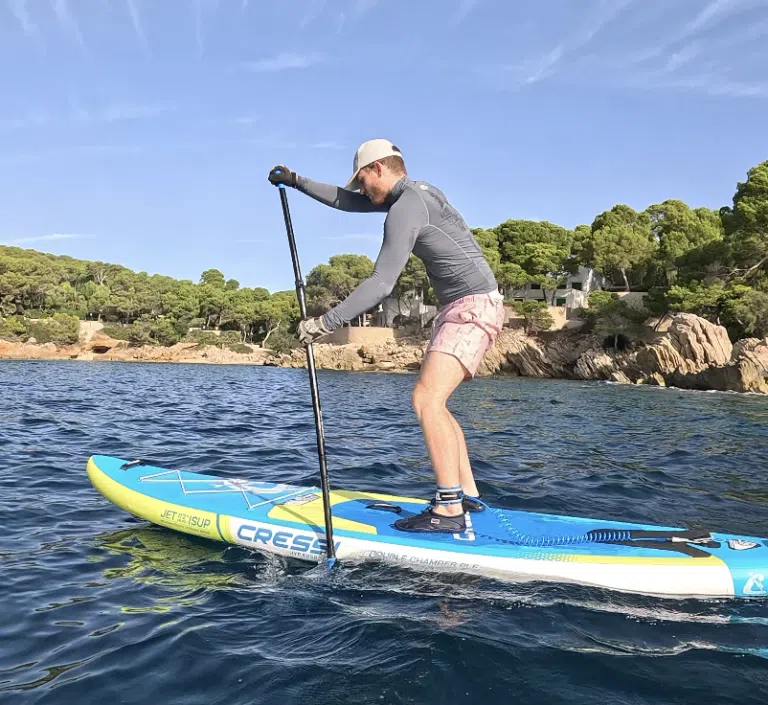
When it comes to stand-up paddleboarding, the paddle is more than just a means to propel yourself forward—it’s an extension of your body. Using a paddle that’s the correct length ensures optimal performance, reduces fatigue, and helps prevent injury. But how do you determine the right length? Let’s dive in.
Why Paddle Length Matters
A paddle that’s too long or too short can lead to inefficient strokes, discomfort, and even strain on your shoulders and back. The right paddle length allows for:
- Proper Paddling Technique: Ensures that you can paddle with the correct form, maximizing power and efficiency.
- Comfort: Reduces the risk of overreaching or hunching, which can cause muscle fatigue.
- Control: Enhances your ability to maneuver and balance on the board.
General Guidelines for Paddle Length
While personal preference plays a role, there are general recommendations based on the type of paddleboarding you’re doing:
- Flatwater Paddling/Touring:
- Paddle Length: 8 to 10 inches (20 to 25 cm) taller than your height.
- Reason: A longer paddle provides a more vertical stroke, which is efficient for straight-line paddling and generates more power with less effort.
- SUP Surfing:
- Paddle Length: 6 to 8 inches (15 to 20 cm) taller than your height.
- Reason: A slightly shorter paddle allows for quicker, more agile strokes needed for maneuvering on waves.
- Racing:
- Paddle Length: 10 to 12 inches (25 to 30 cm) taller than your height.
- Reason: A longer paddle maximizes stroke reach and efficiency, important for speed over long distances.
- Whitewater Paddling:
- Paddle Length: Around 8 inches (20 cm) taller than your height.
- Reason: Balances the need for power with the agility required to navigate rapids.
How to Measure the Correct Paddle Length
Here’s a step-by-step method to find your ideal paddle length:
Method 1: The Stand-Up Test
- Stand Upright: Place the paddle vertically in front of you with the blade touching the ground.
- Reach Up: Extend one arm straight overhead.
- Check the Height: The T-grip handle should align with the bend of your wrist where it meets the palm.
Method 2: Mathematical Calculation
- Measure Your Height: Know your exact height in inches or centimeters.
- Add the Recommended Length:
- For flatwater paddling, add 8 to 10 inches (20 to 25 cm).
- For surfing, add 6 to 8 inches (15 to 20 cm).
- For racing, add 10 to 12 inches (25 to 30 cm).
- Result: The total is your ideal paddle length.
Example:
- If you’re 5’8″ (68 inches or 173 cm) tall and planning to paddle on flat water:
- 68 inches + 8 inches = 76 inches (or 173 cm + 20 cm = 193 cm)
- Your paddle should be approximately 76 inches (193 cm) long.
Adjusting for Personal Preference
While guidelines are helpful, personal comfort and paddling style are important:
- Arm Length: Individuals with longer or shorter arms relative to their height may need to adjust accordingly.
- Paddling Technique: If you prefer a higher or lower paddle stroke, you might choose a slightly longer or shorter paddle.
- Board Thickness: Thicker boards position you higher above the water, possibly requiring a slightly longer paddle.
Adjustable vs. Fixed-Length Paddles
- Adjustable Paddles:
- Pros: Versatile, can be shared among different paddlers, and allow for experimentation with paddle length.
- Cons: Slightly heavier due to the adjustment mechanism.
- Fixed-Length Paddles:
- Pros: Lighter and potentially more durable.
- Cons: Lack flexibility once cut to size.
Tip: If you’re new to paddleboarding or still refining your technique, an adjustable paddle is a great choice.
Common Mistakes to Avoid
- Overlooking Paddle Angle: Remember that paddle blades are angled forward to increase stroke efficiency. Ensure the angle is facing away from you when paddling.
- Ignoring Comfort: Don’t stick rigidly to guidelines if the paddle feels uncomfortable. Adjust within a reasonable range to suit your comfort.
- Not Accounting for Board Type: As mentioned, board thickness affects your distance from the water. Consider this when choosing paddle length.
Testing Your Paddle Length
Before committing to a paddle length:
- Try Before You Buy: If possible, demo paddles at different lengths to see what feels best.
- Seek Expert Advice: Consult with staff at a paddle shop or experienced paddlers.
- Adjust and Observe: If using an adjustable paddle, try different lengths during various paddling sessions.
Conclusion
Finding the perfect paddle length enhances your stand-up paddleboarding experience by improving efficiency, comfort, and control. By considering your height, paddling style, and the type of paddleboarding you’ll be doing, you can determine the ideal paddle length for your needs. Remember, these guidelines are starting points—feel free to adjust based on what feels right for you.